
Last updated: November 3, 2026
Before a school district talks features, it wants proof the product is safe. A yearly survey of district technology leaders, released in May 2026 by a national association of K-12 technology leaders and drawing on more than 600 of them across 44 US states, found that 55% of districts require vendors to supply product safety information. Far fewer ask for evidence on usability, interoperability or research backing, and only 29% require information on whether a product is accessible and inclusive for all learners. Some 86% have a process for vetting free tools before teachers can use them, and the share of districts with no AI guidelines dropped from 43% in 2025 to 21%.
Those numbers describe procurement, and they come from US public K-12 districts only, so universities and corporate learning teams aren't in them and nothing here measures search behavior directly. They still show which content settles an edtech shortlist. A district IT director vetting a vendor goes looking for a privacy page, a data processing agreement, an accessibility statement and integration details. An AI assistant asked about the same vendor draws on whatever of that material it can find and trust.
Pick an edtech SEO agency that understands institutional buying before it promises traffic. A good one writes separately for the educators who read about teaching and for the administrators, IT staff and procurement officers who approve the purchase. It times work to the school year, publishes privacy and accessibility material as search assets, and checks that AI assistants put the product in the correct segment, so a K-12 tool stays out of corporate training answers. Two agencies below have published edtech results. The other seven bring sound methods with no named B2B education client.
TL;DR
Miraa - Best for B2B edtech companies that want product pages, privacy and integration content, and AI answer tracking at a fixed monthly fee.
Flying Cat Marketing - Best for learning platforms competing for higher education and enterprise buyers who now compare vendors inside AI assistants.
GrowPad - Best for corporate learning and e-learning content vendors working with a tight budget and one core service line.
Stratabeat - Best for established edtech companies that want SEO, content and a website rebuild from one senior team.
DerivateX - Best for funded K-12 and higher education software vendors whose AI answers confuse their segment or privacy posture.
PipeRocket Digital - Best for edtech companies that sell to committees and want campaigns timed to the academic calendar.
Bay Leaf Digital - Best for education software companies that want SEO inside a broader marketing program, including paid and automation.
Loopex Digital - Best for edtech teams that mainly need link building and on-page work on a month-to-month contract.
Siege Media - Best for edtech brands that also market directly to teachers or learners and want large content assets.
The nine side by side
Agency | Strongest fit | What it sells | Entry fee found | Clutch standing | Education evidence | AI answer evidence |
|---|---|---|---|---|---|---|
Miraa | Fixed-fee program with AI answer checks | Ten services, product-led SEO through agentic SEO/GEO | $2,500 a month | Own client results, Ahrefs estimate | None | Prompt tracking in every plan |
Flying Cat Marketing | Learning platform visibility in AI answers | SEO strategy, GEO and AEO, content, links, international SEO | $4,000 a month for GEO and AEO | 4.9 from 10; latest in window Apr 2, 2026 | D2L case, Dec 2025 to Sep 2026 | Share of tracked AI answers, 12% to 33% |
GrowPad | Lead-focused SEO on a small budget | SEO and GEO audits, clusters, links, AI visibility track | $2,000 a month Clutch package | 5.0 from 39; latest Oct 12, 2026 | Blue Carrot e-learning case | AI Overview citation share, 1% to 8% |
Stratabeat | SEO plus website and content | SEO, GEO, content, B2B websites, CRO | $8,000 a month Clutch package | 5.0 from 13; latest Jul 9, 2026 | B2B edtech listed as an industry | AI search mentions in recent reviews |
DerivateX | Segment and privacy accuracy in AI answers | GEO-led SEO, entity work, citation outreach | $3,500 a month Series A pilot; $5,000 to $12,000 tiers plus citation budget | 5.0 from 7; only in-window review Nov 20, 2025 | K-12, higher ed and L&D page | Audit across several AI assistants |
PipeRocket Digital | Committee mapping and academic timing | SEO, AI SEO, PPC, ABM, attribution | $5,000 a month | 4.7 from 18; latest Jul 30, 2026 | Edtech page by segment | AI referral growth in an in-window review |
Bay Leaf Digital | SEO within full-funnel marketing | SEO, GEO, content, PPC, HubSpot, automation | $3,999 a month on six months | 5.0 from 4; only recent review Apr 2, 2026 | Education SaaS page by sub-segment | GEO and AEO in its SEO service |
Loopex Digital | Links and on-page fixes | Link building, content, technical SEO, AI SEO | $1,000+ Clutch minimum, month to month | 5.0 from 98; latest Sep 1, 2026 | No B2B edtech case | AI citation work offered |
Siege Media | Large content and design assets | Content strategy, GEO, design, digital PR | $5,000+ Clutch minimum | 4.9 from 48; latest Aug 31, 2026 | Education GEO page aimed at enrollment | Prompt visibility growth in an in-window review |
Why edtech search works differently
Institutions buy and people use. The person who loves a B2B edtech product is often a teacher, an instructional designer or a training manager. The person who signs is a superintendent, a provost, a CIO or an HR director, and between them sit IT reviewers, curriculum committees and procurement offices. Content has to serve all of them, and an agency that writes only for "educators" leaves most of the buying group with nothing to read.
The calendar sets the pace. K-12 districts tend to plan purchases well ahead of the autumn term, around budgets tied to the fiscal year. Universities run longer evaluations, often through formal RFPs and committees that meet a few times a semester. Corporate learning budgets usually reset once a year. A page that starts ranking after districts have already chosen is late, so a capable agency plans publishing and refreshes against these windows.
Student data privacy is part of the product. In the United States, FERPA governs education records and COPPA covers data from children under 13, and many states layer on their own student privacy laws and contract terms. Districts often want a signed data privacy agreement before a pilot. A vendor that tucks its privacy position into a footer link loses buyers at IT review. Plain-language pages on data handling, retention, subprocessors and certifications answer late-stage queries and give AI assistants something accurate to quote.
Accessibility belongs in the same bucket. Public institutions face accessibility requirements, and more buyers ask for WCAG conformance reports and a VPAT. The survey figures above show many districts don't demand this material yet, which leaves room for vendors who publish it clearly. An agency should index and link accessibility statements and conformance documents, and make sure its own page templates for the vendor meet the standard those documents describe.
Three segments behave like three markets. K-12 software sells to districts and sometimes states. Higher education software sells to universities and colleges through IT and academic leadership. Corporate learning platforms sell to HR, enablement and compliance teams. Terms, competitors and proof points differ in each, and AI assistants sometimes blur them. If an agency can't say which segment a page targets, the page will find the wrong buyer.
Educational content pulls in the wrong crowd. A post on classroom engagement can draw thousands of teachers and students with no purchasing role. That traffic helps brand and links a little and pipeline hardly at all. Agencies worth hiring keep informational content apart from evaluator pages, and report on demo requests, pilot sign-ups and RFP invitations alongside sessions.
The scope here is B2B edtech: software and services bought by schools, districts, universities and companies. Consumer course marketing, tutoring sold to parents and student enrollment campaigns sit outside it, and agencies whose education work is mostly of that kind are flagged below.
How the shortlist came together
This roundup is a companion to the B2B SaaS SEO guide, which lays out search strategy for software companies generally. For the mechanics of AI answers, a primer on answer engine optimization covers how assistants choose the pages they cite. Edtech vendors that sell much like any other software company may also find a fit in the comparison of agencies built for B2B SaaS search.
Nobody paid to be included, and no agency saw this article before publication. Each firm's site and Clutch profile were checked between October 20 and 23, 2026. Apart from Miraa, an agency needed to pass four checks:
Education or adjacent relevance: an edtech or education page, a B2B education client, or B2B software work that carries over cleanly to institutional buyers.
Fresh reviews: at least one Clutch review posted after November 3, 2025. Only reviews from that period are quoted or summarized.
AI search capability: AEO, GEO or an equivalent AI visibility service sold alongside SEO.
B2B focus: education evidence that comes mainly from consumer course, tutoring or enrollment marketing didn't count toward the first check.
Several agencies with education pages fell short. One had a single e-learning example, a consumer platform, behind just two Clutch reviews. Another had an edtech page and no Clutch profile that could be located. A few agencies that did make the list also have education cases aimed at consumers or prospective students; those are noted and their figures left out.
Quoted phrases come from the headline sentence Clutch displays for each review. Ratings, review totals and dates were recorded on the day each profile was checked.
1. Miraa
A studio for B2B software SEO and AEO, Miraa leans on custom AI agents for the grunt work. Those agents handle research, rank and prompt monitoring, and reporting, while human strategists and editors decide what goes live. It has no edtech page, no education client and no case study in this market. Education isn't among the sectors Miraa names, though it takes on other B2B software vendors whose buyers do careful research before a purchase, through its B2B SaaS SEO service.
Services
Clients can draw on all ten services:
Product-led SEO: pages for the jobs an institution needs done, such as rostering students from an SIS, tracking compliance training completion or running proctored assessments.
Content-led SEO: clusters planned separately for classroom users and for the IT, finance and procurement staff who approve a contract.
Technical SEO: crawl rules, page speed and structured data for marketing sites, help centers and resource libraries.
On-Page SEO: tightening titles, headings and internal links on pages sitting just below page one.
SEO Site Migration: holding rankings when a vendor rebrands, merges product sites or changes CMS.
SEO Website Recovery: tracing a traffic loss to its cause and repairing it.
AEO/GEO: auditing what AI assistants say about the product, its segment, its privacy position and its integrations, then fixing the source pages they rely on.
Content Writing: articles drafted from interviews with the client's product, implementation and compliance staff.
Link Building: editorial outreach with no paid placements.
Agentic SEO/GEO: purpose-built agents track rankings, AI prompts and rival launches, and an editor approves each change.
For an edtech vendor, the most useful pieces are probably product-led pages mapped to institutional jobs, AEO/GEO checks on segment and privacy accuracy, and content for approvers. Miraa has no education specialists on staff, so the client would supply subject matter review on pedagogy, accessibility and student privacy law.
Pricing
Miraa charges $2,500 a month on the Basic Growth plan, with Growth+ at $3,500 and Hyper-Growth at $5,000. An edtech vendor pays what any other sector pays, AI search visibility is in from the first tier, and every step up keeps what came before. SEO Site Migration costs $4,000 one-time.
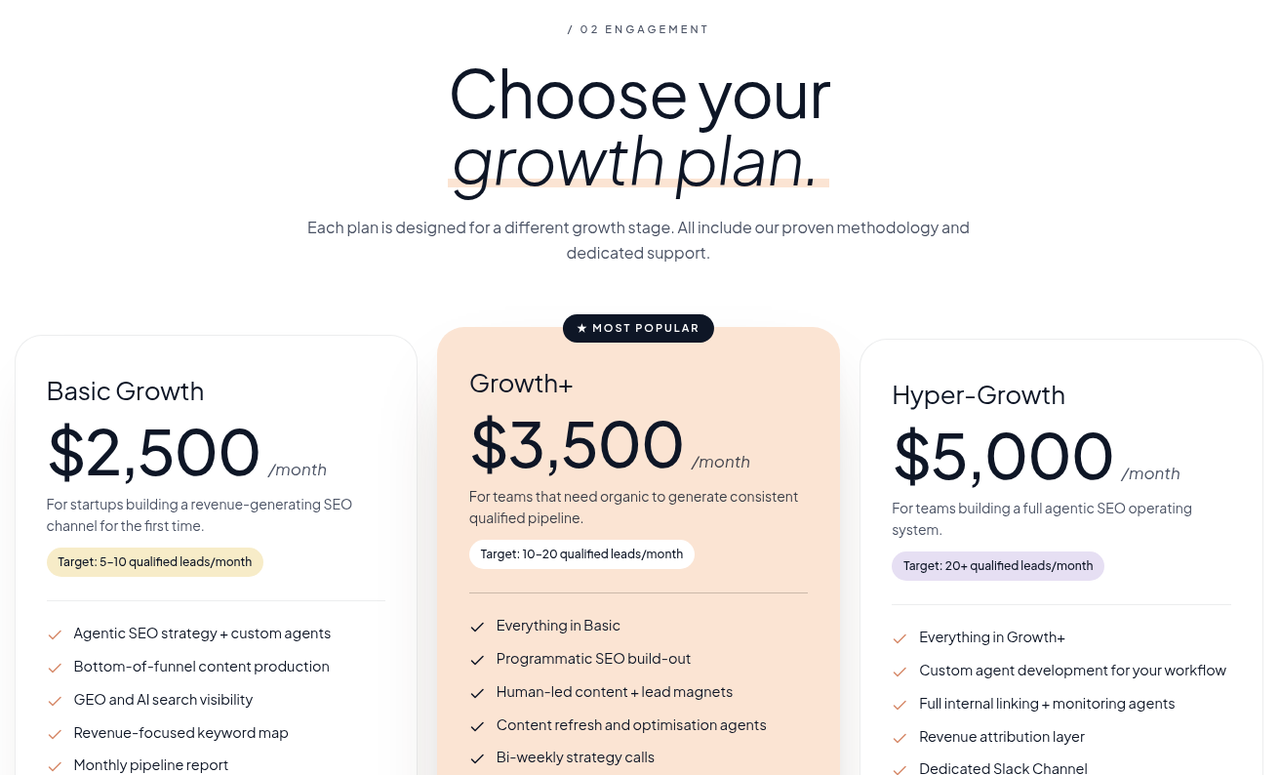
Miraa plans at $2,500, $3,500 and $5,000 a month
An LMS vendor that merges two product sites before district buying season and then stays on Basic Growth for ten months would pay $29,000 in total.
Reviews
No school, university or training buyer has reviewed Miraa in public. What can be checked is Ahrefs traffic for a client in another sector, set out under Clients.
Clients
Miraa hasn't published an education client or result, and its published case studies cover sales and outreach software, a long way from a school district. None of that counts as edtech proof.
Vibe.co, a Miraa client outside education, has its contract period marked on the Ahrefs chart below. Ahrefs puts its estimated organic traffic at 1,492 on 28 Oct 2024, where the two-year view begins, just before the note marking when Miraa started. By the point marked as the end of the contract, in late 2025, the line has passed the 7.5K gridline. Through 2026 it stays above 5K, and in October 2026 it peaks just past the 10K line. These are Ahrefs estimates, not Vibe's own analytics.
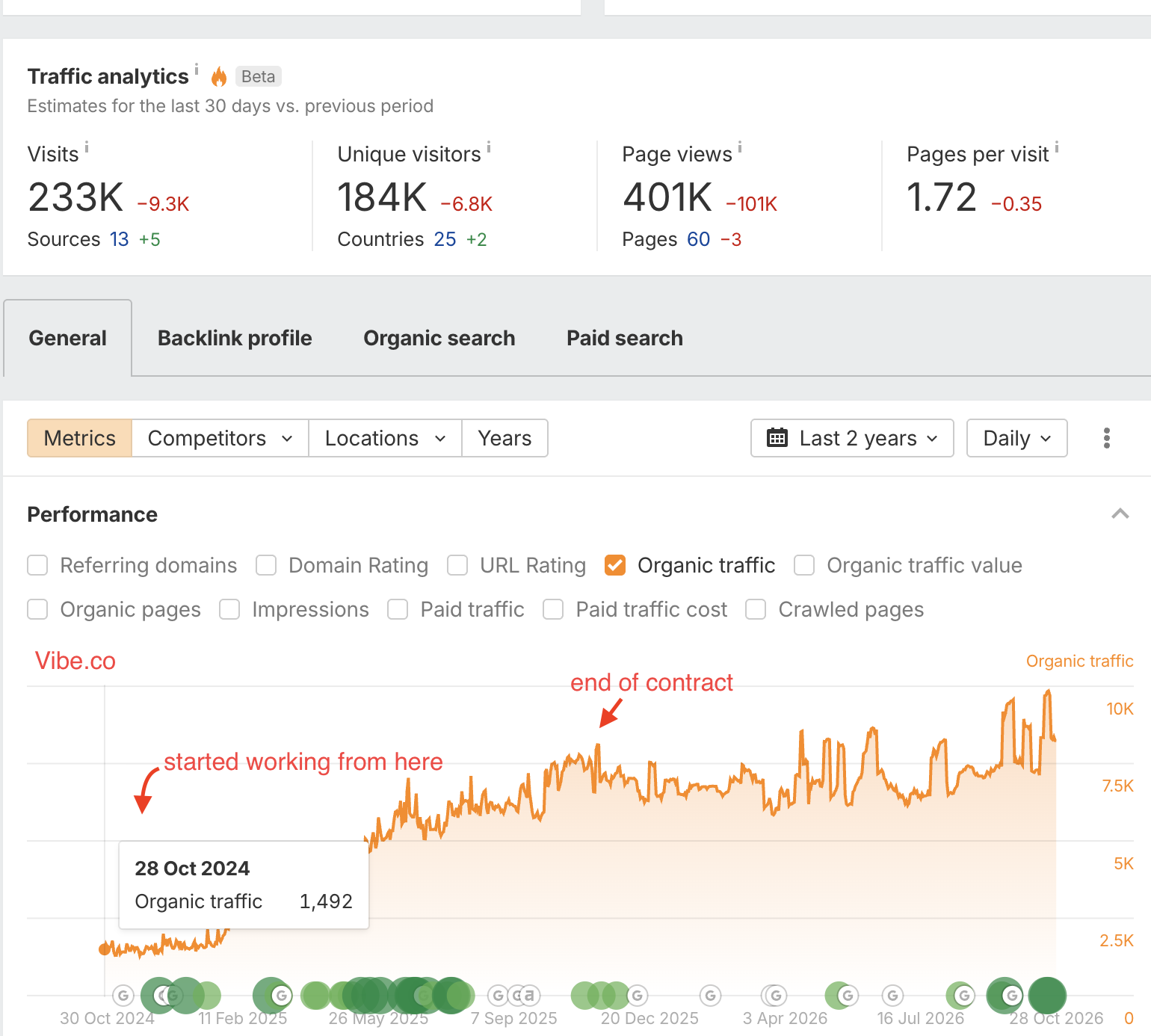
Vibe.co organic traffic during and after Miraa's contract, Ahrefs estimate.
Summary
Miraa has the lowest fixed entry fee here and builds AI answer work into every plan, with no edtech client, no third-party reviews and no in-house education expertise to set against that. B2B edtech vendors that handle their own subject matter review get institution-focused pages and AI answer tracking at a set monthly cost.
2. Flying Cat Marketing
Flying Cat Marketing is a B2B SaaS SEO agency with 10 to 49 staff, according to Clutch, and a strong international practice in French, German, Spanish and Italian search. It has the most detailed recent B2B edtech case of any agency reviewed here.
Services
Its services span SEO strategy, GEO and AEO, technical SEO, content, link building, analytics and reporting, full-service SEO, vertical SaaS SEO and international SEO with translation. For D2L, maker of the Brightspace learning platform, the team moved the biggest share of the content budget onto the pages AI assistants use when recommending a learning platform:
best-LMS roundups by use case
alternatives pages
head-to-head comparisons, with positioning approved by D2L's product marketers
It refreshed 10 to 15 pages a month and pointed outreach at the third-party lists that already show up as sources in AI answers.
Pricing
GEO and AEO engagements start at $4,000 a month, according to Flying Cat's D2L case study. On Clutch the floor is a $1,000+ project, billed at $100 to $149 an hour.
A higher education LMS vendor holding the $4,000 GEO and AEO floor through one twelve-month RFP cycle spends $48,000. D2L told Clutch it had spent around $150,000 by April 2026, so a program on its scale costs far more than the floor.
Reviews
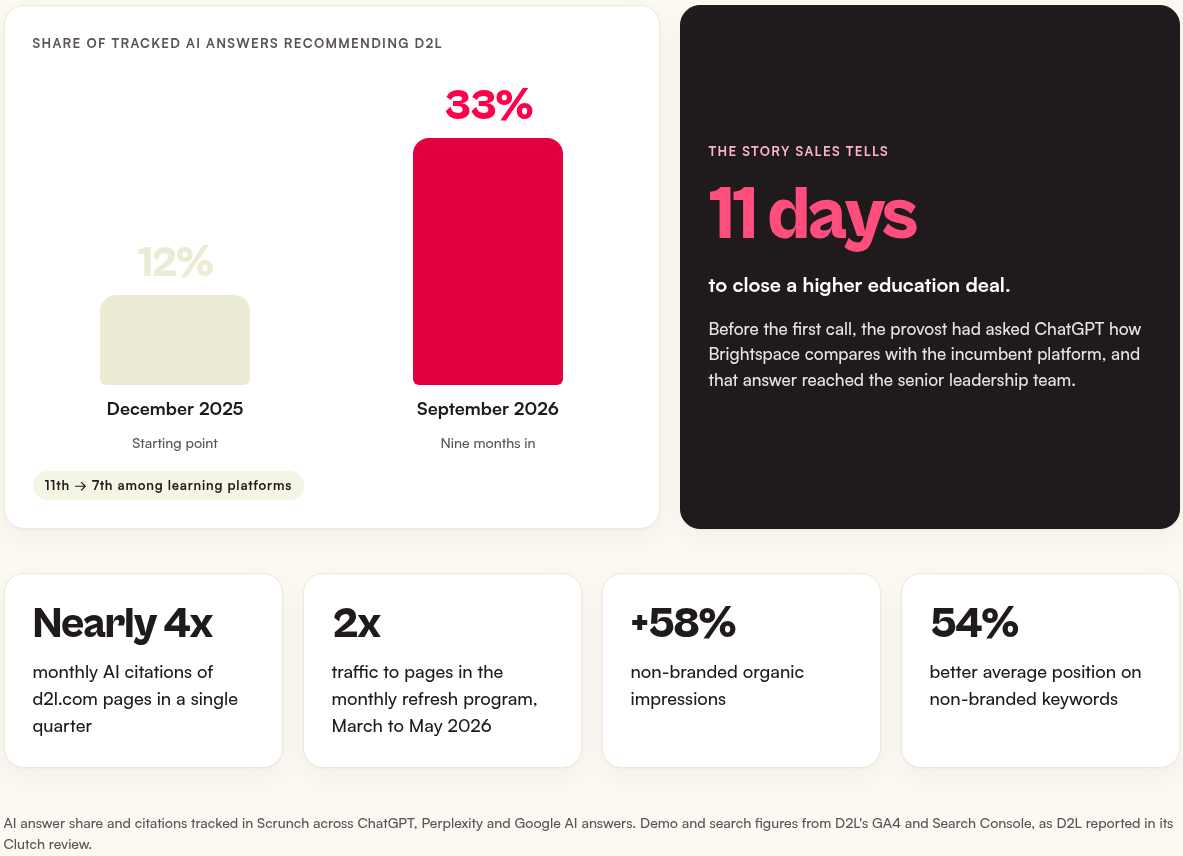
Flying Cat averages 4.9 over 10 Clutch reviews. D2L's director of digital marketing reviewed it on April 2, 2026. He said the team makes a point of meeting people across the client's organization to learn what the program should deliver, and reported non-branded organic impressions up 58% on the prior year and demo request conversions from organic search and AI assistants up 73% on the prior year. He also cited a 54% improvement in average position for non-branded keywords, without naming the period, over work that began in April 2025.
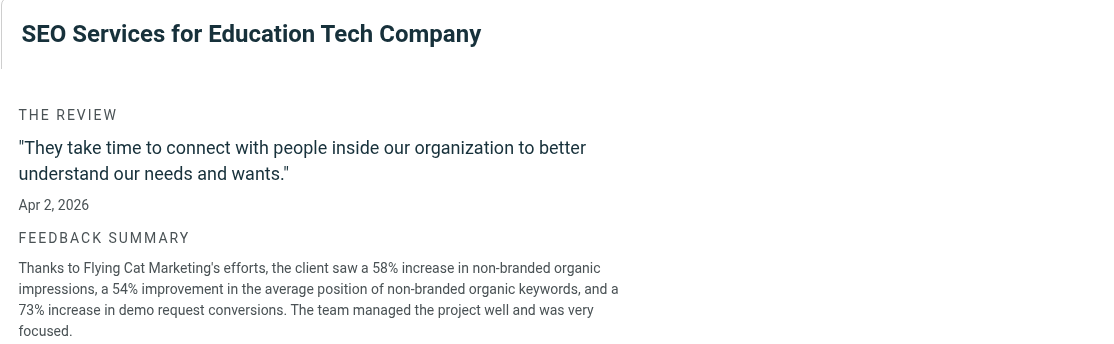
D2L review of Flying Cat on Clutch, April 2026
Clients
The D2L case study, published in October 2026, reports that D2L appeared in 12% of tracked AI answers about learning platforms in December 2025 and 33% by September 2026, climbing from 11th to 7th among the platforms tracked.
D2L share of tracked AI answers, Flying Cat case study
Demo requests from ChatGPT ran at 3.2 times the prior year. The case also describes a higher education deal that closed in 11 days after a provost asked ChatGPT how Brightspace compared with the incumbent. Answer share came from a third-party AI visibility tool, and demo and search figures from D2L's own analytics.
Summary
Flying Cat has the clearest edtech result on the list: dated, with a named client and a method that matches how institutions now compare platforms. LMS and learning platform vendors selling to universities and enterprises get the most from it. Paid media and site rebuilds are out of scope, and the $4,000 floor is steep for a small K-12 tool.
3. GrowPad
GrowPad, based in Dnipro, Ukraine since 2020, serves SaaS and B2B technology companies and keeps a dedicated eLearning SEO and GEO page, updated in October 2026.
Services
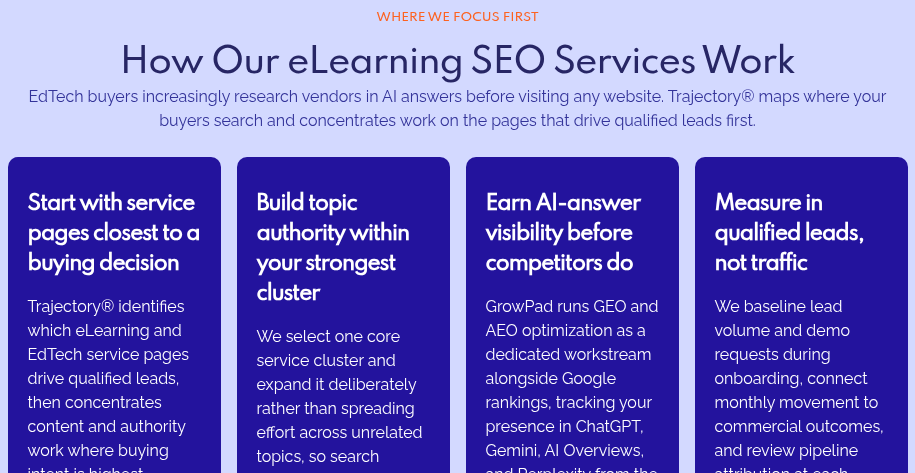
The edtech offer opens with an SEO and GEO audit and then follows a method GrowPad calls Trajectory, which ranks pages by how close they sit to a buying decision. Work concentrates on one core service cluster, with supporting pages, use cases and FAQ sections written the way buyers phrase AI prompts. Link building goes after education and B2B publications and the listicles AI systems already cite. A separate AI visibility track adds a technical AI audit, page-level fixes and monthly tracking in AI Overviews, Perplexity, ChatGPT and Copilot, with recorded video updates every two weeks. GrowPad also makes a point edtech teams should hear: learning content attracts people curious about a subject, and platform evaluators are a separate audience, so the two need separate pages.
GrowPad eLearning SEO services page
Pricing
Clutch packages start at $2,000 a month, with a $1,000+ project floor and $50 to $99 an hour, which puts GrowPad among the cheapest options here.
An e-learning course vendor that keeps the $2,000 package from January through the back-to-school rush in September, nine months, spends $18,000.
Reviews
GrowPad averages 5.0 from 39 Clutch reviews. The newest, from ABM Cloud's CMO on October 12, 2026, says organic traffic has climbed steadily, main product pages now hold top positions, AI search visibility is trending up and the site came through a major Google update without losing ground.
Clients
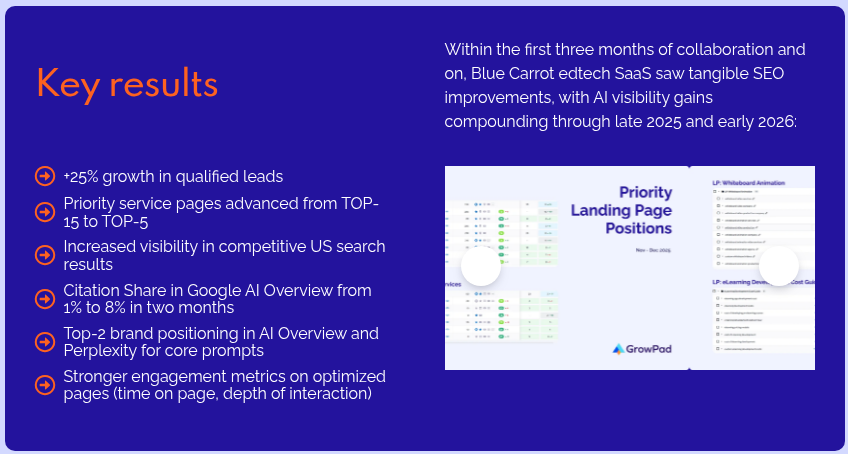
GrowPad published its Blue Carrot case in August 2026. Blue Carrot, based in Poland, builds custom e-learning courses and marketing videos for organizations, so its buyers are companies. From December 2025 to January 2026, Blue Carrot's citation share in Google AI Overviews rose from 1% to 8%, and it held roughly second place as a brand in AI Overviews and Perplexity answers.
Blue Carrot results listed in the GrowPad case study
The case admits AI referral traffic stayed flat or dipped slightly over the same months.
Summary
GrowPad pairs a clear B2B e-learning case with low fees and a method built for small budgets, which fits corporate learning and e-learning vendors. Blue Carrot sells content services, so LMS or district software proof is still missing, and K-12 procurement and privacy rules would be new ground.
4. Stratabeat
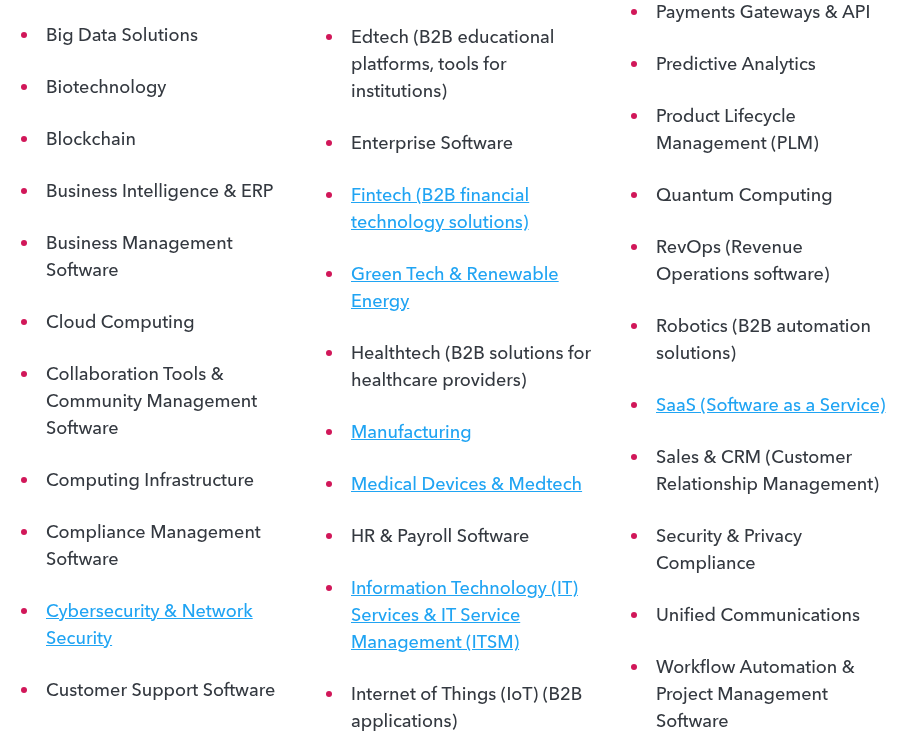
Stratabeat, a B2B organic growth agency founded in 2011 in Burlington, Massachusetts, lists edtech among its industries, defined as B2B educational platforms and tools for institutions.
Stratabeat industry list including Edtech
Services
It offers SEO and GEO, content, B2B website design and development, conversion rate optimization and marketing strategy. That mix suits edtech companies whose site needs rebuilding before SEO can work, say when separate products for schools and businesses share one confusing domain.
Pricing
Clutch packages come in at $8,000, $15,000 and $22,000 monthly, over a $5,000+ project floor and $200 to $300 hourly. That makes Stratabeat the most expensive firm here.
A higher education platform that buys the $15,000 package for the two quarters before an RFP season commits $90,000. The $8,000 package over the same six months costs $48,000.
Reviews
Stratabeat averages 5.0 from 13 Clutch reviews. A senior content marketing manager at a marketing success platform wrote on December 24, 2025 that each team member seemed "genuinely jazzed to brainstorm new ideas, tackle issues, dig into the data." The same reviewer said they weren't sure of the results. The team published and refreshed many blog posts, adding takeaways, tables of contents, author bios and a reading progress bar, while AI was changing organic search behavior across the industry.
Clients
No named edtech client turned up. In a January 16, 2026 review, WellSaid, a text-to-speech company, reported organic traffic up 30% and organic conversions up 45% after an SEO and AEO audit and strategy, over an engagement that began in October 2025.
Summary
Stratabeat suits established edtech companies that want strategy, content and a website rebuild from one senior team and can spend $8,000 a month or more. Its edtech claim rests on an industry listing with no case study behind it.
5. DerivateX
DerivateX, a Bengaluru agency founded in 2024, sells GEO-first SEO to B2B SaaS firms in the $5 million to $50 million ARR range. DerivateX treats K-12 and higher education buying in more detail than any other agency reviewed, on an edtech industry page it last updated in May 2026.
Services
DerivateX splits the market into six categories, among them K-12 learning and curriculum tools, K-12 student information systems, higher education LMS, corporate learning, and assessment and AI tutoring.
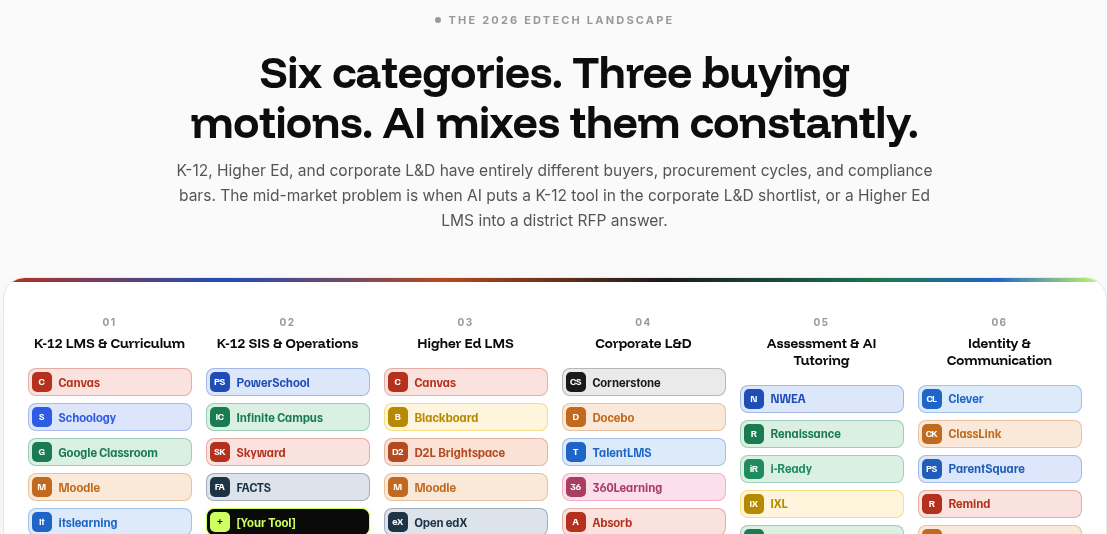
DerivateX edtech categories on its industry page
Its central idea is segment disambiguation: canonical content stating whether a product serves K-12, higher education or corporate learning, so AI assistants stop dropping a district tool into a university answer. It also proposes:
a machine-readable page mapping the product to FERPA, COPPA, SOC 2 and state laws such as New York Education Law 2-d
content tying a product's cost to federal and state funding lines
integration guides for systems like PowerSchool, Clever and ClassLink
outreach to education trade press (its own weightings for those outlets are estimates and aren't used here)
Pricing
Pricing opens with a 90-day Series A pilot from $3,500 a month, followed by retainers at $5,000, $8,000 and $12,000 a month, and the agency suggests budgeting another $1,000 to $3,000 a month for citation outreach. DerivateX also quotes that pilot from $5,000 a month and won't run a retainer below $5,000 according to its pricing FAQ, so ask which number applies before signing. Its one-time $3,500 diagnostic is a separate fee that becomes a credit toward the retainer when the vendor signs within 30 days. On Clutch the floor is $5,000+, with no hourly rate.
A K-12 student information system vendor that runs the pilot from January through March at $3,500 a month, with the smallest $1,000 citation budget, spends $13,500 while district budgets for the next school year are being set. At the $5,000 rate those three months cost $18,000.
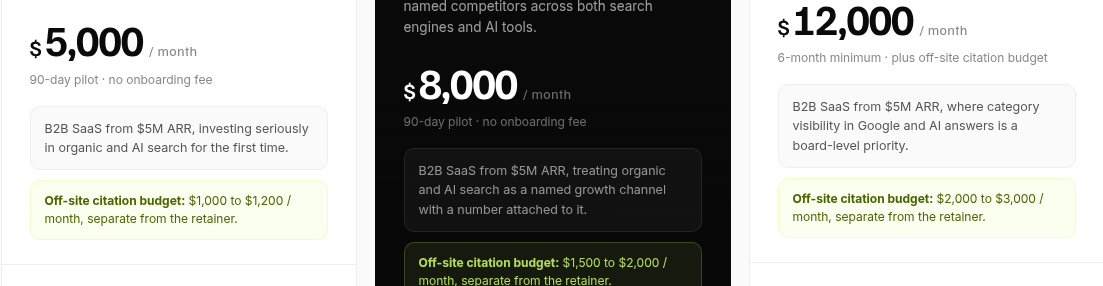
DerivateX tiers with separate off-site citation budgets
Reviews
Seven Clutch reviews give DerivateX a 5.0. Only one falls inside this guide's window. REsimpli, which builds CRM software for real estate investors, posted it on November 20, 2025. Its head of marketing set the goal as outranking competitors in LLM search and reported doing so on most of the agreed queries, which is unrelated to schools or campuses.
Clients
DerivateX names no edtech client or result, and its figures on how many district and university technology leaders use AI for vendor research have no source, so they're left out.
Summary
DerivateX has thought harder than most about how AI assistants mishandle edtech segments and privacy claims, and a funded K-12 or higher education vendor could act on its plan directly. It has no published edtech result and few reviews, and the citation budget comes on top of the retainer.
6. PipeRocket Digital
PipeRocket Digital, founded in 2023 in Chennai, is a B2B SaaS marketing agency covering SEO, AI search, paid media and marketing operations. PipeRocket updated its edtech marketing page in June 2026, and the offer covers K-12, higher education and corporate learning.
Services
PipeRocket builds the offer on buying cycles. It describes districts buying in spring for a fall rollout, universities running multi-year RFP cycles tied to the fiscal year and corporate learning budgets resetting annually, and proposes campaigns timed to each. It argues that faculty and learning leaders buy on retention, completion and outcome data, so bottom-of-funnel pages should open with documented results. It wants FERPA, COPPA, GDPR and state student data rules surfaced on landing pages and in ads so IT reviewers can qualify themselves, and it maps content to faculty, IT, procurement and sometimes boards. A five-agent SEO stack is deployed on each edtech account.

PipeRocket edtech page on academic calendar buying
Pricing
On its pricing page, PipeRocket's Single-Channel plan starts from $5K a month, Multi-Channel from $10K and Full GTM from $20K. Its Clutch project floor is $5,000+, with no hourly rate.
Its own calendar puts district buying in spring. A classroom tool that starts in November to be visible by then pays $30,000 for an assumed six months at the $5,000 entry rate.
Reviews
PipeRocket holds 4.7 from 18 Clutch reviews. The head of marketing at LateShipment.com, a post-purchase operations platform, wrote on May 9, 2026: "They worked like an extended team." Over a year of SEO work ending in January 2026, the reviewer reported inbound conversions up 25%, SQL to SQO conversion up 35% to 40% and revenue up about 25%. In a July 30, 2026 review, Amnic said AI platform referral traffic nearly doubled between May and June 2026.
Clients
Goldcast, Spendflo and HyperVerge appear among the logos on the edtech page. None of them is an education company, and no edtech case is published.
Summary
PipeRocket has the most practical view of academic timing and buying committees, plus paid media when it's needed. Its edtech offer is still a plan with no named education client behind it.
7. Bay Leaf Digital
Bay Leaf Digital is a full-funnel B2B SaaS marketing agency in Grapevine, Texas, running since 2013. It updated its education SaaS industry page in September 2026.
Services
Bay Leaf lists the sub-segments it markets: learning delivery and engagement, assessment and student success, content creation and curriculum tools, education administration from SIS to scheduling, admissions and CRM, corporate learning and professional development, and newer models such as AI tutoring and simulation.
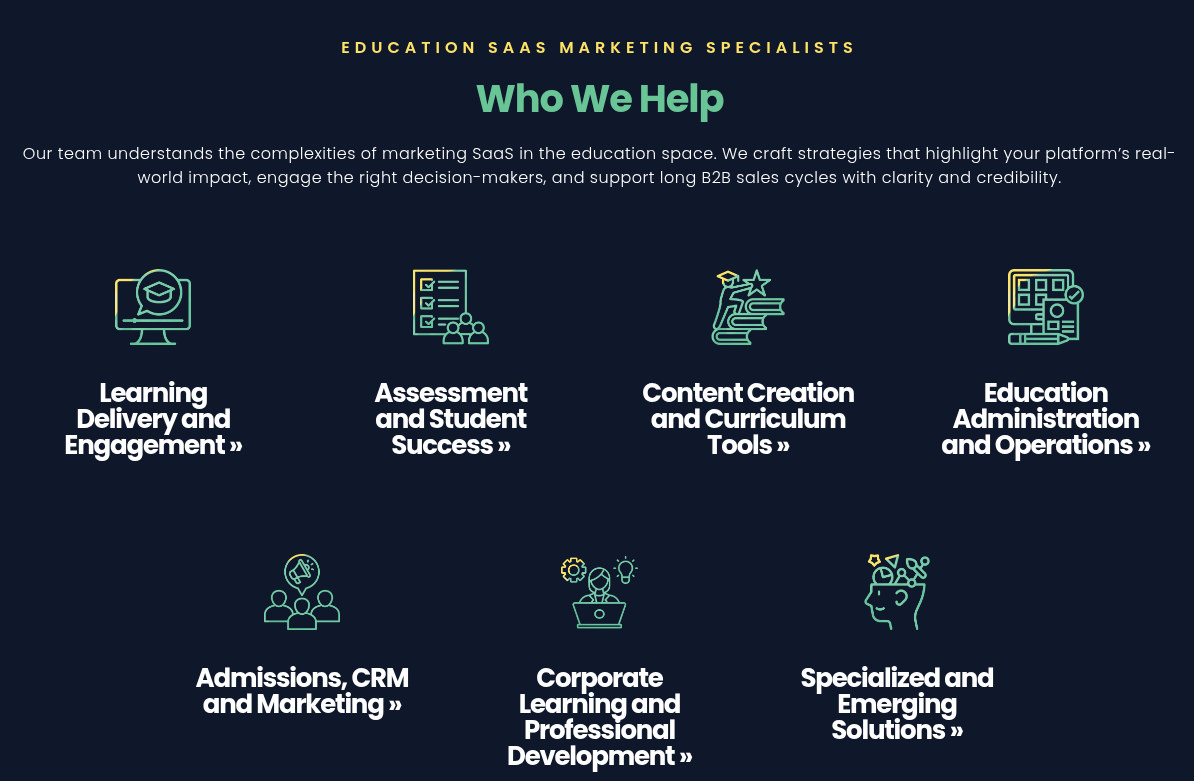
Bay Leaf education SaaS segments it markets to
Services include SEO, AEO and GEO, technical SEO, content and video, PPC, social, website conversion work, HubSpot management, marketing automation and analytics. For an edtech company with no in-house marketing team, that breadth may count for more than SEO depth. A market size forecast Bay Leaf quotes carries no source and isn't used.
Pricing
The entry package, Authority Builder, costs $3,999 a month on a six-month commitment, and Growth Partner work starts at $5,000 a month. On Clutch the minimum is $5,000+ and the hourly rate $100 to $149.
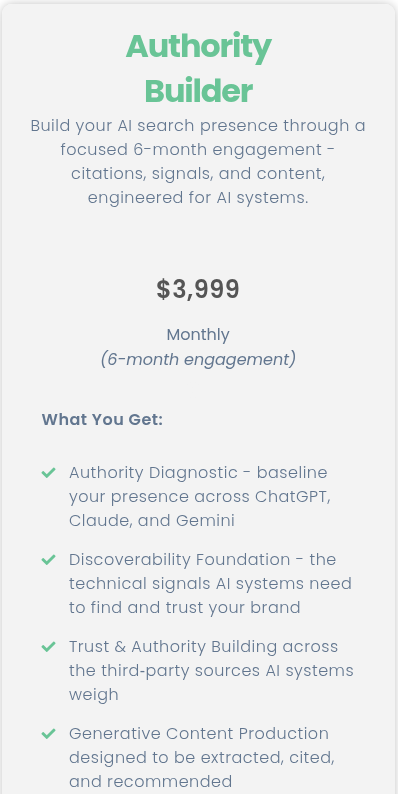
Bay Leaf Authority Builder package at $3,999 a month
The six-month commitment on Authority Builder comes to $23,994, so a corporate learning vendor without a marketing hire commits close to $24,000 before it can change course.
Reviews
Bay Leaf has 5.0 from 4 Clutch reviews, with just one recent. An executive at Tratta, a financial services software company, reviewed it on April 2, 2026 for web development, SEO and content work. Bay Leaf ran content production and the marketing calendar, the reviewer said, and revived a stalled marketing function, with more traffic, leads and awareness.
Clients
Testimonials on the education page come from a localization software company and other B2B clients. No edtech case is published.
Summary
Bay Leaf fits education software companies that need a whole marketing function more than an SEO specialist, with SEO, AI search, paid media and automation on a six-month plan. Its education evidence is a well-organized industry page, and its recent review record is thin.
8. Loopex Digital
Loopex Digital is a large SEO agency best known for link building, with offices in Glendale, California and Yerevan, Armenia. It has operated since 2018 and sells B2B, SaaS and AI SEO.
Services
Loopex offers content, link building, digital PR, technical SEO, audits and consulting, plus AI SEO and AI citation building for ChatGPT, Perplexity, Gemini and Claude.
Pricing
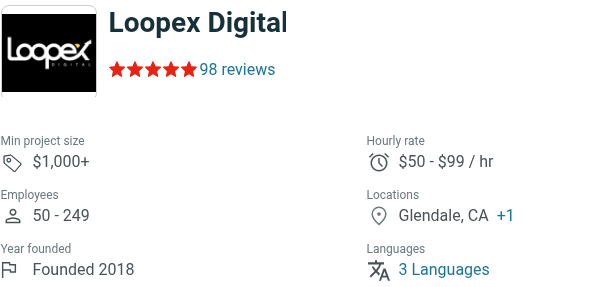
On Clutch, Loopex starts at $1,000+ per project and $50 to $99 an hour. Contracts run month to month, with no monthly fee published.
Loopex Clutch minimum and hourly rate
An edtech team that already has a content plan could buy an assumed 20 hours of link building a month, $1,000 to $1,980 at the Clutch rate, and stop after any month.
Reviews
Loopex has 98 Clutch reviews averaging 5.0. On July 9, 2026, a marketing contact at VCA Software, an insurance claims technology company, said the site now ranks in the top 10 for its main SaaS keyword and its variations, and that the team hits deadlines and beats expectations on deliverables.
Clients
No B2B edtech client is published.
Summary
Loopex is a cheap, flexible option for link building and on-page work, with a long review record, and suits edtech companies that already have a content strategy. It's the weakest edtech fit on the list, so knowledge of district procurement, student privacy and academic timing would have to come from the client.
9. Siege Media
Siege Media, founded in 2012 in Austin with offices in New York, Chicago and San Francisco, is a content and GEO agency of 50 to 249 people. It updated its education GEO page in August 2026.
Services
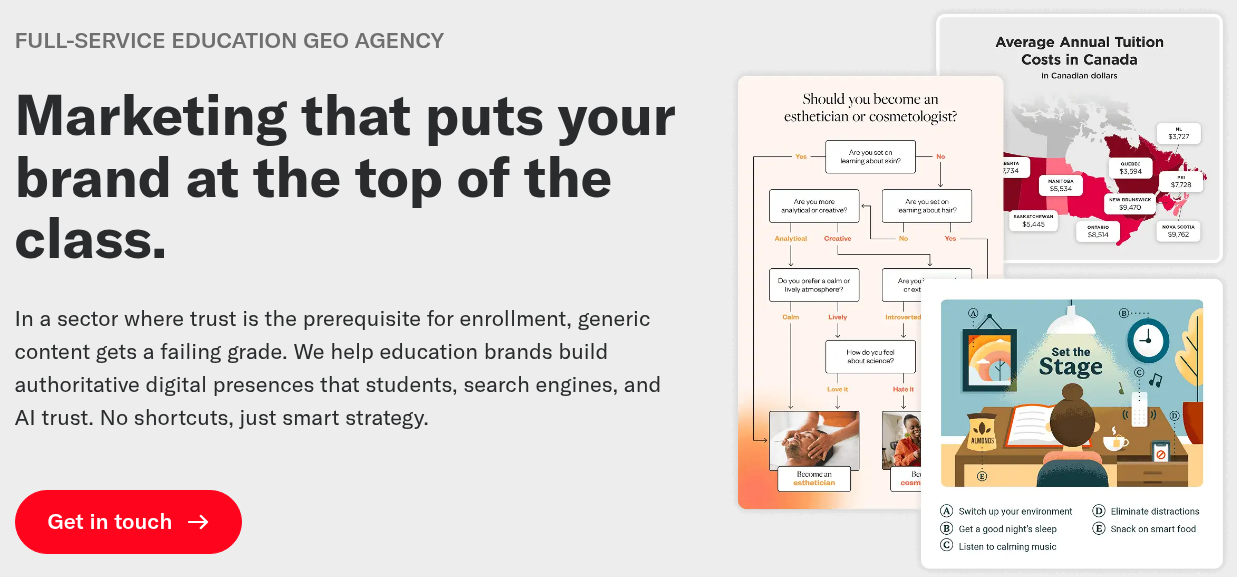
Siege provides content strategy, content creation, GEO, design, digital PR, Reddit marketing and affiliate partnerships. Siege pitches its education work at enrollment, under the hero line "In a sector where trust is the prerequisite for enrollment, generic content gets a failing grade." That's student marketing, a different sale from institutional software.
Siege Media education GEO offer
Pricing
Clutch records a $5,000+ project floor and an hourly band of $100 to $149. Siege doesn't publish monthly fees.
For an online program provider aiming at learners, an assumed 40 hours a month costs $4,000 to $5,960 at that band, so even at the low end the $5,000 floor is met in the second month.
Reviews
Siege averages 4.9 from 48 Clutch reviews. In a review posted August 31, 2026, covering the year to August 2026, the content director at an online therapy platform reported AI visibility on high-priority tracked prompts up more than 400% and said Siege's articles produced two of the blog's three highest-traffic posts.
Clients
No B2B edtech software client turned up.
Summary
Siege makes large, well-designed content, and its education pitch centers on enrollment and learner marketing. Edtech brands with a big educator or learner audience can put that to use, while a program built around procurement and IT approval needs a different agency.
What the entry fees look like
Agency | Lowest figure found | Where it comes from |
|---|---|---|
GrowPad | $2,000 a month | Package shown on Clutch |
Miraa | $2,500 a month | Pricing page, three fixed plans |
DerivateX | $3,500 a month | Pilot for Series A firms; retainers run to $12,000; citation budget extra |
Bay Leaf Digital | $3,999 a month | Six-month Authority Builder package |
Flying Cat Marketing | $4,000 a month | GEO and AEO, D2L case page |
PipeRocket Digital | $5,000 a month | Pricing page; Single-Channel plan |
Siege Media | $5,000+ | Clutch minimum project |
Stratabeat | $8,000 a month | Clutch package |
Loopex Digital | $1,000+ | Clutch minimum project; no monthly fee published |
A Clutch project minimum is a floor for any engagement and says little about the monthly retainer. Watch for six- and twelve-month commitments, separate citation budgets and paid media fees that only appear late in a proposal.
Questions to ask an edtech SEO agency
Buyers and segments:
Which segment is the product in, K-12, higher education or corporate learning, and how will content make that clear to search engines and AI assistants?
Who in the buying group will each page serve, and which roles get nothing in the first quarter?
How will the plan line up with district budget season, university RFP cycles or annual training budgets?
Privacy, accessibility and trust:
How will FERPA, COPPA, state privacy agreements and certifications be explained on the site, and who checks the legal accuracy?
Will accessibility statements and conformance reports be indexed and linked, and do the agency's own page templates meet WCAG?
What outcome evidence, such as completion, retention or pilot results, can be published, and how will it be sourced?
AI answers and measurement:
Which prompts will be tracked, how often, and in which assistants?
How will reporting tie search and AI visibility to demo requests, pilots and RFP invitations as well as visits?
Which named education clients can be contacted for a reference?
How to choose by who buys your product
Selling to K-12 districts puts privacy and segment accuracy first. Ask for a plan that covers data privacy pages, integration guides for SIS and rostering systems, and content timed to spring planning. DerivateX and PipeRocket have written the most specific district plans, though neither has published a district result. Miraa can build the same pages at a lower fixed fee if the vendor handles privacy review.
Selling to universities calls for comparison content and work on AI shortlists. Committees and provosts now compare platforms inside AI assistants, and Flying Cat's D2L case is the closest match to that motion. Expect longer timelines, and judge progress on answer share and RFP invitations.
A corporate learning platform or e-learning service sells to HR, enablement or compliance leaders, and the search behavior looks a lot like standard B2B SaaS. GrowPad's Blue Carrot work fits this segment and its fees suit smaller teams. Stratabeat and Bay Leaf suit larger companies that also need a site or wider marketing.
On a tight budget, GrowPad and Miraa start lowest. Loopex is cheap for links but needs strong direction.
A company that also markets to individual teachers or learners has a reason to look at Siege's content and enrollment focus, provided someone else covers the institutional pages.
Only Flying Cat and GrowPad bring a dated, named B2B education case. Every other agency here is asking an edtech vendor to trust a method, and that gap deserves as much attention as price.
FAQ
What does an edtech SEO agency do?
It plans and produces search and AI answer content for companies selling education software or services to institutions: product and comparison pages, privacy and accessibility content, technical SEO, links, and tracking of how AI assistants describe the product.
How much does edtech SEO cost in 2026?
Among these agencies, published entry fees run from about $2,000 to $8,000 a month, and some list only a Clutch project minimum. Programs with paid media, a site rebuild or a separate citation budget cost more.
How long does edtech SEO take to show results?
Movement on priority pages can show up within a few months, but institutional sales cycles are long, so pipeline effects usually take more than one buying season to read clearly.
Should edtech companies treat AI search separately?
Yes. Assistants can mix up K-12, higher education and corporate learning products, and may misstate privacy terms. Tracking a fixed set of prompts and fixing the pages assistants lean on is a separate job from ranking in Google. There's a primer on tracking brand visibility in AI search and an explainer on structured data for AI answers.
Do consumer education agencies work for B2B edtech?
Sometimes. Enrollment marketing is tuned for individual learners making quick decisions, while B2B edtech needs content for committees, IT reviewers and procurement, and that takes a different skill set.