

Last updated: October 31, 2026
Lawyers have stopped treating generative AI as an experiment. A January 2026 report from the research arm of a legal and tax information company found that 41% of law firm respondents said their organization already uses GenAI. Across all respondents the share was 40%, up from 22% a year earlier. On personal habits, 57% of individual professionals said they use publicly available AI tools, against 31% who use paid industry-specific products. The online survey ran in October and November 2025, before the report came out, and drew 1,514 legal, tax, risk and government professionals in 27 countries, all screened for familiarity with AI.
That's a related signal, and a broad one. It measures AI use at work across several professions and says nothing direct about how lawyers shop for software. The gap between 57% and 31% is still the ground a legal software company has to take. Lawyers open a general assistant every day. When one asks it which contract review tool suits a 50-person in-house team, or whether a research product is safer than pasting a brief into a chatbot, the answer shapes the shortlist.
Judge a legal tech SEO agency by how well it understands the way lawyers weigh risk, and treat publishing volume as a minor detail. A strong partner knows that selling to a managing partner and selling to a general counsel are two different jobs, writes about privilege and conduct rules without overreaching, and works to get the product described accurately when buyers ask AI assistants about accuracy, security and fit. Three agencies stand out. Six more suit narrower needs.
TL;DR: nine picks, one line each
Miraa - Best for legal software companies that want product-led SEO and AI answer work at a fixed monthly price, and have a lawyer on staff to check drafts.
DerivateX - Best for AI-for-lawyers products that need to be cited correctly on accuracy and ethics questions, and can pay for a citation budget.
PipeRocket Digital - Best for CLM, e-discovery and matter management platforms selling to general counsel and legal ops, with AI search tied to pipeline.
Bay Leaf Digital - Best for early legal software companies that need a whole marketing team with SEO as one part.
SimpleTiger - Best for practice management and contract software that wants an established SaaS SEO firm with legal software clients.
Stratabeat - Best for funded legal services platforms that want strategy, content and a new website from one senior team.
ESA Digital - Best for legal and privacy software expanding into non-English markets.
Loopex Digital - Best for legal compliance and risk software chasing commercial keywords on flexible terms.
GrowPad - Best for smaller legal software companies that want technical SEO and content at a low entry price.
Comparison table
Agency | Services | Lowest price | Clutch record | Legal software proof | AI answer proof |
|---|---|---|---|---|---|
Miraa | AEO/GEO plus product-led, content-led and technical SEO, writing, links and more | Fixed plans of $2,500, $3,500 and $5,000 | Not on Clutch or G2 | No legal software client | AI search in every plan; no legal result published |
DerivateX | GEO-first SEO, AI citation work | $5,000 monthly plus citation budget | 5.0 (7 reviews), latest in window Nov 20, 2025 | Legaltech page with professional rules mapping | AI answer testing across four assistants |
PipeRocket Digital | SEO, GEO, PPC, pipeline reporting | From $3,000 monthly | 4.7 (18 reviews), latest Jul 30, 2026 | Legaltech page covering CLM and e-discovery | AI referral growth in software reviews |
Bay Leaf Digital | Outsourced B2B SaaS marketing with SEO and GEO | $3,999 monthly or $5,000+ | 5.0 (4 reviews), single in-window review Apr 2, 2026 | Legal tech page organized by product category | GEO listed as a service |
SimpleTiger | SaaS SEO, technical fixes, links, AI search | $5,000+ Clutch minimum | 4.9 (32 reviews), latest Feb 5, 2026 | Centerbase, ContractWorks (named, undated) | AI results reported by a 2026 reviewer |
Stratabeat | SEO, GEO, content, web design | $8,000 to $22,000 monthly | 5.0 (13 reviews), latest Jul 9, 2026 | Company Sage review (attorney-backed LLC formation) | AI search credited with sales by a 2026 reviewer |
ESA Digital | SEO, GEO, international SEO | $5,000 monthly package | 5.0 (43 reviews), latest Jul 2, 2026 | Consent platform case built on privacy law terms | AI Overviews citations up about sevenfold |
Loopex Digital | SEO, links, digital PR, AEO | $1,000+ Clutch minimum | 5.0 (98 reviews), latest Sep 1, 2026 | ComplyAssistant (healthcare GRC) | AEO offered; no legal AI result |
GrowPad | Technical SEO, content, links, GEO | $2,000 monthly package | 5.0 (39 reviews), latest Oct 12, 2026 | None in legal software | Rising AI search visibility reported by a client |
What legal buyers need from search
Legal software splits into many small markets. Practice management, contract lifecycle management, e-discovery, legal research, IP management, e-billing and legal AI assistants each come with their own buyer, vocabulary and rivals. Practice management sells to a firm administrator or managing partner worried about billing and trust accounting. CLM sells to a general counsel and a legal ops lead who care about approval workflows and clause libraries. E-discovery sells to litigation support teams who think in review volume and defensibility. Lump them together as "legal software" and the pages rank for nothing useful.
Firms and in-house teams use the same words to mean different things. Law firms buy software to serve clients and protect margins. Corporate legal departments buy it to rein in outside counsel spend and move faster for the business. Both say "matter management". To a firm it means tracking billable work, and to an in-house team it means tracking requests from sales and HR. The agency has to know which one the product serves before it writes a title tag.
Conduct rules sit behind every claim. Lawyers owe duties of competence, confidentiality and supervision, written in the United States into the American Bar Association's Model Rules and each state's version of them. When a product touches client data or produces work product, buyers want to know how it supports those duties. Promising that a tool will "keep you compliant" or "eliminate errors" invites doubt from readers trained to spot overstatement. Precision works better: what the product does, what the lawyer still has to check, and where the documentation lives.
Accuracy has become a buying question. Since generative features reached research and drafting tools, buyers ask how often a product invents a citation and how the vendor tests for it. Pages that publish a testing method, admit its limits and update when the model changes give a cautious buyer something to evaluate, and give AI assistants something concrete to repeat.
Security and confidentiality pages get read first. Data residency, encryption, access controls, certifications and the handling of privileged material are usually what a firm's IT lead or a general counsel checks before anything else. Security or legal staff tend to own these pages, so the agency has to improve structure and findability while leaving approved wording alone.
The free chatbot competes for the same job. Plenty of lawyers already ask a general assistant to summarize a contract or draft a clause, and some never search for a vendor because the assistant says a general tool will do. Honest content about where a specialized product adds review controls, audit trails or Microsoft Word integration gives both people and AI systems a reason to name it.
Committees buy, and they buy slowly. Partners, legal ops, IT, finance and sometimes outside counsel all weigh in, and the cycle can run for quarters. Search work here has to serve the whole group: comparison pages for the champion, security pages for IT, cost pages for finance. One conversion page won't carry it.
How the agencies were chosen
Think of this list as a branch of the B2B SaaS SEO guide, where the wider playbook sits. For background on how answer engines pick sources, read what AEO is and how it works. If no legal specialist fits, the wider shortlist of SEO agencies for B2B software companies covers firms that work across categories.
Nobody paid for a spot, and no agency was hired to help produce the guide. Evidence comes from agency websites and Clutch profiles, read October 20 to 23, 2026. Every agency other than Miraa had to meet four conditions:
Legal software relevance: a page aimed at legal tech companies, or a named or described client selling software or tech-enabled services to lawyers and legal teams.
Fresh reviews: one or more Clutch reviews dated after November 3, 2025. Only those are quoted or summarized.
AI answer work: AEO, GEO or another AI search service offered within the engagement.
Vendors over firms: agencies whose legal work markets law firms to their clients were set aside unless they also showed work for companies selling to lawyers. Law firm SEO is a separate job with a separate buyer.
The fourth condition did most of the filtering. One agency's legal page and only legal client were law firms. Another's legal case study turned out to be a firm's own website. Others had nothing on Clutch newer than mid-2025, and one had no Clutch profile. Loopex Digital and GrowPad also market law firms; they stay because their other evidence passed, and their entries say so.
Quotes are the headline line Clutch shows above each review. Ratings, counts and dates reflect each profile when it was checked.
1. Miraa
Miraa is an SEO and AEO studio for B2B software companies, with custom AI agents running research and monitoring and people making the strategy and editing calls. It has no legal tech page, no legal software client and no case study from the legal market. The nearest names on its client list are privacy software companies, Redacto and IQWorks, and no results are published for them. Miraa names twelve verticals on its industries page, among them fintech, accounting and healthtech, and says the team takes on other B2B software companies whose buyers research before buying. Legal software falls under that line, and the B2B SaaS SEO service is where it would sit.
Services
Every client gets access to the same ten services:
Product-led SEO: one page per task a lawyer hands the product, such as intake, conflict checks, clause comparison or privilege logging.
Content-led SEO: clusters split by buyer, so a firm administrator and an in-house legal ops lead each find material written for them.
Technical SEO: indexing rules for help centers, integration directories and security documentation.
On-Page SEO: tightening pages that sit just off page one, from titles to the internal links behind them.
SEO Site Migration: moving a domain, CMS or knowledge base without losing rankings.
SEO Website Recovery: diagnosing a traffic drop and repairing the cause.
AEO/GEO: checking how AI assistants describe the product's accuracy, security and integrations, and fixing gaps at the source.
Content Writing: drafts built from the client's own subject matter, with the in-house lawyer doing the final legal check.
Link Building: editorial outreach, never paid placements.
Agentic SEO/GEO: custom agents tracking rankings, AI prompts and competitor changes, with editors approving anything that goes live.
Product-led SEO and AEO/GEO do most of the work for legal software. Miraa offers no legal expertise, so the client supplies the legal reviewer.
Pricing
Miraa publishes three fixed monthly plans: $2,500 for Basic Growth, $3,500 for Growth+ and $5,000 for Hyper-Growth. AI search visibility work begins on the lowest plan, each tier builds on the one before, and no industry pays more than another. Site migrations are a separate one-time project at $4,000.
Running the numbers
A year on Growth+ costs $42,000. If the help center moves to a new CMS that year, the $4,000 migration project brings it to $46,000, which is still $14,000 under twelve months of DerivateX's entry retainer before any citation spend.
The cost the invoice won't show is legal review. No plan includes a lawyer, so every draft that touches privilege, confidentiality or accuracy claims waits on your own counsel's calendar.
Clients
No legal software work has been published. Miraa's case studies page covers cold-outreach and sales software, a long way from legal buyers. One of those clients is Mailforge, which sells cold email infrastructure. Its estimated organic traffic sat between roughly 1K and 1.5K for most of the two years charted below, then started rising around January 2026. After a spike near 5K in July and a late-summer dip under 3K, it reached a high close to 5.5K in October 2026 (Ahrefs, Oct 2026).
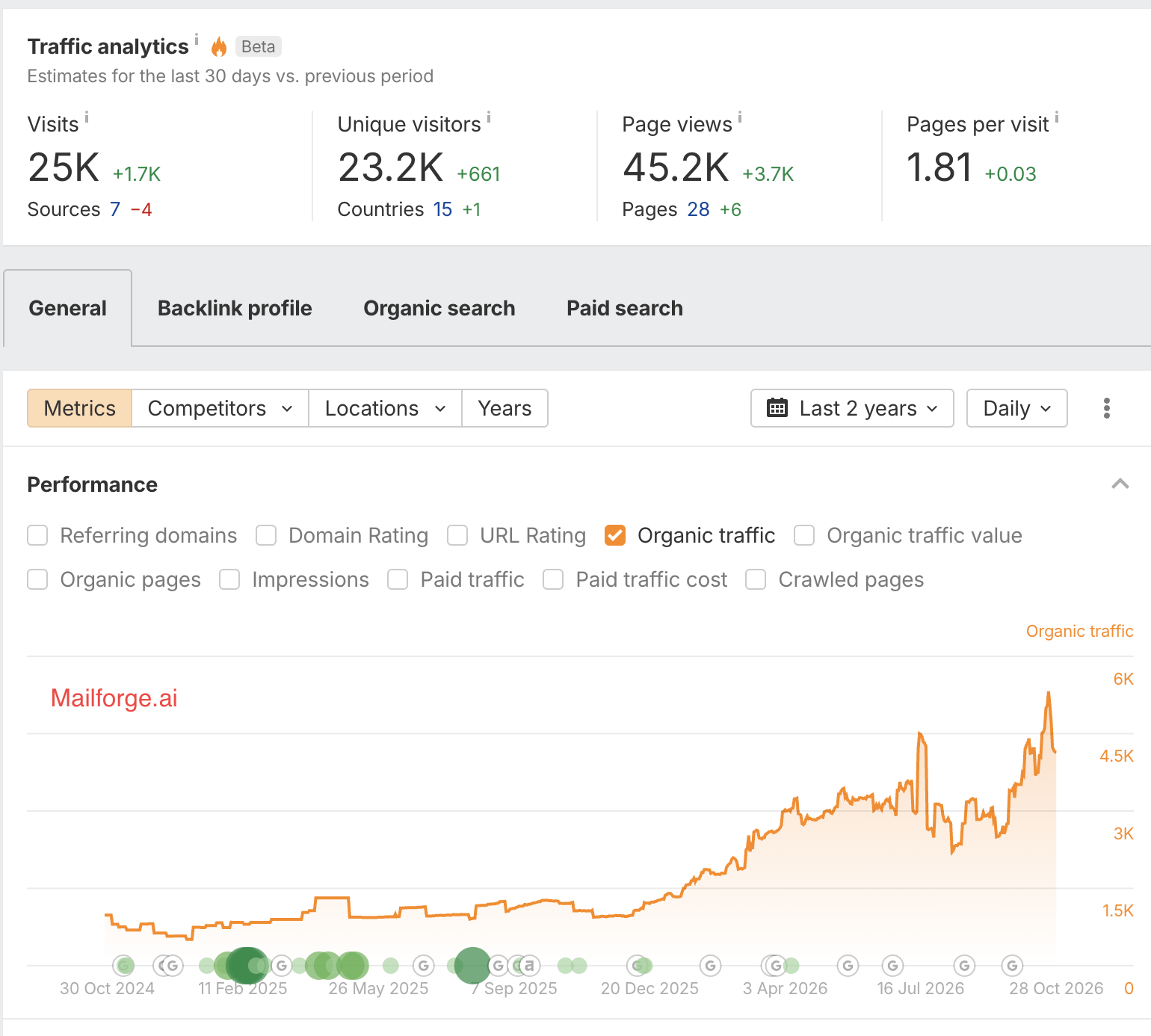
Mailforge.ai organic traffic, Ahrefs estimate (2-year view to Oct 2026).
Summary
The lowest fixed entry price here with AI answer work from day one. Evidence is the weak spot, since it has no legal client or case and no third-party reviews.
2. DerivateX
DerivateX, founded in 2024 and based in Bengaluru, sells SEO and GEO to B2B SaaS companies in the $5 million to $50 million ARR range. A dedicated legaltech page, last updated in May 2026, goes further into how lawyers buy than any other agency page reviewed for this guide.
Services
The legaltech page splits the market into six categories, from practice management to AI for lawyers to CLM, and argues that each draws a different shortlist from AI assistants. Work starts by mapping a product's claims to ABA Model Rules 1.1, 1.6, 5.1 and 5.3, covering competence, confidentiality and supervision. From there it:
publishes its hallucination testing method for the product
builds detailed pages on Microsoft Word integration
creates content by practice area, such as litigation, M&A or employment
pitches legal trade press and benchmark publications
co-authors with the client's own legal experts, with no ghostwriting
A 48-hour prompt audit across four AI assistants is the usual first step.
Pricing
Plans cost $5,000, $8,000 or $12,000 monthly, with a separate citation budget of $1,000 to $3,000 a month. The $3,500 diagnostic is credited against the first invoice when the client signs inside 30 days, and the two cheaper plans can begin as a 90-day pilot. Clutch shows a $5,000+ minimum project.
Running the numbers
The $8,000 middle plan is $96,000 a year before placements. Its tier carries a citation budget of $1,500 to $2,000 a month, so the year lands between $114,000 and $120,000.
Watch the diagnostic window. The $3,500 credit applies only if you sign inside 30 days, and the committee buying described earlier can take quarters. A legal software company that needs partner, IT and finance sign-off should line up those approvals before booking the diagnostic, or plan to lose the credit.
Reviews
DerivateX has a 5.0 rating across 7 Clutch reviews, and just one is recent enough for this guide. REsimpli, a CRM for real estate investors, reviewed it on November 20, 2025 and described a plan that attacked competitors' rankings on many fronts. The others are from mid-2025 or earlier.
Clients
No legal software client appeared in the material reviewed. The legaltech page points to an undated case on managed IT for tax and accounting firms, so its ranking claim is left out.
Summary
No one on this list has thought harder about how lawyers use AI assistants to vet software. It's a method with no legal client behind it yet, and only one review falls in the window.
3. PipeRocket Digital
PipeRocket Digital, founded in 2023, works out of Chennai with 10 to 49 people and sells SEO, GEO and paid search to B2B SaaS companies. Its legal tech offer, updated in June 2026, covers CLM, e-discovery, legal research, matter management, IP and compliance platforms as the products it markets.
Services
PipeRocket runs SEO, GEO, PPC and marketing operations, reporting against pipeline. Whoever wrote the legaltech page understands how legal buyers decide. General counsel and managing partners trust peers over vendors. Privilege and data residency belong near the top of a page, out of the footer. Campaigns have to steer around deal-close season and filing deadlines. The page also maps two procurement paths: partner committees in firms, and GC, CFO, IT security and outside counsel in companies. AI agents do research, drafting and audits, and senior strategists check language against conduct expectations.
Pricing
Engagements start at $3,000 a month on the pricing page, and Clutch lists a $5,000+ minimum project. The site states different minimum terms on different pages, a detail worth pinning down in the contract.
Running the numbers
At the $3,000 floor a year costs $36,000. Clutch's $5,000+ project minimum means a single month at that rate falls short, so the shortest workable trial is two months, or $6,000. Every extra month of lock-in the contract adds is another $3,000 committed before you see whether AI referrals move.
Reviews
PipeRocket holds a 4.7 rating from 18 Clutch reviews, most from 2026. A marketing manager at an AI customer service and IT support platform wrote on June 22, 2026: "They were ready to say no to action items that would hurt the brand." That client's average site position moved from the low 30s to about 13 by April and May 2026. Amnic, a FinOps platform, posted the newest review on July 30, 2026 and reported AI platform referrals up 99%.
Clients
The legal link is the service page; no legal client is named. Dated results in its reviews come from support software, FinOps and analytics.
Summary
A well-informed legal buyer page and fresh reviews with pipeline and AI referral gains. No legal software result yet, so ask for references from nearby B2B categories.
4. Bay Leaf Digital
Bay Leaf Digital, founded in 2013 in Grapevine, Texas, acts as an outsourced marketing department for B2B SaaS companies. Its legal tech offer, last updated in September 2026, is organized by product type.
Services
The page covers document, knowledge and research platforms, IP management tools, practice-area software for fields like immigration, collections and family law, legal marketplaces and RegTech. Services span SEO, GEO, content, paid media, websites, HubSpot management and analytics. Its FAQ stresses grounding claims in security, accuracy and professional integrity, and pitching ROI as capacity and better client outcomes so the message doesn't threaten the billable hour.
Pricing
The Authority Builder package costs $3,999 a month on a six-month term, and a Growth Partner engagement starts at $5,000 a month. Clutch lists $5,000+ as the project floor, with hourly rates of $100 to $149.
Running the numbers
Authority Builder commits $23,994 over its six-month term. A full Growth Partner year, at its $5,000 starting rate, is at least $60,000. Anything outside the package bills at $100 to $149 an hour, and that's where the watch-out in the How to choose table bites: paid media and ops work the plan doesn't need is easy to add one hour at a time.
Reviews
Four Clutch reviews give Bay Leaf a 5.0. One falls in the window: Tratta, a payments company serving the collections industry, wrote on April 2, 2026 that the agency revived a stalled marketing program and kept a year of content on schedule. The other three are from 2019 and 2022.
Clients
No legal software client or dated legal result was found. The legal tech page quotes undated adoption figures credited to the American Bar Association, so they aren't repeated here.
Summary
Makes sense when a legal software company needs marketing as a whole, with SEO and AI search inside it. The legal evidence is a well-built page with no case behind it.
5. SimpleTiger
SimpleTiger, a SaaS SEO agency in Sarasota, Florida, was founded in 2006. Two legal software names appear in its case studies: Centerbase, a cloud practice management platform for mid-sized firms, and ContractWorks, a contract management tool.
Services
SimpleTiger handles SEO strategy, technical fixes, content, link acquisition and AI search optimization for SaaS companies. Reviewers keep coming back to its reporting and project management.
Pricing
Monthly retainers aren't published. On Clutch, projects start at $5,000+ and hourly work is billed at $200 to $300.
Running the numbers
At those rates the $5,000 minimum buys roughly 17 to 25 hours. Ask how many hours the first project covers and what ships inside them, then compare that with a fixed monthly plan elsewhere on this list.
Reviews
Across 32 Clutch reviews SimpleTiger averages 4.9. A marketing director at an AI lip-sync company wrote on December 9, 2025: "Their strategic thinking and adaptability make them a valuable partner throughout the engagement." The newest review, from an electronic medical records company on February 5, 2026, describes regular reporting on rankings, snippets and AI results.
Clients
Neither the Centerbase nor the ContractWorks case is dated, so only the client names are used.
Summary
The one agency here with two named legal software clients. Both cases are undated, so ask how current that work is.
6. Stratabeat
Stratabeat has worked from Burlington, Massachusetts since 2011, pairing search and GEO with content, web design and CRO for B2B brands. Its closest legal evidence is a review from Company Sage, a business formation service that the Clutch project title calls an LLC attorney company.
Services
Stratabeat covers SEO, GEO, content strategy and writing, web design and development, and CRO. With one team on positioning, site build and search, a legal services platform can rebuild trust signals and product pages in a single project.
Pricing
Three Clutch packages run $8,000, $15,000 and $22,000 a month. Smaller projects start at $5,000+, and hourly work costs $200 to $300.
Running the numbers
Six months on the $15,000 package is $90,000. The watch-out in the How to choose table has a price attached here. If the rebuild drops pages that already rank, recovering them is new work at $200 to $300 an hour, so ask for a redirect map before design starts.
Reviews
Stratabeat holds a 5.0 across 13 Clutch reviews. Company Sage's CMO reviewed it on November 5, 2025 after an engagement spanning web design, content and SEO, and described a founder who stayed hands-on and a team that was easy to reach and closely involved. A wealth management software firm's July 9, 2026 review ties sales directly to AI search.
Clients
Company Sage sells legal formation services online, which makes it legal-adjacent; it doesn't build software for lawyers. No law firm software client was found.
Summary
Senior, full-service delivery and the only legal-adjacent client review on this list. It also costs the most.
7. ESA Digital
ESA Digital, founded in 2020 with offices in London and New York, sells SEO and GEO to funded technology companies and carries Clutch's Premier Verified badge. Its relevant case is about privacy, and it shows how the agency treats legal terminology in other languages.
Services
ESA Digital offers SEO, GEO, international and technical SEO, content and digital PR, and Clutch shows 60% of its SEO focus on generative engine optimization. For a consent management client it built Polish pages around the local term for data protection law, skipping straight translation of English copy. Legal software heading into Europe meets the same problem, since lawyers in each country search in their own legal vocabulary.
Pricing
Clutch SEO packages start at $5,000 a month. Projects begin at $5,000+, billed at $50 to $99 hourly.
Running the numbers
The consent management case ran six months, October 2025 to March 2026. A European launch on that timeline at the package price costs $30,000. Scoped as a one-off project instead, $5,000 at ESA's hourly rates covers about 50 to 100 hours, so ask which route your first market fits.
Reviews
ESA Digital is rated 5.0 over 43 Clutch reviews. In a June 3, 2026 review, a custom software company's CRO said a market audit helped it drop weak markets, AI search visibility began improving within two months, and an AI content agent let it produce five times more content.
Clients
The consent management case, published in July 2026, covers October 2025 to March 2026 for an unnamed platform handling cookie consent under GDPR and CCPA. By ESA Digital's account, Google AI Overviews citations rose about sevenfold and Polish impressions climbed to 54.3K from 24.7K, while average position went from 8.8 to 6.5.
Summary
A dated case where legal terms drove the keyword work, and a strong GEO focus. There's no legal software client to call for a reference.
8. Loopex Digital
Loopex Digital has sold SEO, link building and digital PR to software and service businesses since 2018, from Glendale, California and Yerevan, Armenia. It has more Clutch reviews than anyone else on this list. Most of its legal pages, though, are about SEO for law firms, a different audience from legal software buyers.
Services
Loopex runs technical audits, on-page work, content, links, digital PR and AEO. With software clients it fixes crawl problems first, then builds authority and links around commercial keywords.
Pricing
Clutch puts its floor at $1,000+ per project at $50 to $99 an hour, on month-to-month contracts. It doesn't publish monthly fees.
Running the numbers
The $1,000 floor works out to 10 to 20 hours. With month-to-month terms, a GRC vendor can buy one small project, check the result and stop. A project minimum is only the smallest job an agency accepts, though, so get a monthly figure with its deliverables before comparing Loopex with a fixed plan.
Reviews
Loopex is rated 5.0 from 98 Clutch reviews, the newest dated September 1, 2026. On July 7, 2026, an executive at ComplyAssistant said qualified leads had doubled year over year after Loopex replaced a strategy that had failed.
Clients
ComplyAssistant sells healthcare compliance, GRC and third-party risk software. The May 2026 case study on that client reports service page traffic up roughly tenfold and "healthcare GRC software" climbing from seventh to first. That's compliance software that risk and legal teams buy, a step away from software for law firms.
Summary
Affordable and flexible on terms, with a dated result for compliance software. Its legal marketing experience mostly serves law firms.
9. GrowPad
GrowPad, founded in 2020 in Dnipro, Ukraine, is an SEO agency for IT and B2B software companies. It also markets law firms, and that experience doesn't carry straight over to legal software. It earns a place for its record with technical B2B companies and its low entry price.
Services
GrowPad offers technical SEO, site migrations, content audits and writing, link building and GEO. Reviewers describe structured site work that reaches case studies, author pages and architecture as well as product pages.
Pricing
Packages on Clutch begin at $2,000 monthly. The project floor is $1,000+ and hourly work runs $50 to $99.
Running the numbers
A year at $2,000 a month is $24,000, the lowest published entry on this list and $6,000 under Miraa's Basic Growth over the same twelve months. The saving buys no legal knowledge, so the counsel review cost noted under Miraa applies here too.
Reviews
GrowPad holds a 5.0 from 39 Clutch reviews. The newest, from ABM Cloud on October 12, 2026, reports steady organic growth and an upward trend in AI search visibility.
Clients
No legal software client turned up. Reviewed clients are software development, ERP and IT services firms.
Summary
A low-cost choice for technical SEO and migrations, with fresh reviews. It has no legal tech evidence.
Questions for a legal tech SEO pitch
These separate agencies that understand lawyers from those running a generic SaaS playbook.
The buyer:
Is the plan written for law firms, corporate legal departments or both, and how do the pages differ?
Which legal software category will you treat as the product's home, and which neighboring categories will you avoid?
How will content reach partners, legal ops, IT security and finance, who each judge the product differently?
Claims and review:
Who checks statements about conduct rules, privilege or data residency before publishing?
What happens if the client's lawyer rewrites or blocks a draft?
How do you describe AI features without implying the product removes the lawyer's duty to review its output?
Accuracy pages and AI answers:
Will you help publish a testing method for AI features, and how will it stay current when the model changes?
How do you make security and confidentiality pages easier to find without touching wording legal has approved?
Which prompts will you track, such as tool comparisons, firm size requirements and Word integration questions?
What's the plan when an AI assistant tells a lawyer a free general tool is enough?
How will you report whether assistants describe the product's category and accuracy correctly?
Good answers name a reviewer, a workflow and a schedule. An agency that mostly talks volume and speed hasn't sold to lawyers.
How to choose, by where your product sells
Your situation | Start with | Watch out for |
|---|---|---|
AI drafting, research or review product, worried about how assistants describe its accuracy | DerivateX if the citation budget fits; Miraa at a lower fixed price | Accuracy claims published before a lawyer has checked them |
CLM, e-discovery or matter management sold to general counsel and legal ops | PipeRocket Digital | Minimum terms that differ between the proposal and the site |
Practice management or contract software that wants legal clients on record | SimpleTiger | Case results with no date attached |
No marketing team at all | Bay Leaf Digital | Paying for paid media and ops work the plan doesn't need |
Funded legal services platform that needs a new site | Stratabeat | A rebuild that drops pages already ranking |
Launching in European markets with their own legal vocabulary | ESA Digital | Translated pages standing in for local keyword research |
Compliance or risk software sold into legal departments | Loopex Digital | Law firm SEO tactics applied to a software buyer |
Migration or technical cleanup on a tight budget | GrowPad | Generic content that ignores how lawyers phrase searches |
Structured data also shapes how AI tools read product pages, and this schema primer covers the basics. To check results without leaning on agency reports, use these steps for measuring AI search visibility.
FAQ
How is legal tech SEO different from law firm SEO?
Law firm SEO helps a firm win clients, usually through local search and practice area pages. Legal tech SEO helps a software company sell to lawyers and legal departments, through category pages, comparisons, security documentation and AI answer work aimed at professional buyers.
Do lawyers use AI assistants to research software?
Many already use general AI tools at work. In a survey fielded in late 2025, 57% of legal, tax and risk professionals said they use publicly available AI tools, so those tools likely shape software shortlists too.
Should legal software companies write about ethics rules?
Yes, if a lawyer checks the content and it explains how the product supports a duty without claiming to satisfy it. Clear, dated pages on confidentiality and supervision help both buyers and AI assistants.
How much does a legal tech SEO agency cost?
Published starting prices here range from $2,000 a month (GrowPad) to $8,000 a month (Stratabeat), whose top package is $22,000. Some agencies publish only a Clutch project minimum.
Which agency on this list has the most legal software clients?
SimpleTiger, with Centerbase and ContractWorks among its case studies. Neither case is dated, so ask for recent results.