
Last updated: October 23, 2026
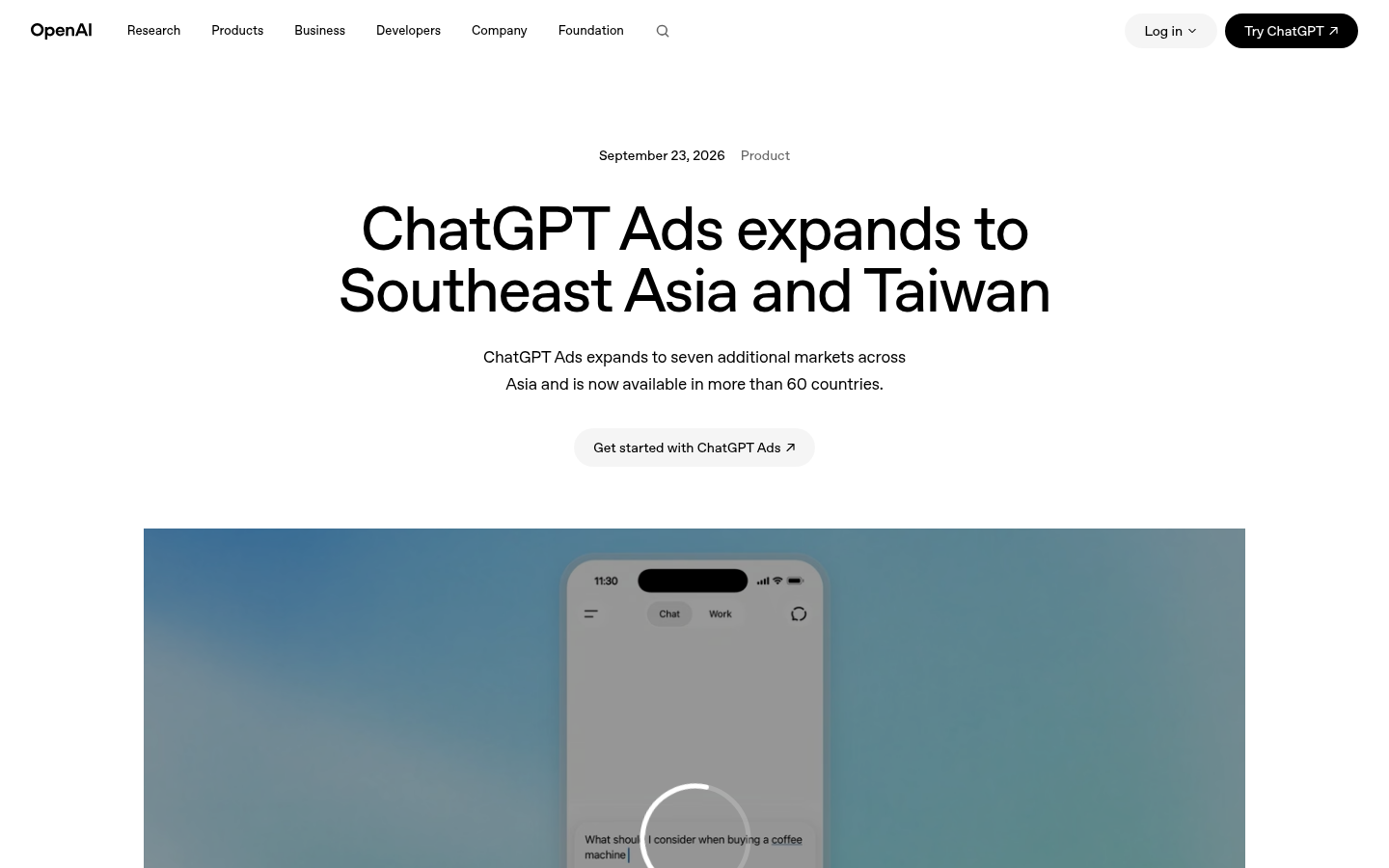
ChatGPT ads were running in more than 60 countries by September 23, 2026, according to OpenAI. The first test started in the US on February 9, so the program went from one country to more than 60 in about seven and a half months.
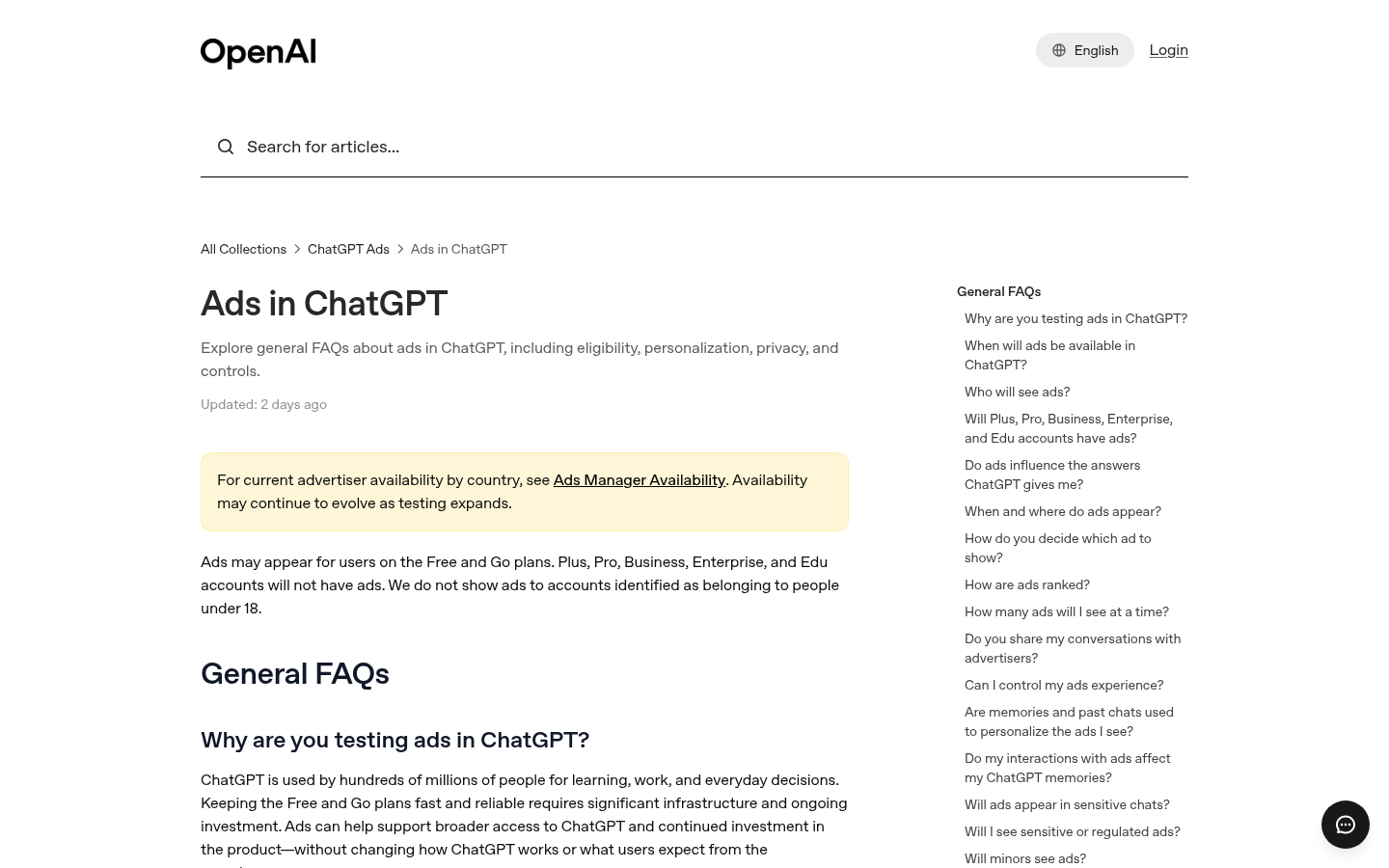
For B2B SaaS marketers, the speed matters less than one line in OpenAI's help center. People on Business, Enterprise and Edu plans never see an ad, and neither do Plus or Pro subscribers.
Our verdict: ChatGPT ads are worth a small, capped test if you sell a self-serve product to founders and small teams. If you only sell to enterprise buyers through a sales team, wait. Most of the people you need are on ad-free plans, and the targeting B2B teams usually rely on doesn't exist here yet.
This guide sticks to what OpenAI has documented: who sees the ads, what formats exist, how targeting and pricing work, and what still isn't public. Then it covers how paid placement relates to the organic answers your AEO work is trying to win.
What's live as of October 18, 2026
Everything in this table comes from OpenAI's own announcements, help center and developer docs. Where OpenAI calls something a test or an alpha, so does the table.
Item | Status | Where it's documented |
|---|---|---|
Ad unit below ChatGPT responses | Live in 60+ countries | Testing ads in ChatGPT, Sept 23 expansion post |
Self-serve buying through Ads Manager | Beta, advertiser entity must be based in one of 63 listed countries | |
Buying through OpenAI's sales team, agency or technology partners | Live | Sept 23 expansion post |
Ads API for campaigns, audiences and reporting | Live, documented for developers | |
Sponsored Agents (chat with a business's AI representative after clicking an ad) | Limited alpha with selected advertisers (tested in the US), no early-access requests | |
Visual ads shown while ChatGPT generates an image | Testing in the US with an initial group of advertisers, starting later in October | |
HubSpot integration (create ads, track performance, follow up on leads in HubSpot) | Live since September 16, 2026 |
The standard ad sits under a response and includes the advertiser name, a favicon, a headline, description copy, a landing page and an image, per Ads in ChatGPT: The Basics. Users see one ad unit at a time, which may hold one or several images.
The B2B catch: work accounts are ad-free
OpenAI's user FAQ is explicit. Ads may appear for people on the Free and Go plans. Plus, Pro, Business, Enterprise and Edu accounts don't get ads, and neither do accounts identified as belonging to someone under 18. Temporary Chats show no ads either. Ads can also appear in logged-out ChatGPT, where OpenAI limits them to ads that suit all audiences.
Think about what that means for a SaaS company selling to mid-market or enterprise teams. If a buyer's employer has rolled out ChatGPT Business or Enterprise, their research on that account is invisible to advertisers. You can only reach them when they're on a personal Free or Go account, or logged out.
Who does that leave? Founders and small teams who haven't paid for a plan, people researching on their phone after hours, freelancers and consultants, and buyers in markets where paid plans are less common. That's a real audience. It's just not the same audience as "everyone who uses ChatGPT at work."
What isn't public: OpenAI doesn't publish how many of its weekly users are on Free or Go, how that split varies by country, or how much work-related research happens on personal accounts. Anyone quoting a precise "B2B reach" figure for ChatGPT ads is estimating. For the usage numbers OpenAI and its rivals do share, see our AI assistant usage statistics.
Targeting: what you can aim at, and what you can't
According to OpenAI's targeting documentation, a campaign can be targeted by:
Country, region or market, with up to 2,500 location IDs in inclusion and exclusion lists
Platform: Ads Manager lists five options (Android app, Android web, desktop web, iOS app and iOS web), while the API groups them into iOS app, Android app and web
Custom audiences built from your own customer or prospect identifiers: email, phone, their SHA-256 hashes, or Android advertising IDs
Context hints at the ad group level, which describe the conversations, topics or keywords where your offer may be relevant
Two details matter a lot for B2B.
First, the audience minimum. A custom audience needs at least 25,000 matched users before you can use it for inclusion or bid multipliers. Exclusion audiences have no minimum. For most SaaS companies, an account-based list of target accounts won't reach 25,000 matched people, so true ABM targeting is off the table for now. Excluding current customers, on the other hand, works at any size, and you should do it from day one.
Second, context hints don't work like search keywords. OpenAI says they guide matching but "are not exact-match keywords and do not guarantee delivery in specific conversations." You describe what you sell and who it helps, and the system decides where it fits. If you're used to bidding on exact category terms in search, expect less control.
What isn't documented: targeting by job title, seniority, company, industry, company size or technology stack. None of these appear in the targeting docs. Ad personalization based on past chats and memory also isn't initially available in the EEA or Switzerland, per the user FAQ, so ads there lean on the current conversation. OpenAI's campaign guide also tells advertisers targeting the EEA or Switzerland to avoid custom audiences for now.
Pricing and buying
OpenAI documents three campaign objectives in Create Campaigns for ChatGPT Ads:
Views, billed per 1,000 impressions (CPM)
Clicks, billed per valid click (CPC)
Conversions, optimized toward a supported conversion event but still billed per click (oCPC) or per 1,000 impressions (oCPM), never per conversion
Ads are chosen through what OpenAI calls a relevance-weighted, second-price auction. You set a maximum bid at the ad group level, or let the system adjust bids under a Maximize clicks or Maximize conversions strategy. For CPC campaigns, OpenAI's own guidance is to start with a maximum bid of $3 to $5 per click.
A few rules catch new advertisers:
The minimum daily budget is $25 in US dollars, with local equivalents such as €15, £15 and ₹725. A daily budget is an average over seven days, so one day's spend can reach twice the figure.
Some new self-serve accounts can only advertise in their home country until identity verification is approved and they've spent enough there. Selecting other countries doesn't override this.
Billing is postpay. Spend accrues, and self-serve card accounts are charged when they hit a payment threshold or at the end of the month.
To target only the US, you have to include the US explicitly. Excluding other countries doesn't do it.
What isn't public: average CPCs or CPMs by category, any B2B or SaaS benchmark, the spend threshold that unlocks other countries, and pricing for Sponsored Agents. OpenAI's interest form for Sponsored Agents with HubSpot mentions eligibility criteria including "a minimum daily ad spend for 28 days," but says the amount and currency will be confirmed before onboarding.
What the reporting shows
Ads Manager reporting currently includes impressions, clicks, spend, click-through rate, average CPC, average CPM and conversions. Impressions and clicks refresh about every 15 minutes, while spend can lag by seven to eight hours.
For conversions, OpenAI offers a measurement pixel, a Conversions API, an image tag and integrations with customer data and attribution tools. Its October 5 post adds partners for conversion data, click attribution and early geo-based incrementality tests. You can also add UTM parameters to landing page URLs, and OpenAI says they persist on clicks.
What you won't get is the conversation. Advertisers receive aggregated performance data, never chats, chat history or memories. If someone messages you through an ad, you see only the messages they send you. Reports can be split by country, device, platform and product, and there's no equivalent of a search terms report showing which prompts triggered your ad. Without the prompt, you can't learn from it the way you would from search query data, so judge the channel on landing-page behavior and pipeline instead of guessing at intent.
How It Fits With Organic AEO
One of OpenAI's ads principles is "answer independence." The user FAQ says ads run on separate systems from the chat model, and that advertisers "have no ability to shape, rank, or alter ChatGPT's responses." Sponsored Agent conversations are kept separate from both ChatGPT's own answers and the user's original chat.
Take that at face value and three practical points follow.
Buying ads won't get you recommended in the answer itself. The organic answer above your ad is decided the same way it was before you spent anything.
Your ad can sit directly under an answer that recommends a competitor, or describes your product badly. If the answer is wrong about your pricing or features, fix that through the organic work, because no ad setting will.
Ads and organic visibility can reinforce each other for a buyer who sees both, but only organic presence reaches Plus, Pro, Business and Enterprise users, who never see ads.
The organic side is covered in our playbook on how to get recommended by ChatGPT, and the wider discipline in our pillar on answer engine optimization. Treat ChatGPT ads as a separate, paid line item that rents space next to an answer you still have to earn.
Where ChatGPT ads make sense for B2B SaaS, and where they don't
Based on the documented targeting, audience and ad policies, this is our read.
Worth testing if:
You sell a self-serve or product-led tool with a free trial or card signup, so a click can become a user without a sales call
Your buyers include founders, freelancers or small teams who are more likely to be on Free or Go plans
Your category gets asked about in plain language ("tool to schedule social posts for a small agency") that context hints can describe well
You can exclude existing customers and measure signups with a pixel or Conversions API
Probably not worth it yet if:
You sell only to enterprises through a sales team, since the people you need most are likely on ad-free work plans
Your go-to-market depends on reaching named accounts, given the 25,000 matched-user minimum
You're in a regulated category such as financial services or health, where OpenAI applies stricter eligibility, keeps ads away from sensitive conversations and generally doesn't allow these ads outside the US
Your product competes with OpenAI's own, since its ad policies reserve the right to decline ads that conflict with its "business interests, or competitive position"
Your main markets aren't on the availability list, or your legal entity isn't based in one of them
Early practitioner results on X are mixed and should be read as anecdotes. The CEO of a web scraping API company posted on September 29 that €3,274 of spend, launched the day ads opened to French companies, produced 39,779 clicks and, so far, no new paying customers. He suggested the reason himself: many developers who'd pay for his product may already be on paid ChatGPT plans. A founder selling a hosting control panel reported on September 30 roughly 7,000 clicks and 128 conversions from about $1,200, at a $0.18 CPC. Both are self-reported by people promoting their own products, with no audit of what counted as a conversion. The gap between them is the useful part: cheap clicks are easy, and paying customers depend on the offer.
Running paid and organic side by side without double-counting
You don't need a new attribution model for this. You need clean labels.
Tag every ad landing URL with UTM parameters and a paid medium, so ad clicks don't mix with organic referrals from ChatGPT in your analytics.
Keep a separate line in your reporting for organic AI visibility (citations and mentions from a fixed prompt set) and paid ChatGPT results (spend, clicks, conversions). Don't add them together as "ChatGPT performance."
When both lines move in the same month, say so in the report instead of crediting either one.
For the organic measurement method, see how to measure AI search visibility. For tying either channel to revenue, our guide to B2B SEO attribution goes deeper than this post should.
A 30-day test plan
If the fit checklist above points to yes, here's a contained way to find out.
Week 1: confirm your entity's country is on the availability list and that your product fits a supported ad category, set up the pixel or Conversions API, upload an exclusion audience of current customers, and pick one product line with a clear signup action.
Week 1: write three to five context hints that describe specific use cases and buyer situations, not generic category words. Pair them with a landing page built for one use case, ideally a comparison or use-case page rather than your homepage. Our guide to SaaS comparison pages covers how to build those.
Weeks 2 and 3: run a Clicks campaign at OpenAI's suggested $3 to $5 starting bid, or a Conversions campaign if your event volume supports it. Keep the budget fixed so you aren't reading noise.
Week 4: compare cost per signup and signup-to-activation rate with your paid search benchmarks, and check whether the organic answers for the same use cases changed at all. They shouldn't have, and that's the point of checking.
Set your stop rule before you start. For example: if cost per activated trial is more than twice your paid search figure after the full budget, pause and revisit in a quarter, when OpenAI may have added formats or targeting.
What OpenAI hasn't made public
To keep expectations honest, here's what the official documentation doesn't tell you as of October 18, 2026:
How many users are on ad-supported plans, overall or by country
Average CPC or CPM, or any benchmark by industry
Job title, company, industry or firmographic targeting, which isn't documented at all
Which prompts or topics triggered an ad
Sponsored Agents pricing, minimum spend or wider availability dates
When the visual ad format expands beyond the initial US test
Whether B2B software is a supported category. The ad policies say that during the initial test, ads are primarily limited to consumer verticals, including "digital products or education," and B2B software isn't named
OpenAI's help articles are updated often, some within the last few days. Recheck the availability list and pricing pages before you commit a budget.