
Last updated: October 31, 2026
About one in five of Google's top 20 results for common how-to searches now shows signs of AI writing. A company that sells AI detection software ran its detector over 1,777 of those results in July 2026, drawn from a fixed panel of 500 informational queries, and flagged 384 of them (21.6%) as more likely than not to be at least 5% AI-generated. It published the monthly tracker report on October 1, 2026.
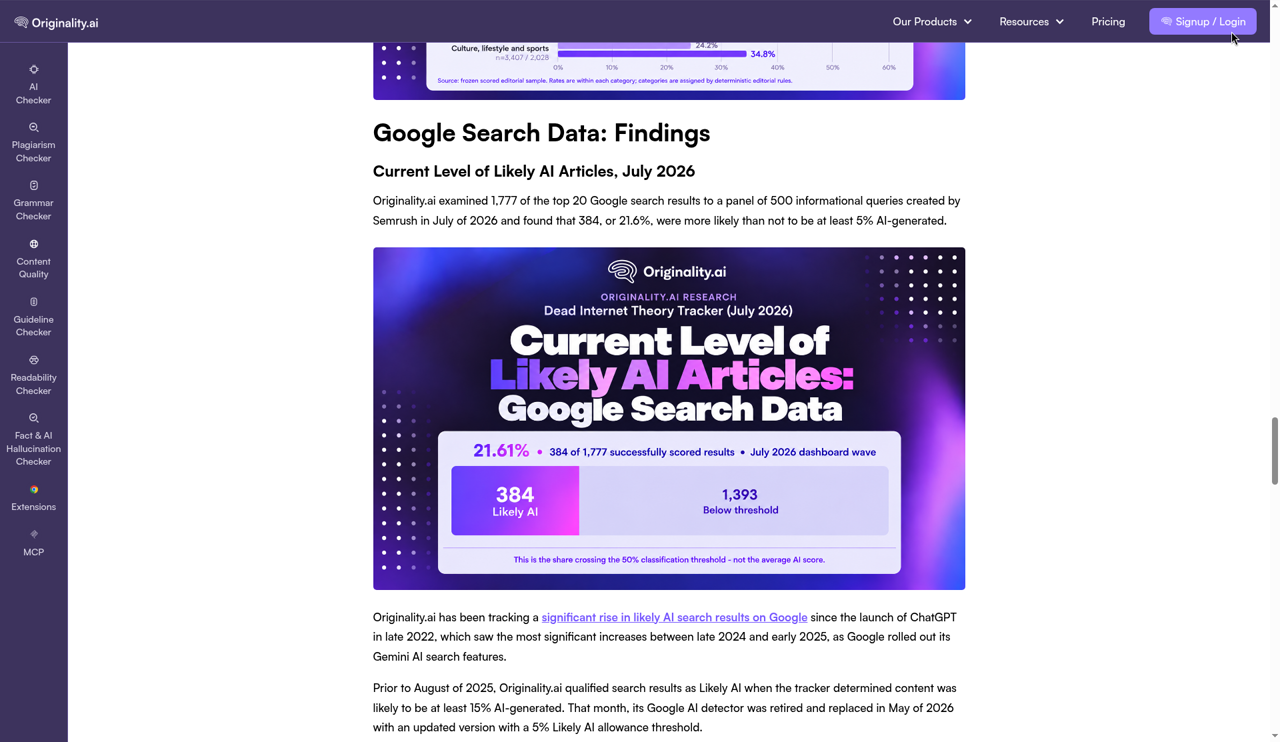
Originality.ai July tracker: 21.6% of sampled top results flagged.
No, Google doesn't penalize a page because a model helped write it. Its spam policies target pages produced at scale, mainly to rank, with little value for readers, and they apply to those pages whether a person or a model wrote them. For a B2B blog, the risk comes from publishing more than your experts can check, with nothing in each post that only your company knows. When one in five top results shows some AI involvement, a blanket penalty on AI text is hard to believe.
How much AI-assisted content already ranks
The figure above comes from Originality.ai's Dead Internet Tracker report for July 2026, published October 1, 2026. Originality.ai sells AI detection software, so it has a stake in how much AI content people think is out there. Read its numbers with three limits in mind:
The threshold moved. Before August 2025 the tracker counted a search result as likely AI at 15% AI-generated or more. It retired that detector in August 2025 and switched to a new one with a 5% threshold in May 2026, so the July figure isn't directly comparable with older months.
The queries aren't yours. The panel is 500 common informational queries, mostly how-to searches, built by an SEO software company. B2B software searches may look different.
Detectors make mistakes. A flag means the tool judged it more likely than not that at least 5% of the page was machine-written. That says nothing about whether a person edited, fact-checked or added to it.
Whether any one of those pages keeps ranking depends on the policies below.
What Google's current documentation says
Google's guidance on using generative AI content, last updated October 1, 2026, opens on a positive note. It says generative AI "can be particularly useful when researching a topic, and to add structure to original content." The next sentence sets the limit: using these tools "to generate many pages without adding value for users may violate Google's spam policy on scaled content abuse."
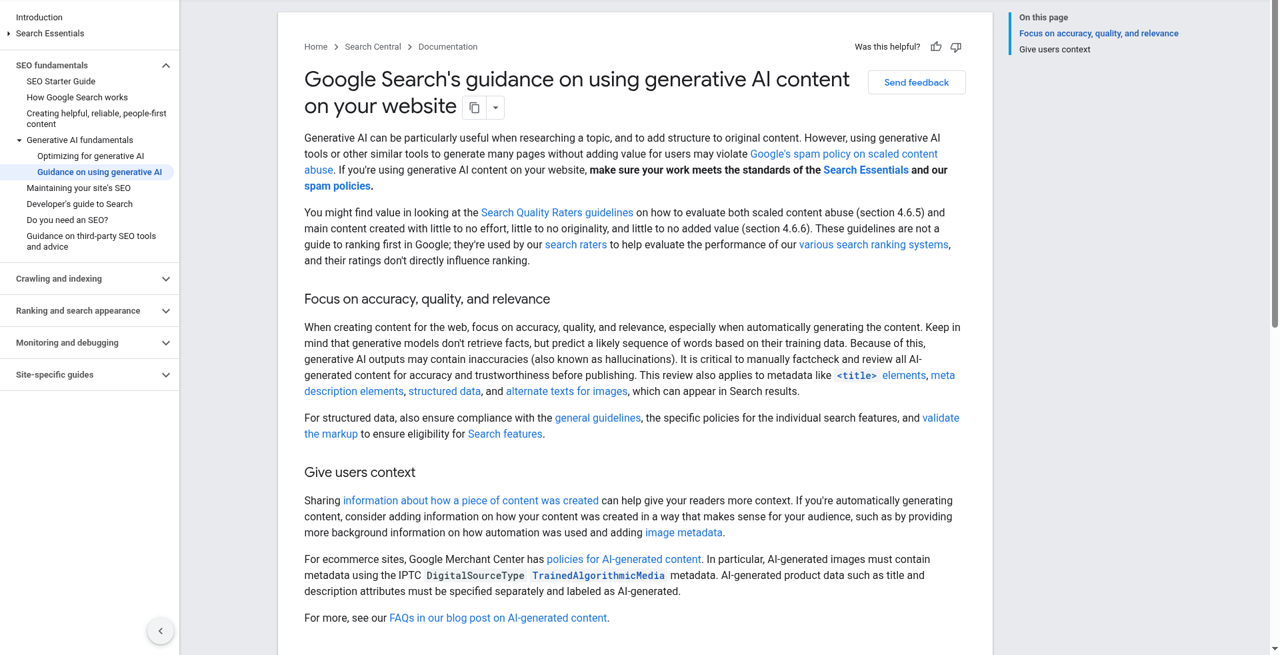
Google's guidance on using generative AI content in Search.
Under Google's spam policies (last updated August 28, 2026), scaled content abuse means many pages generated mainly to manipulate rankings, typically unoriginal content that provides little to no value, "no matter how it's created." Freelancers who type out a thousand thin pages break that rule just as much as a model that generates them.
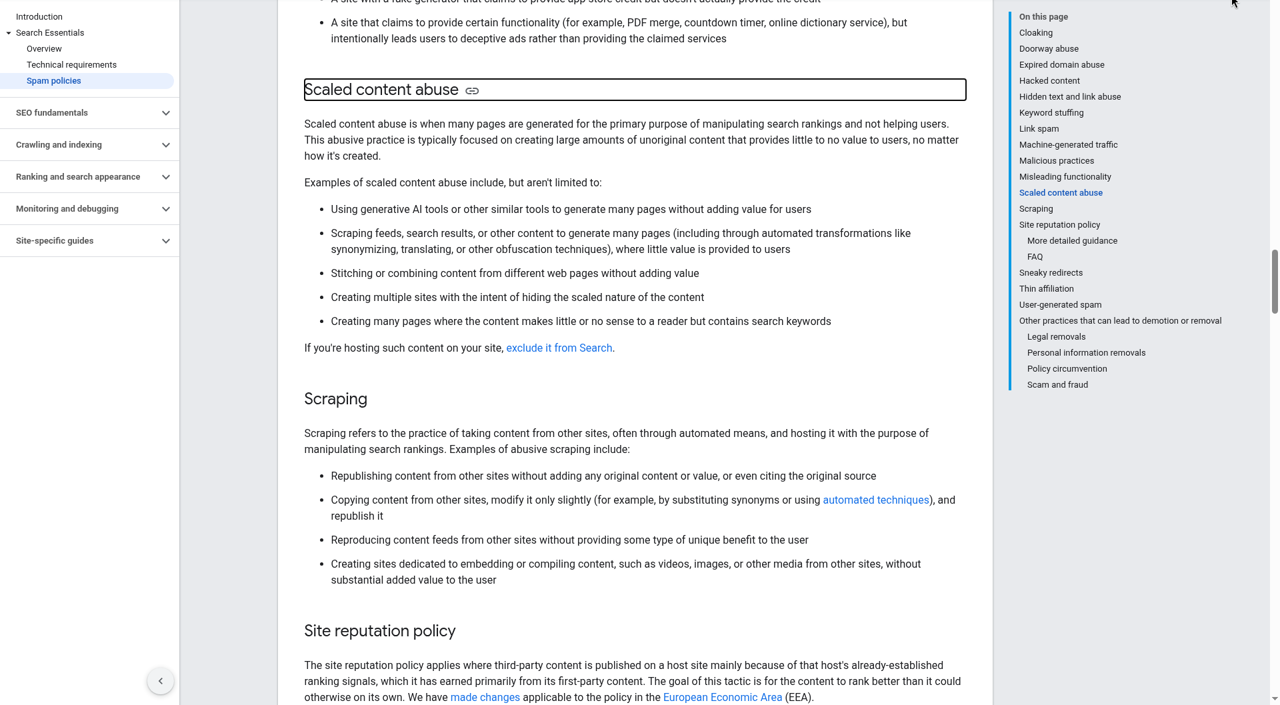
Google spam policies: the scaled content abuse section.
Google's guide to helpful, people-first content, last updated October 5, 2026, puts the line in terms of purpose. Using automation, including AI, to produce content mainly to manipulate rankings is a spam violation. Using it to help people isn't singled out at all.
For a marketing team, that turns the usual worry around. Whether Google can spot the AI matters less than whether the page would deserve to rank if a person had written it.
Scaled content abuse in plain English
The scaled content abuse policy gives examples. On a software company's blog, they tend to look like this:
Dozens of posts generated from a keyword list, each restating what already ranks and adding nothing from your product, customers or team.
Competitors' articles run through a paraphraser or synonym swapper and published as new.
Paragraphs stitched together from several pages, with no analysis of your own.
Several sites created to hide how much of this content there is.
Pages that make little sense to a reader but carry the target keywords.
The policy sets no word count and bans no tool. Ten AI-drafted posts that each include a customer example, a screenshot of your own product and a real opinion aren't what it describes. Ten human-written posts that summarize the top three results could be.
Template-driven pages, such as integration directories and grids that pair a tool name with an industry, carry their own version of this risk. The guide to programmatic SEO for B2B SaaS covers those.
The site reputation policy and third-party content
The second policy B2B teams run into is about whose content sits on your domain. Google now calls it the site reputation policy. It applies when third-party content is published on a host site mainly because of the ranking signals that host has already earned.
Google's definition of third-party content is broad. It names users of the site, freelancers, white-label services and people not employed directly by the host. Outsourced writing isn't a problem in itself, and the policy says so: having third-party content is only inconsistent with it when the content is there mainly to borrow the host's ranking signals. Google's own examples of trouble include sponsored payday-loan reviews on an educational site and a low-quality "best casinos" page on a medical site. On a software blog, the closer match is a partner or affiliate section on an unrelated topic that your team never edits, and AI makes that kind of section cheap to fill.
When Google reviews a section by hand, it looks at how far the host controls it: whether design and formatting match the main site, whether quality drops compared with the rest of the domain, whether someone clearly owns the content, and whether the same text appears on other sites. The outcome depends on where the searcher is. Outside the European Economic Area, the pages can get a manual action. Inside it, they may be treated as separate from the main domain and ranked on their own.
The same section of the policy notes that Google generally presumes individual pages, including new ones, match the overall quality of the rest of the domain. Weak AI posts published in bulk can reflect on the pages around them, not only on themselves.
What Google's quality guidance looks for
The helpful content guide suggests judging each page by "Who, How, and Why":
Who: is it obvious who wrote the page, and does the byline lead to real information about that person?
How: if automation substantially produced the page, can readers tell, through a disclosure or some other way?
Why: was the page made mainly to help people, or mainly to attract search visits?
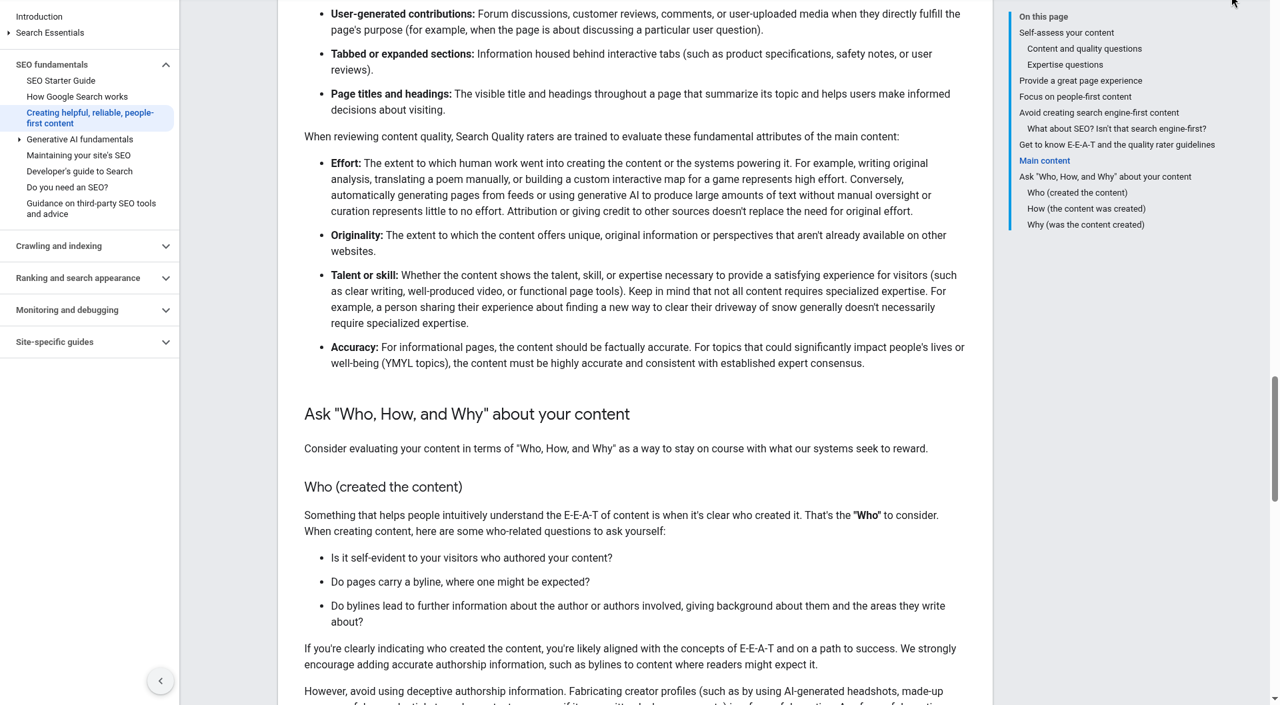
Google's helpful content guide: the Who, How, and Why questions.
The same guide calls fabricated creator profiles a form of deception and gives AI-generated headshots, made-up names and false credentials as examples. Inventing an expert is a common shortcut on AI-heavy blogs, and it turns a quality problem into a trust problem.
The guide also describes how Google's quality raters judge effort. Writing original analysis counts as high effort. The guide gives "using generative AI to produce large amounts of text without manual oversight or curation" as an example of little to no effort, and adds that crediting other sources "doesn't replace the need for original effort." The AI guidance points to two sections of the rater guidelines for more detail: 4.6.5 on scaled content abuse and 4.6.6 on main content created with little to no effort, originality or added value.
Raters don't set rankings. Google says their ratings don't directly influence ranking and are used to check whether its systems work. They're still the plainest description of what those systems are meant to reward.
Where your blog stands, and what to do next
Most B2B blogs aren't spam operations. Trouble usually builds slowly, as the content calendar grows faster than the team's knowledge. Find the situation closest to yours.
You publish a few AI-assisted posts a month, each reviewed by an expert
You're inside the policies as written. Keep doing three things: start every brief from something only your company has, have the person who knows the subject check every claim, and put a real name on the byline. Google's AI guidance asks for manual fact checks of AI output, including titles, meta descriptions, structured data and image alt text, because models predict likely words and don't retrieve facts.
Your output doubled this year and expert input didn't
This is the most common way B2B blogs drift toward scaled content.
Run the numbers for a team that goes from 8 posts a month to 16 while one product manager still reviews everything. The gap between the June 24 and August 18 spam updates on Google's dashboard was about eight weeks. Over a stretch like that the reviewer now faces 32 posts instead of 16. At two hours of careful review per post, that's 64 hours, roughly a full day every week on top of a product job. Something has to give, and review is the easiest step to skip. Here's what that looks like on the page:
Posts that once started from a sales call or a product manager now start from a keyword.
Most posts could run on a competitor's blog with the logo swapped.
Claims about integrations, pricing models or compliance go live without a check from the people who know.
Bylines name people who didn't write or review the post, or people who don't exist.
Old posts get "refreshed" by regenerating them, so the date changes and little else does. Google's helpful content guide names changing dates without substantial changes as a warning sign.
If two or more fit, slow down to the pace your reviewers can handle. The workflow below helps.
You host partner, affiliate or guest content
Review it against the site reputation policy. Content your team edits, brands consistently and puts a responsible name on is in line with Google's examples. A section that exists to rank on your domain's strength, with little input from you, isn't.
You write about finance, health or security software
The accuracy bar is higher on topics that affect money or health. The guide to E-E-A-T and YMYL for fintech covers how that applies to financial software.
A safer AI-assisted workflow
This workflow uses AI for research, outlines, first drafts and metadata, and keeps people responsible for experience, accuracy and sign-off.
Start with input only your company has: a customer quote, a pattern in support tickets, product data or a sales objection. A brief with none of these probably doesn't need to become a post.
Use AI to research and outline. Ask it what the current top results cover, then decide what your page adds that they don't.
Draft with AI if you like, then rewrite the parts that carry a view. The recommendation, the examples and the "who this isn't for" lines should sound like your team.
Fact-check every claim by hand, including the metadata.
Name a real author or reviewer. Add a byline where readers would expect one, link it to a real profile, and never invent a person.
Disclose automation where a reader might wonder "How was this created?", which is the test Google's helpful content guide uses. A short note on a data page or a tool-generated table is usually enough.
Publish only as fast as your reviewers can read. Volume your experts never read is volume nobody vouched for.
The same steps apply when an outside writer or an SEO content agency drafts the posts. Steps 1, 4 and 5 still need someone on your team.
How to tell if a drop is spam-related
Enforcement comes in two forms, and they look different.
A manual action comes from a human reviewer at Google. Google's help page for the Manual actions report in Search Console (checked October 2026) says the report shows a count of manual actions at the top, and a green check mark when there are none. Once you've fixed every listed issue, you request a review from the same report and describe your fixes.
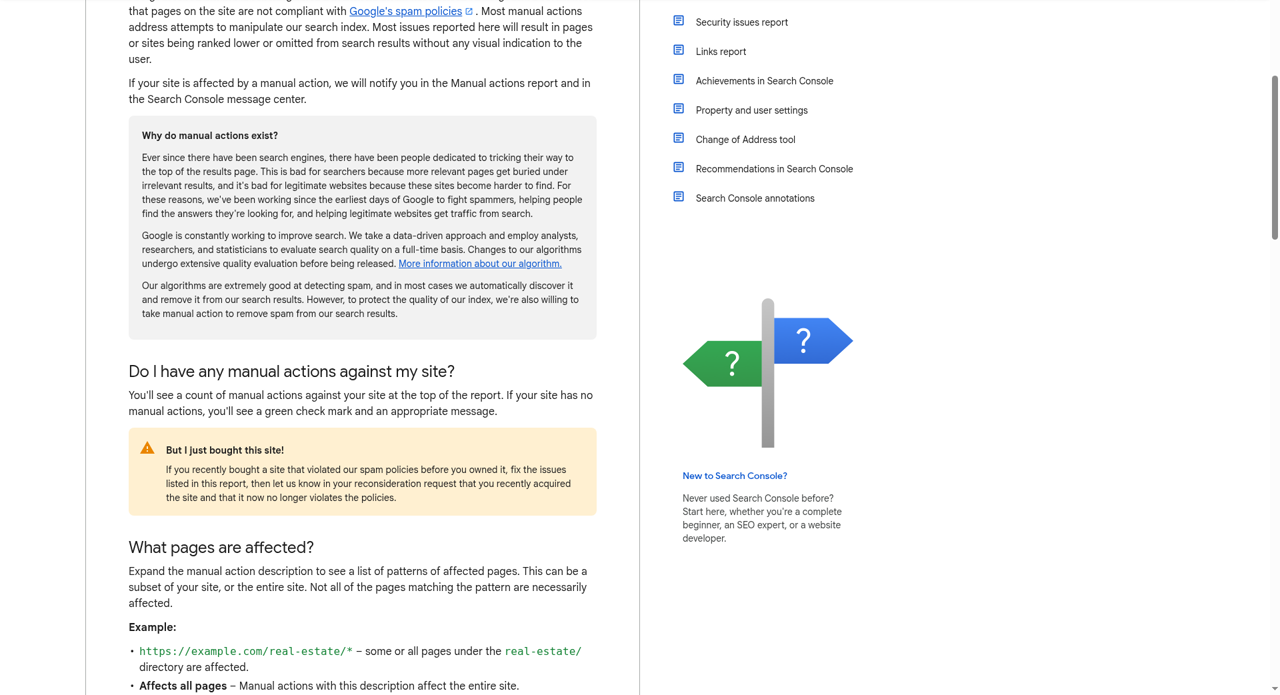
Search Console help: what the Manual actions report shows.
Algorithmic demotion has no notice. Google's page on spam updates, last updated December 10, 2025, says its automated spam detection runs all the time, and that it announces a spam update when it makes a notable improvement to systems such as SpamBrain. Google's Search Status Dashboard lists four spam updates in 2026 so far: March 24, June 24, August 18, and September 24, the last of which ran for about two weeks, into October 8. Nothing newer was listed on October 29, 2026.
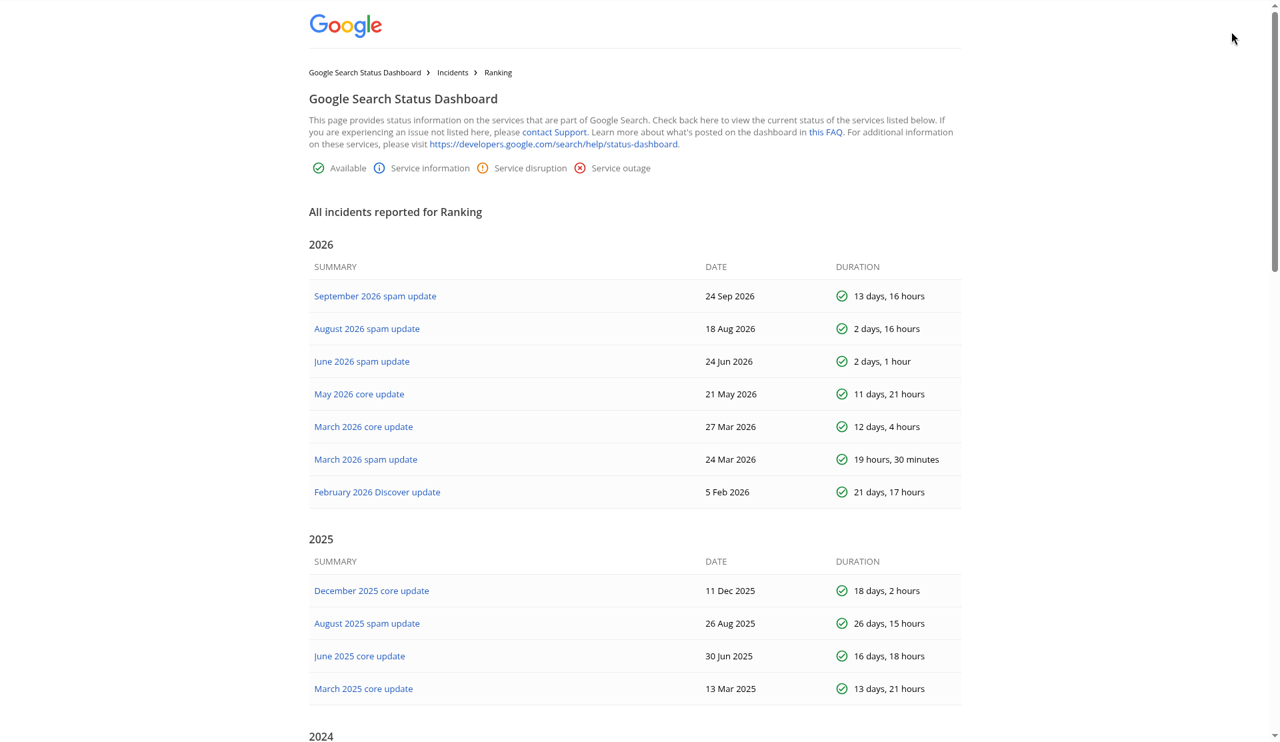
Search Status Dashboard listing Google's 2026 spam updates.
Signs that point to Google's spam systems:
The drop lines up with a spam update on the dashboard, with no core update running at the same time.
Losses cluster in a section you scaled quickly, while older, expert-led pages hold steady.
Many recent AI-assisted pages sit in the Page indexing report as crawled but not indexed.
Impressions fall across a whole directory, not only on a few queries.
No single sign proves a spam problem. Two or three together are reason enough to audit that section before you publish more.
How to recover if a section grew too fast
Inventory the section. List every post with its traffic, links and whether it carries anything original.
Keep and improve the pages that have real input. Add the example, the data or the reviewer they were missing.
Merge near-duplicates into one stronger page and redirect the rest.
Remove or noindex pages that add nothing original. The scaled content abuse policy says to exclude such content from Search if you host it.
For a manual action, fix the whole pattern before you request a review, and explain what changed.
Plan for months. Changes may help only once Google's automated systems learn "over a period of months" that the site complies, per the spam updates page.
FAQ
Does Google penalize AI-generated content?
Not for being AI-generated. The spam policies target scaled, low-value content "no matter how it's created."
Can Google detect AI content?
Google hasn't said it ranks pages by detecting AI. Its policies and quality guidance describe outcomes instead: many pages with little value, no original effort, deceptive authorship. Those apply to human-written pages too.
Should B2B blogs label AI-assisted posts?
Where a reader might reasonably wonder how a page was made, yes. Google's helpful content guide recommends a disclosure in that case, alongside an accurate byline from a real person.
Is it safe to use AI for content refreshes?
Yes, if the refresh adds something: new data, a changed recommendation, a fixed error. Regenerating a post to change its date adds nothing, and Google lists date changes without substantial updates as a warning sign.
Final thoughts
Each policy above comes back to the same test: does the post carry something only your company knows, with a real person standing behind it? A B2B blog that passes it can use AI to move faster. When the review queue can't keep up, the fix is to publish less until it can.
For how organic search fits a software company's wider growth plan, start with the B2B SaaS SEO guide.