
Last updated: October 28, 2026
Copilot is spreading through offices quickly. On the company's own July 29, 2026 earnings call, it reported that enterprise customers deploying Copilot to most of their information workers grew nearly 75% in one quarter. That's a usage number, not a citation count, for the April to June 2026 quarter across the company's global customer base. Some of those workers are the people who research and shortlist software for their companies.
My verdict: getting cited in Copilot is mostly a Bing problem, and the company is unusually open about how that problem works. Copilot looks things up through Bing, and a page Bing hasn't indexed can't be a source. The work is simple to describe: get indexed fast, then read Bing's AI Performance report to see which pages Copilot already cites. Then rewrite those pages around the phrases the report shows.
One honest caveat on that opening figure. The company is reporting its own number on an investor call, it isn't audited, and the starting base wasn't given. It tells you Copilot is reaching more of the workforce. It says nothing about how often Copilot cites any particular website.
This post covers Copilot and Bing only. For the broader picture of answer engines, see the AEO pillar guide and the explainer on generative engine optimization.
How Copilot grounds answers in the Bing index
Microsoft's web search documentation for Copilot, last updated August 18, 2026, spells out the mechanics. When web search is on, Copilot reads the user's prompt and picks out terms where web information would help. It then writes a short search query and sends that query to the Bing search service.
That generated query is not the user's prompt. Microsoft describes it as "a few words informed by the user's prompt". The full prompt isn't sent unless it's very short, and neither are the user's files or emails. Copilot then composes its answer from what Bing returns.
Three things follow from that design:
Your page competes on a short, rewritten query, not on the buyer's long question. Clear, literal headings that match how people phrase a need matter more than clever copy.
If Bing hasn't crawled and indexed a page, Copilot can't find it. There's no separate Copilot index to submit to.
If you block Bingbot in robots.txt, you're blocking Copilot citations too. Bing's AI Performance announcement says Bing respects all content owner preferences expressed through robots.txt.
Microsoft has also written about how grounding changes what an index must do. In a May 6, 2026 post, Bing describes the unit of value moving from pages to "groundable information", meaning discrete, supportable facts with clear provenance. The post also says a grounding system may abstain when evidence is missing, stale or conflicting. For a site owner, that means stating facts plainly, keeping them current and making sure your pages don't contradict each other.
Setup: get Bing to index you, then keep it current
If you haven't touched Bing Webmaster Tools in years, this takes an afternoon.
Verify your site. Bing's add and verify help page lists the options. The fastest route is importing your verified properties from Google Search Console, and imported sites are verified automatically. Otherwise use an XML file, a meta tag, a DNS CNAME record or Domain Connect.
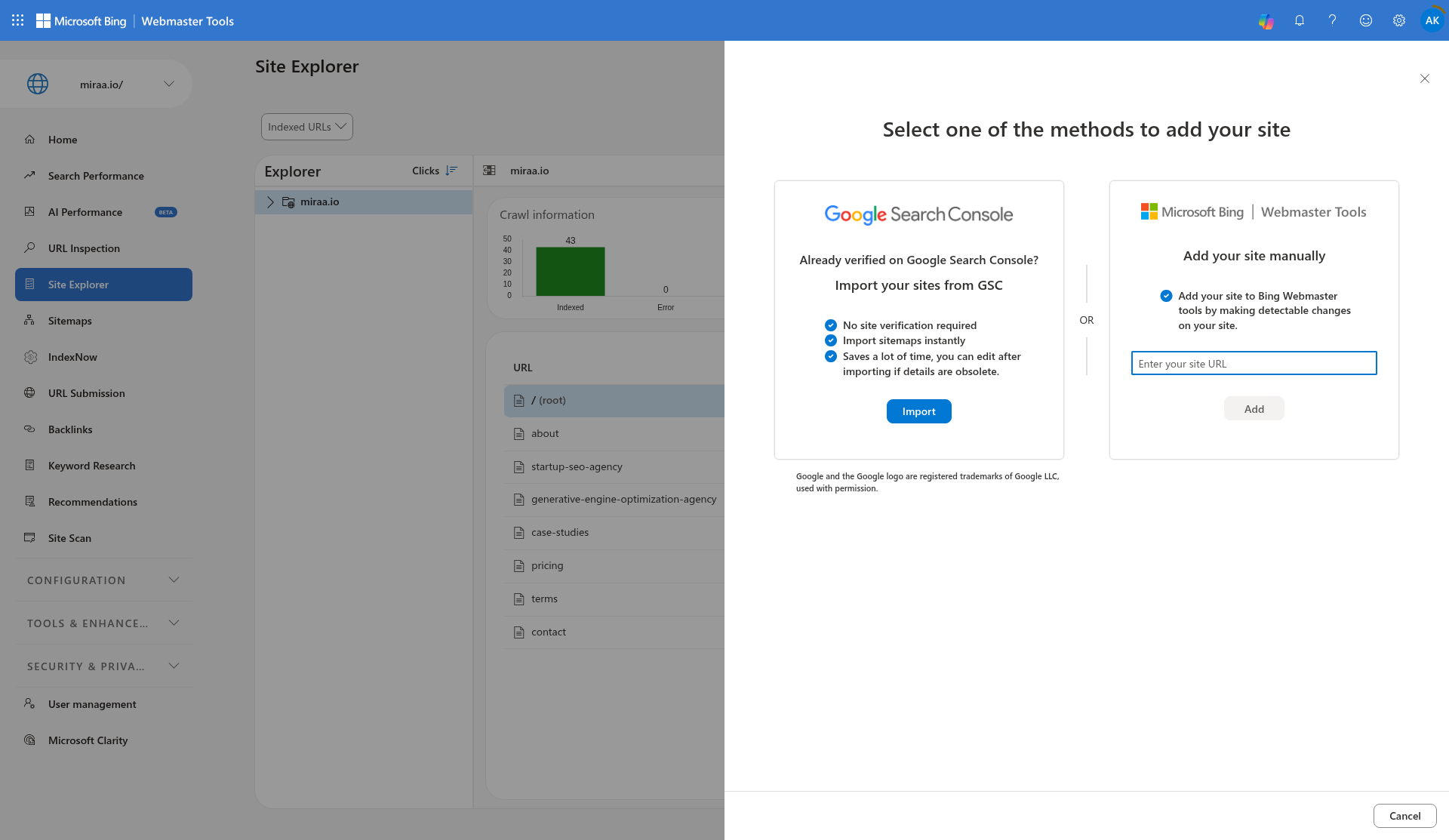
Bing Webmaster Tools add-site screen for miraa.io, with the option to import from Google Search Console.
Submit your sitemaps. Add the same XML sitemaps you give Google, following Bing's sitemaps guidance. Check the crawl and index coverage reports a few days later, because pages that are excluded there can't be cited.
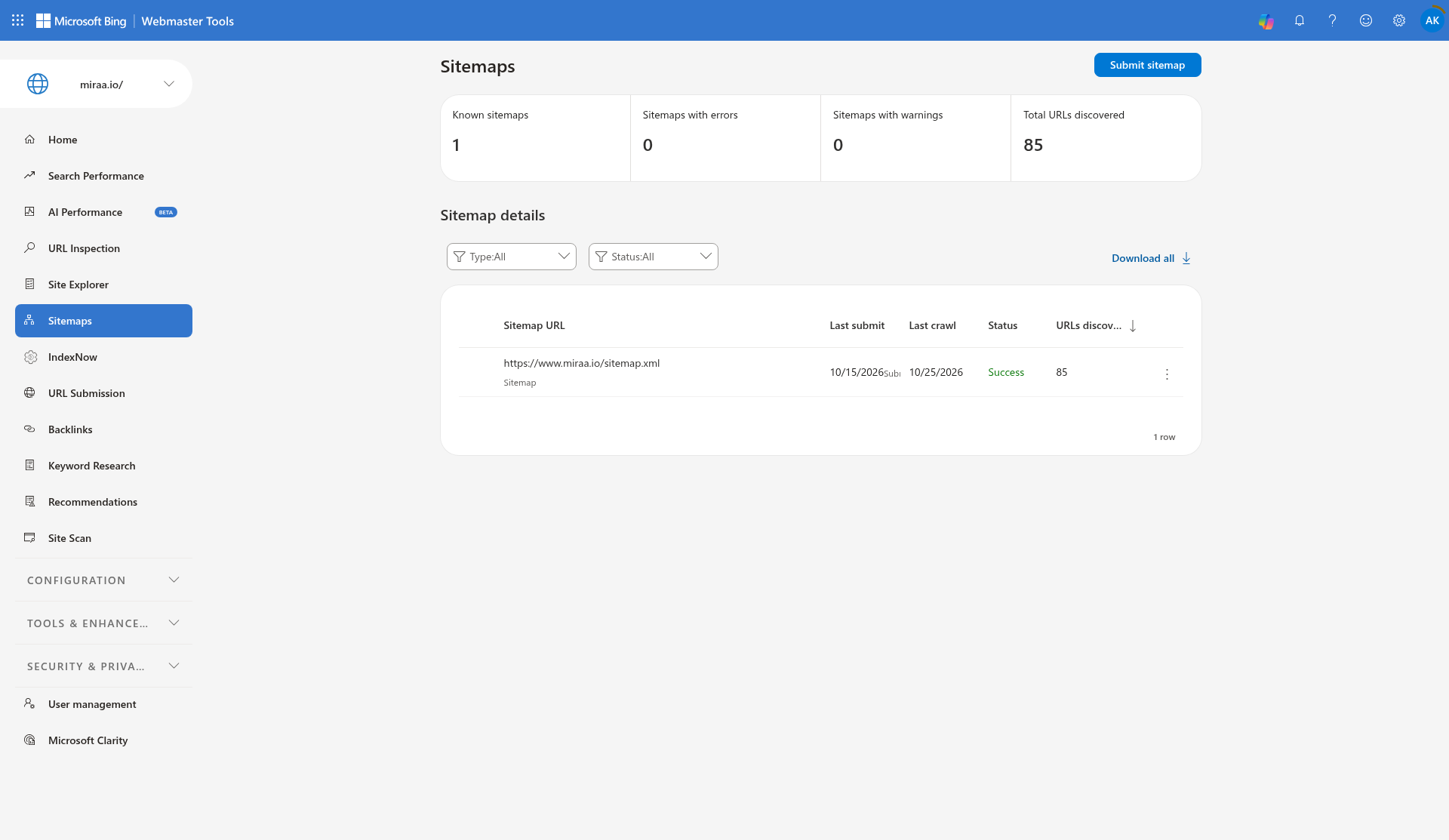
Bing Webmaster Tools sitemaps report for miraa.io.
Turn on IndexNow. IndexNow is a protocol for telling participating search engines when a URL is added, updated or deleted. You host a key file on your domain, then ping an endpoint with the changed URL. A single POST can carry up to 10,000 URLs. A 200 response only means the engine received the URL, not that it indexed it. Many CMS platforms and CDNs offer IndexNow as a setting, so check before you build anything.
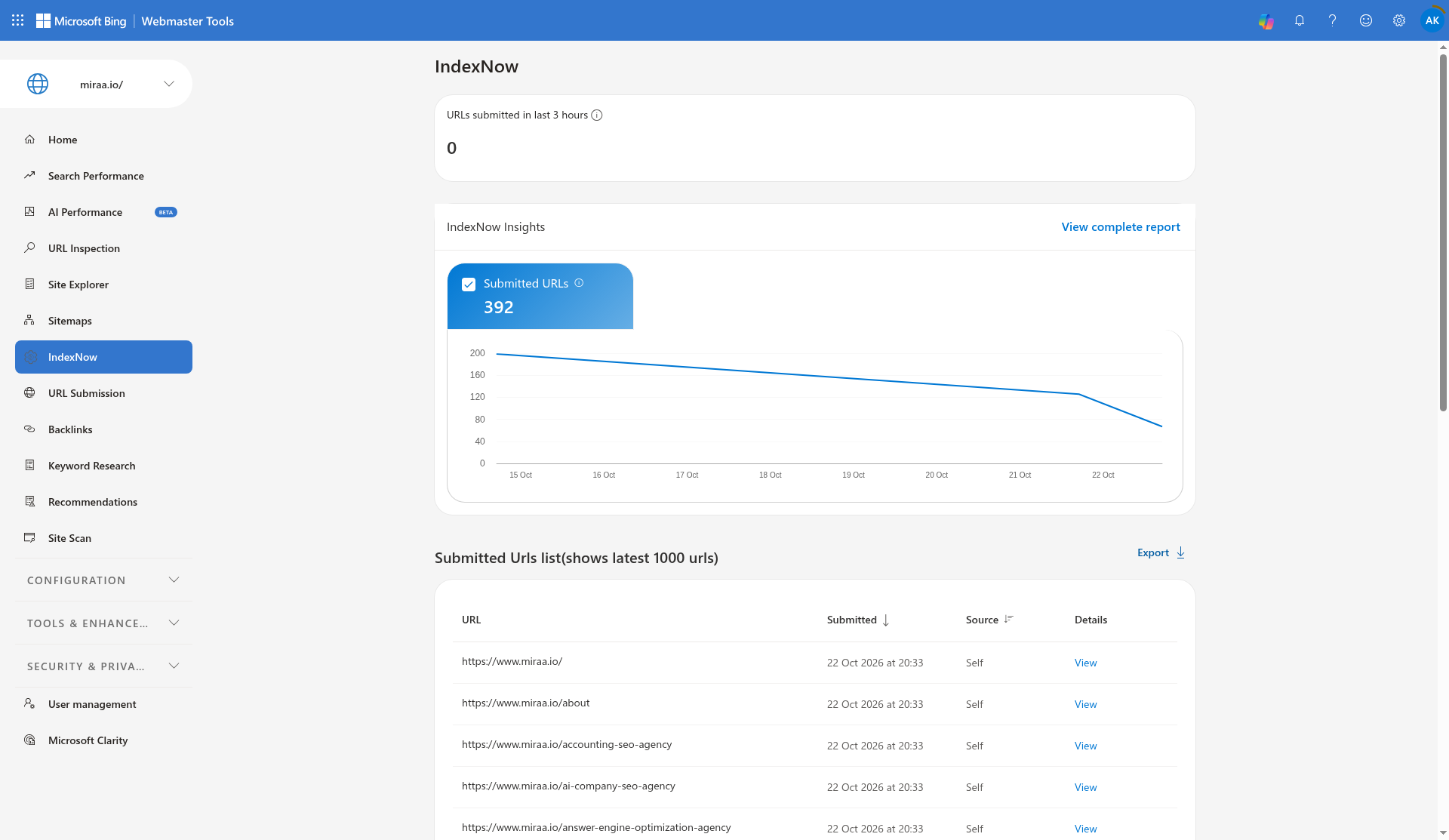
Bing Webmaster Tools IndexNow report for miraa.io, listing submitted URLs.
Prioritise the pages that hold facts buyers ask about. That means pricing, plan limits, integrations, security and compliance, and comparison pages. When one of those changes, it should reach Bing the same day.
Finally, check your robots.txt for rules that block Bingbot, often left over from an old crawl-budget fix. If you're reviewing AI bot rules more broadly, a separate guide to AI crawlers covers that.
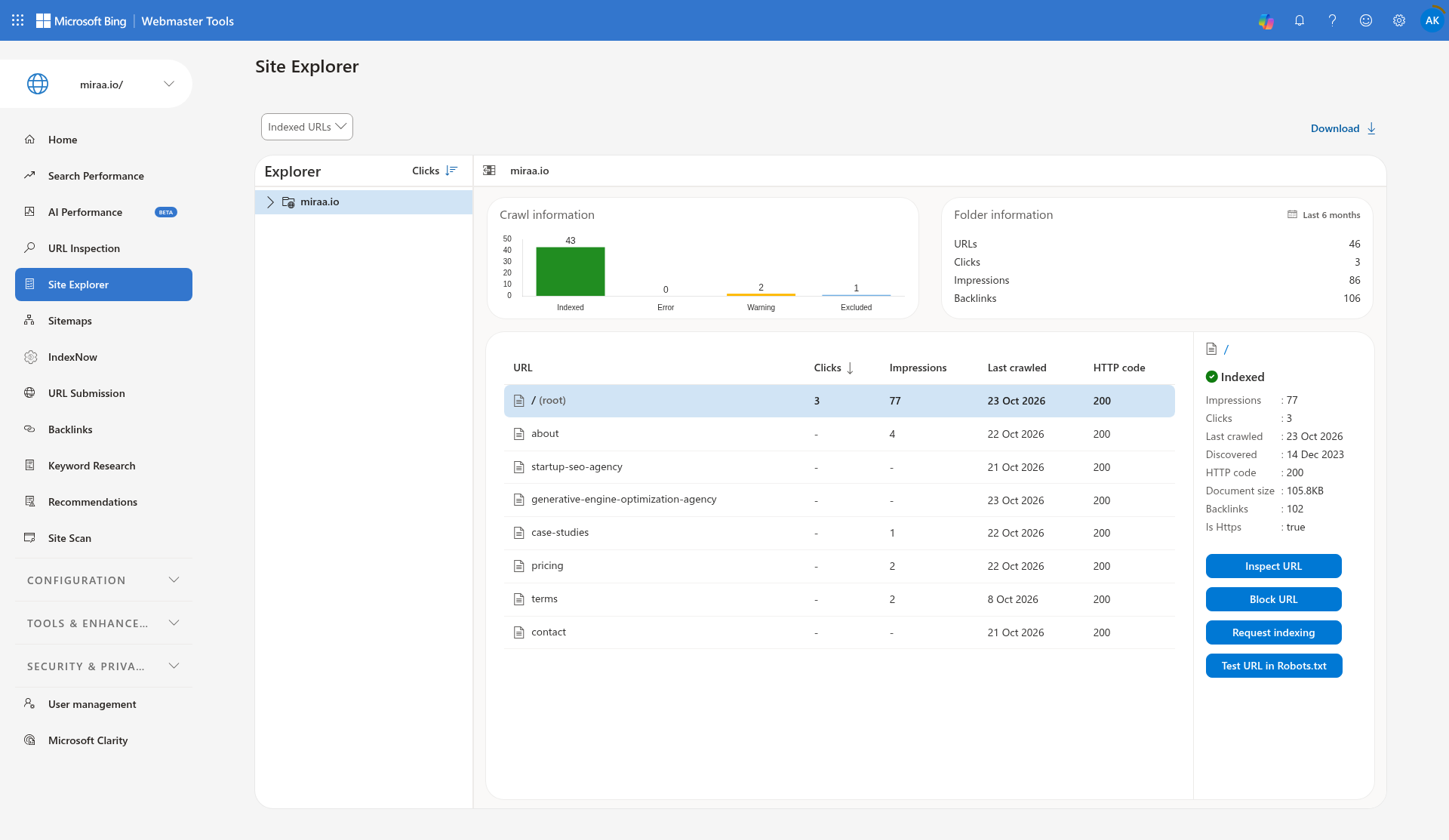
Bing Webmaster Tools Site Explorer index coverage for miraa.io.
Reading the AI Performance report
Microsoft launched AI Performance in Bing Webmaster Tools as a public preview on February 10, 2026. It covers citations across Copilot, AI-generated summaries in Bing and "select partner integrations". The core metrics are:
Total citations: how many times your pages were shown as sources in AI answers over the period you choose.
Average cited pages: the average number of unique pages from your site cited per day.
Grounding queries: the key phrases the AI used when retrieving your content. Microsoft says this list is a sample.
Page-level citation activity: which URLs were cited, and how often.
Trends over time, so you can see whether a change moved anything.
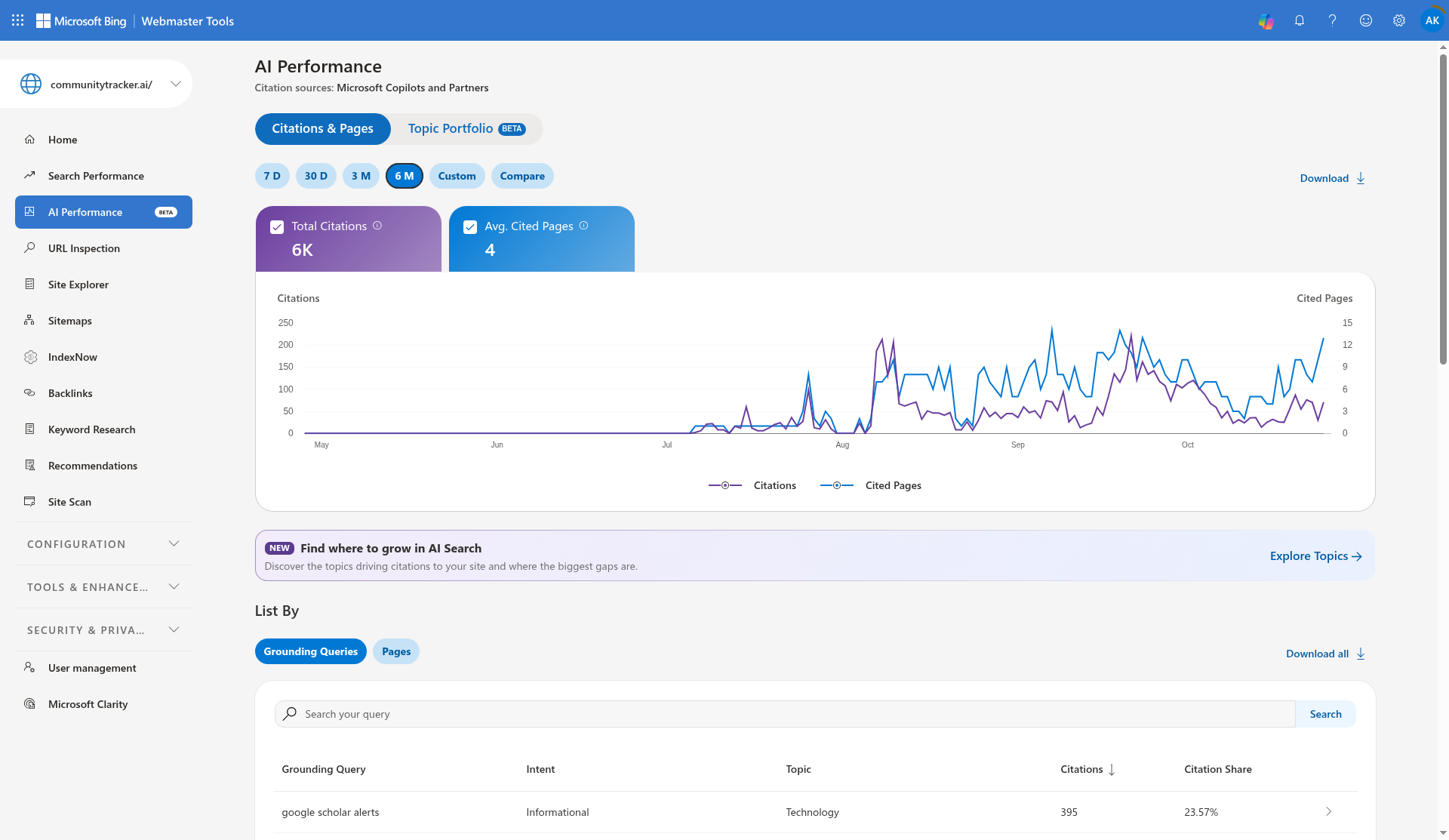
Bing Webmaster Tools AI Performance report for Communitytracker.ai, a Miraa client.
The AI Performance help page adds two limits worth reading twice. The report "does not measure rankings, authority, performance, or importance." Grounding queries are grouped phrases, "not individual user questions or specific answers". You will never see a buyer's exact prompt here.
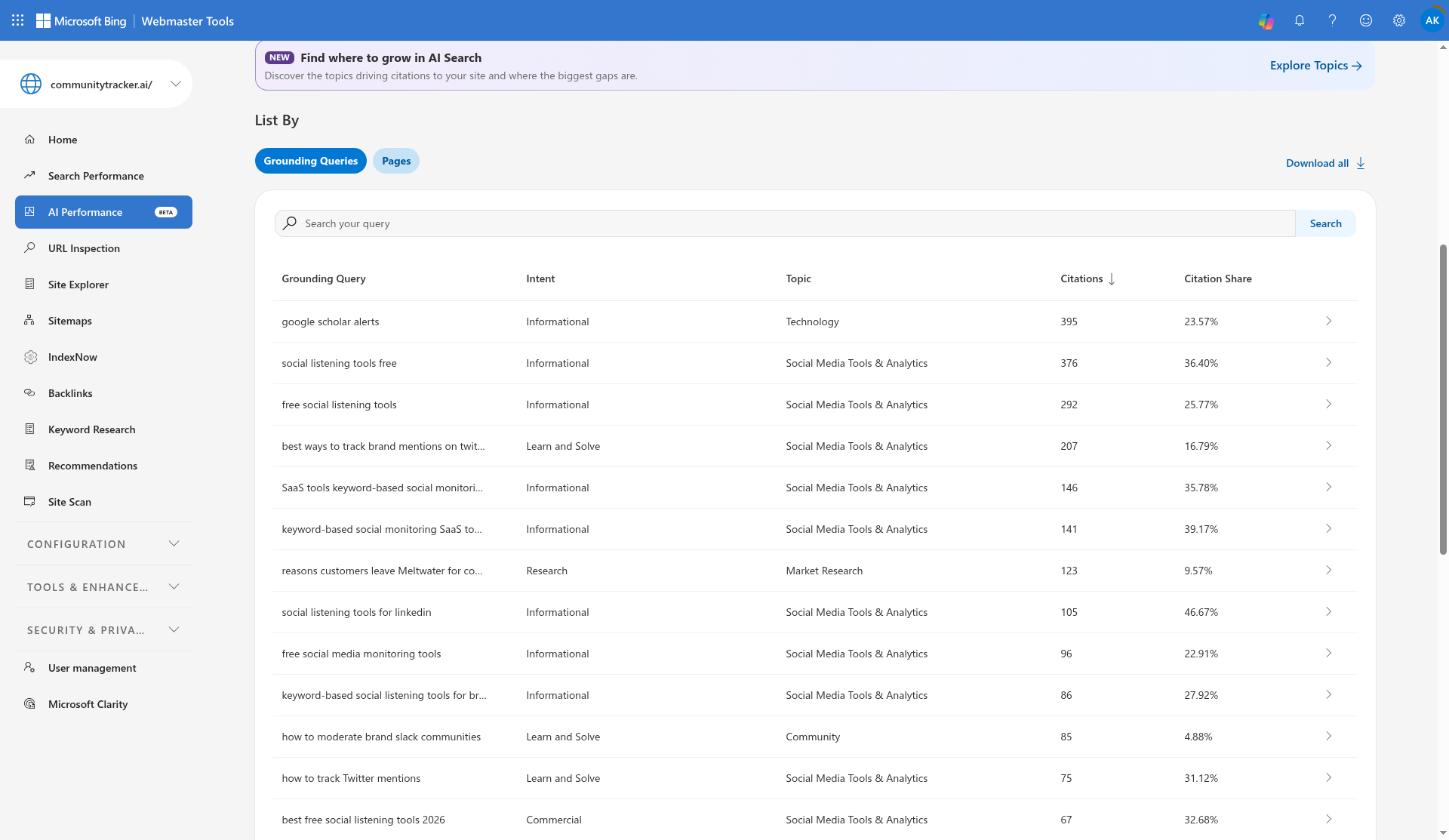
Top grounding queries in Bing Webmaster Tools AI Performance report for Communitytracker.ai, a Miraa client.
Bing has kept adding to it. A June 16, 2026 update brought four more views:
Intents, which sort grounding queries into types such as Informational, Commercial, Research, and Learn and Solve.
Topics, which group related queries.
Citation Share, which shows what percentage of citations for a grounding query went to you. Microsoft notes it doesn't expose competitor domains or represent traffic share.
Compare, which overlays a previous period.
On October 13, 2026, Bing added a Topics Portfolio tab in beta. It shows each topic's size, the number of sites cited for it and its queries, plus Top Opportunity Queries shown as ranges, over one, two or three months. Microsoft's own caveats: classification can be imperfect, small sites may not see the tab, and branded queries can show up as opportunities. Its advice is to treat the numbers as directional signals.
What the report doesn't give you is clicks. A citation is not a visit, and nothing here tells you whether a cited page sent anyone to your site. Keep that in mind before you report citation counts upward as if they were traffic.
If you want to compare Copilot against other engines, that's a separate job. The guide to measuring AI search visibility covers it. This post stays inside Bing's report.
Turning grounding queries into page fixes
The grounding query list is the most useful thing in the report, because it shows grouped versions of the phrases the AI used when it retrieved your pages. Run the routine below once a month.
Export the grounding queries for your top cited pages and for pages you expected to see but didn't. Group them by intent. Commercial and research phrases matter most for a SaaS company.
For each important phrase, open the page Copilot cited, or the page you wish it had cited, and check four things.
Headings. Does a heading on the page say, in plain words, what the grounding phrase is asking? If Copilot searched "SOC 2 automation pricing per employee", a heading reading "Simple, transparent pricing" doesn't help it. Something like "SOC 2 automation pricing: per-employee plans" does.
Tables. Microsoft's own advice in the launch post names clear headings, tables and FAQ sections. Plan comparisons, integration lists and limits read far better in a table than buried in prose. The guide to comparison pages shows how to structure one fairly.
FAQs. Short question-and-answer blocks that mirror real grounding phrases give Copilot a clean span to quote. Keep answers factual and two or three sentences long. The guide to schema markup for AI search explains when FAQ markup is worth adding.
Freshness and evidence. Microsoft also tells site owners to support claims with evidence and keep content current. Put a date next to facts that change. If you cite a benchmark or certification, link it. Remove old pages that state outdated prices, or redirect them, because a grounding system that sees conflicting facts may skip you entirely.
After you ship a change, ping IndexNow with the updated URL and note the date. Then use Compare in the report a month later to see whether citations for that page moved. Expect noise. The grounding list is a sample, and a single month proves little.
Work prompts in Microsoft 365 Copilot, and how to spot-check them
Your buyers mostly meet Copilot at work, inside Microsoft 365. That changes a few things.
Admins control web access. Microsoft's documentation describes an "Allow web search in Copilot" policy in the Cloud Policy service. IT admins can enable web search, disable it, or disable it only in Work mode while allowing it in Web mode. In companies that turn it off, Copilot answers vendor questions without reading your site at all.
Work mode mixes in company data. A buyer in Work mode may ask Copilot to compare vendors against an internal requirements doc. The web portion still runs through Bing queries, so the same page fixes apply.
Citations look different by surface. In Copilot Chat, a linked citation section shows the exact web search queries that Copilot sent to Bing, and those stay visible for 24 hours. Microsoft says citations aren't available in the Copilot pane inside apps such as Word or PowerPoint.
That last point gives you a free spot-check. Once a month, run five to ten work-style prompts in Copilot Chat with web search on. Examples include "Compare the top three [category] tools for a 200-person company", "Does [your product] support [key integration]?" and "What does [your product] cost per user?" For each, note the search queries Copilot shows, which sources it cited and whether your facts were right. Compare those generated queries with the grouped grounding phrases in your report. When they cover the same need, you know which page to strengthen.
Where to start, by situation
If Bing Webmaster Tools shows few or no citations, start with indexing, not content. Import from Search Console, submit sitemaps, set up IndexNow and check for Bingbot blocks. Look again in a few weeks.
If you get citations but mostly on blog posts, Copilot is finding your educational content and missing your product facts. Use grounding queries from those posts to see what buyers are asking next. Then make sure pricing, integrations and security pages answer those questions in plain, dated sentences.
If citations are steady but Citation Share for your key commercial queries is low, other sites are answering better. You can't see who, so run the spot-check prompts and read the sources Copilot cites. Then write a more specific, better-structured version on your own page.
If you sell mainly to large enterprises, test in Microsoft 365 Copilot Chat, not just the consumer app. Ask a friendly customer whether their tenant allows web search. Some won't, and for those buyers your public facts reach Copilot only indirectly.
If you're a small site and don't see Topics Portfolio, that's expected during the beta. The core citation and grounding query reports still apply.
What to watch out for
The report is a preview. Metrics, definitions and coverage may change, so a sudden jump can reflect an update on Bing's side rather than anything you changed. Check the Bing Webmaster blog before you celebrate or panic.
Grounding queries are a sample of grouped phrases. Don't treat absence from the list as proof that Copilot never searched a phrase.
Citations aren't rankings or importance. Microsoft says so plainly. A page with many citations isn't necessarily your most valuable page.
Don't rewrite pages around every phrase. Chasing dozens of near-duplicate grounding phrases with thin pages is how sites drift into scaled, low-value content. Fix the pages that matter and leave the rest.
Be careful with Microsoft's bigger claims. In a February 2026 post, Bing said its grounding "powers nearly every major AI assistant in the market." That's the company's own statement, with no list of assistants or numbers behind it. Don't plan around it.
Final thoughts
Copilot cites what Bing can find, trust and quote. Get indexed and stay fresh with IndexNow. Read the AI Performance report every month, and treat grounding queries as a brief for rewriting your most important pages. Then check the results in Copilot Chat yourself. If indexing is the blocker, start with the technical SEO basics: crawl access, sitemaps and index coverage.