
Last updated: November 5, 2026
Half of the people in the US job category that covers SEO strategists earned less than $78,760 a year in May 2025, according to wage estimates a federal statistics agency released in May 2026. That's a median salary for employees only. It leaves out benefits and payroll taxes, it leaves out the self-employed, and the category is broad: search marketing strategists sit in it next to market research analysts and other marketing specialists from every industry.
Divide that median by 12 and you get about $6,560 a month for one specialist, before any overhead. That's more than the $5,000 a month at which the two SaaS-focused agencies I checked start. So none of the three routes is the cheap one. The useful question is what each dollar buys: one person's full attention, a specialist's narrow expertise, or a team's breadth.
If you don't have an SEO function yet, I'd put one internal owner in charge and buy the execution from outside. Hire in-house first when search is already a core channel and there's enough work to fill a calendar. Use a freelancer for a bounded problem with a clear finish line. Sign an agency when several disciplines need to move at once and nobody inside has time to coordinate them. The rest of this guide covers the costs behind that view and how to apply it to your situation.
The three options in one table
Here's how the models compare on the factors that tend to settle it for a software company.
Factor | In-house hire | Freelancer | Agency |
|---|---|---|---|
Typical cost basis | Annual salary plus benefits and tools | Hourly or per-project rate | Monthly retainer, often with a minimum term |
Speed to start | Slowest, since you recruit and then onboard | Fast for a defined task | Moderate, with scoping and a kickoff month |
Product knowledge | Grows every month | Limited to what you brief | Depends on the account team's tenure |
Breadth of skills | One person's strengths | One specialty, sometimes two | Strategy, content, technical and links under one contract |
Control over priorities | Full | High for the task in scope | Shared, set by the statement of work |
Main risk | A single point of failure | Availability and handover gaps | Junior staff on the account, slow pivots |
Best for | Search as a primary channel with steady work | Audits, migrations, a content sprint | Multi-track programs with no internal team to run them |
No row in that table is absolute. A senior freelancer can bring more breadth than a junior hire, and a small specialist agency can feel closer to an employee than a large one does. Use the table as the default pattern, then test it against the actual people or firms on your list.
What each option really costs
Cost comparisons between these models usually go wrong in one of two ways. Either a salary is set against a retainer as if the salary were the whole cost of an employee, or a freelancer's hourly rate gets multiplied by forty hours a week as if a contractor would ever be engaged full time. I've tried to avoid both below.
The in-house hire
The cleanest public benchmark for an SEO salary in the US is the Occupational Employment and Wage Statistics program run by the Bureau of Labor Statistics. In its May 2025 estimates, published on May 15, 2026, the median annual wage for market research analysts and marketing specialists is $78,760. The lowest-paid 10% earned less than $43,390 and the top 10% earned more than $155,480. These figures cover US employees and exclude the self-employed. In O*NET, the Labor Department's occupational database, "Search Marketing Strategists" is a detailed occupation inside this group, with sample job titles that include SEO strategist and SEO consultant.
Industry matters a lot here. Within the same occupational group, according to BLS, the median is $102,670 for workers in the information sector, which includes software publishers, against $77,820 in management, scientific and technical consulting. A SaaS company recruits from the higher-paying pool, so I'd plan with the information-sector median.
Salary is only part of what an employee costs. The BLS employer cost survey for June 2026, released on September 9, 2026, found that wages and salaries made up 68.5% of total compensation costs for full-time private industry workers, with benefits making up the other 31.5%. That split is an average across all occupations, so what follows is my own estimate for a marketing role. Dividing the information-sector median of $102,670 by 0.685 gives roughly $150,000 a year, or about $12,500 a month, before software subscriptions, recruiting fees or the manager's time.
If you want a senior person who can set strategy and later build a team, the benchmark moves up. In the same BLS data, the median marketing manager earns $166,790 nationally and $192,600 in the information sector. BLS doesn't publish a separate figure for a head of SEO, so I use those manager numbers only as a rough reference point for a senior hire.
Then there's time. Recruiting a specialist takes weeks or months, and the new hire needs more time to learn the product, the buyer and the site's history before their recommendations get sharp. None of that shows up in a salary figure, yet it's a real cost if you need results this year.
The freelancer
Freelance rates are harder to pin down because they vary by country, experience and how the work is packaged. I looked for a freelancer rate study first published in the past year that I'd trust as a benchmark and didn't find one, so I'm leaving the number out. What I can say is that the spread is wide. Low-cost marketplace profiles from every region sit at one end, and senior US consultants who can show SEO results for software companies sit well above them.
Pricing models vary too. Plenty of senior freelancers prefer fixed project fees or monthly retainers to hourly billing, which makes rate cards hard to line up side by side. Ask two or three people to quote the same scope before you set a budget.
To put a quote next to a salary, take a part-time engagement of about 20 hours a week, or roughly 87 hours a month, and multiply by the hourly rate you're quoted. You pay no benefits or payroll taxes, but there's no guarantee the person will be free next quarter, and you still need someone internal to brief the work, review it and get developer time for fixes.
The agency
Agency pricing is the hardest of the three to benchmark. Many firms never post a figure, and the ones that do package the work in different ways, so I've kept to prices agencies publish on their own pages.
Two SaaS-focused firms I looked at both start at $5,000 a month, and I checked both prices on November 3, 2026. LoudFace engagements start from $5k a month, scoped on an intro call, across its Solo Autopilot, Dual Autopilot and Scale Autopilot tiers, and a fixed-scope project still goes through a retainer, with three months as the minimum.
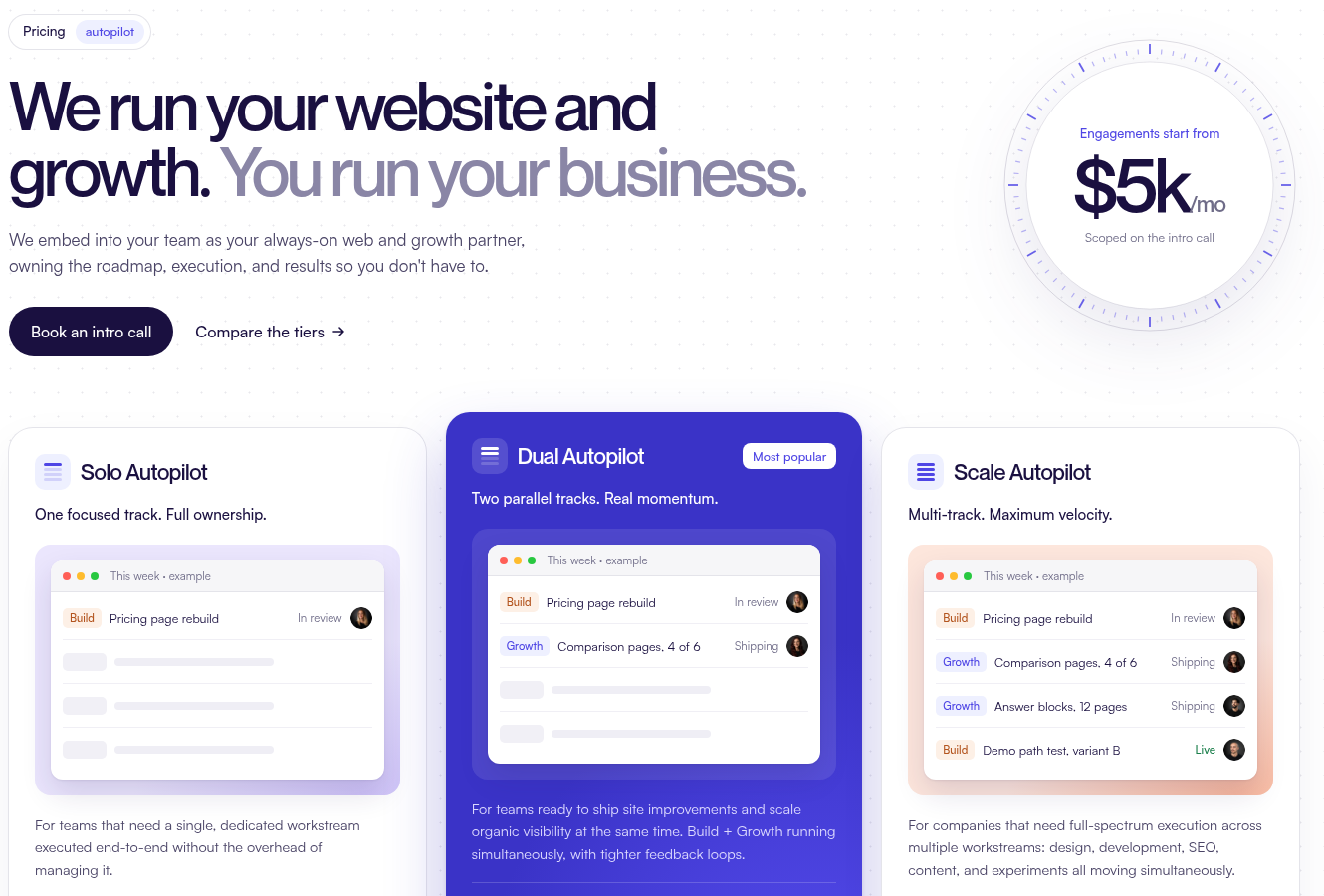
LoudFace tiers start from $5k a month, captured Nov 3, 2026
LoudFace pitches itself to B2B SaaS, fintech and funded companies from Series A to C, and SEO sits in a Growth track next to AEO and content systems. I like that setup if you want site builds and search handled by one team. Because every scope is set on a call, I'd treat $5k as an opening number, and a pre-seed company falls outside its stated audience.

LoudFace targets funded Series A to C companies, captured Nov 3, 2026
TripleDart offers standalone SEO and AEO from $5K a month. I couldn't find its contract terms, so ask about them early.

TripleDart FAQ: standalone SEO/AEO from $5K a month, captured Nov 3, 2026
Its clients are Series A to growth-stage B2B SaaS companies that also buy paid media. That makes sense for a team that wants organic and paid run together. If you only need a narrow SEO fix, or you haven't raised a Series A, you're outside that audience.

TripleDart works with Series A to growth-stage SaaS, captured Nov 3, 2026
For more examples sorted by budget, see this separate breakdown of published SaaS agency prices.
What a retainer buys varies. At the entry level you might get strategy and a few articles a month. Higher up, several people run content, technical work, link acquisition and AI search tracking. When you set an agency quote against a salary, count the roles the agency covers as well as the headline fee.
The same budget, spent three ways
Take $12,500 a month, which by my estimate above is the loaded cost of one information-sector specialist at the median.
Spent on a hire, it buys one full-time person who knows your product better every month, can sit in pipeline reviews and can push engineering for fixes. It doesn't buy a writer, a link builder or a second opinion.
Spent on freelancers, it could fund a technical SEO consultant for an audit and migration plan, a content strategist two days a week and a steady flow of articles from specialist writers. You gain breadth, and you also become the project manager.
Spent on an agency, it's two and a half times the $5,000 starting fee at either SaaS agency above, so it could pay for a wider scope with some left for content or tools. You get a coordinated team with one point of contact, though the people doing the work are shared with other clients and the contract fixes the scope.
None of these is wrong. The right answer depends on what's missing in your company today.
Where each model tends to break
Every option has a predictable failure mode, and knowing it in advance helps more than a pros and cons list.
In-house: the lone SEO
The usual problem with a single in-house hire is isolation. One person is expected to do strategy, technical audits, briefs, writing, link outreach and reporting, while also competing with product work for engineering time. It's easy for that person to slide into filing tickets while the strategy work waits. And when they leave, much of what they knew about the site goes with them.
A bigger team isn't always the answer. Decide which parts of the job the hire owns and which parts get bought from outside, and give them a direct line to whoever controls the development queue.
Freelancer: the handover gap
Freelancers tend to slip on continuity more than on skill. A freelancer finishes the audit, sends a long document and moves on to the next client, and the recommendations sit unimplemented. Or the person who did your keyword research becomes unavailable halfway through a content plan. The work is good; the link to your plans is thin.
Freelancers work best when someone inside the company owns the outcome and treats the freelancer as an extension of that person.
Agency: the pitch team and the delivery team
The classic agency complaint is that senior people sell the account and junior people run it. A second complaint, specific to SaaS, is slow adaptation: a retainer set around a fixed number of articles keeps producing articles even after the data says the site needs technical cleanup or comparison pages instead. A third is reporting that stops at traffic and rankings when the board wants to see demos and pipeline.
Good agencies answer all three with named team members in the contract, quarterly scope reviews and reporting tied to sales outcomes. You can check for each one before you sign.
Hybrid setups that work for SaaS
Plenty of software companies end up with a mix. Here are three setups I'd consider.
The first is one internal owner with outside execution. A marketer, often not an SEO specialist, owns the search plan and the relationship with product and sales. An agency or a small group of freelancers does the production. Context stays inside the company, and you buy breadth on demand.
The second is an in-house lead with specialist help. A full-time SEO handles strategy, content operations and reporting, and brings in freelancers or a boutique firm for technical audits, migrations or link acquisition. This fits once there's enough ongoing work to justify a full-time person but not enough for a whole team. If link building is the gap, this guide to SaaS link building agencies covers what specialist firms in that niche offer.
The third is an agency now and an internal team later. Early-stage companies often sign an agency to build the foundation, then hire once search proves itself as a channel, with the agency moving to a narrower role or handing over completely. If you plan this path, write the handover into the contract from day one: documentation, access to every tool and account, and a transition period.
How to choose, based on where you are
Company size matters less here than what you already have in place. Find the situation closest to yours.
You have no marketer yet
Don't hire an SEO first. Without someone to connect search to positioning, sales conversations and the product plans, any SEO hire or vendor is working blind. If search is urgent, use a freelancer for a bounded starting project, such as a technical audit or keyword and competitor research, and treat it as input for your first marketing hire.
One generalist marketer, a backlog of content ideas
This is the strongest case for a hybrid. Keep your marketer as the owner of the search plan and add outside execution: a freelancer for technical fixes and a few writers who can learn your product, or an agency if you'd rather manage one vendor than several people. The generalist's job is to make sure every piece maps to something a buyer searches for.
You need pipeline from search within two quarters
An agency with SaaS experience can usually move fastest when several things have to happen at once: technical cleanup, new commercial pages, content refreshes and tracking that ties visits to demos. A new hire may still be onboarding when an agency finishes its first quarter. Insist on reporting that shows qualified demand as well as sessions, and on a scope review after the first 90 days. This list of B2B SaaS SEO agencies compares specialist firms if you want a starting shortlist.
Your product is technical and your buyers are developers
Technical buyers judge you on accuracy, so the people writing and reviewing content need real product knowledge. That favors an in-house owner, ideally someone who can work with engineers and documentation, backed by technical SEO specialists for site architecture and rendering issues. If the site's technical foundation is the main gap, this roundup of technical SEO agencies for SaaS covers firms that focus on that work.
Search already brings a meaningful share of pipeline
When organic search is a core channel, the knowledge your own people build up becomes an asset worth owning. Build an internal team with a lead, and use agencies and freelancers for spikes in demand or specialties you don't need every month. At this stage an in-house team is easier to justify because the work never stops.
You face a migration, a rebrand or a traffic drop
These are bounded projects with high stakes. Bring in a specialist, freelance or agency, who has handled the same kind of event before and can show examples. Pair them with an internal owner who'll still be around after the project ends to handle the long tail of fixes.
You sell into several markets or products
Multiple product lines and languages multiply the work faster than a single hire can keep up. You'll likely need a larger internal team or an agency with international experience. Keep strategy and prioritization inside the company even if production is outsourced.
Red flags for each route
Whichever model you choose, a few warning signs should slow you down.
For in-house candidates, be wary of anyone who talks only about rankings and traffic and can't describe how their past work showed up in pipeline or revenue. Be wary, too, of a role description that asks one person to do strategy, writing, development and outreach at a senior level, since that combination rarely exists in one person at a median salary.
For freelancers, watch for guaranteed rankings, an unwillingness to share past clients or examples, link packages sold by volume, and proposals that skip the question of who will carry out the recommendations.
For agencies, watch for long minimum terms with no performance review, a team you haven't met assigned after signing, reporting that never mentions demos or opportunities, and a one-size package that ignores what your site needs. Also ask how they track visibility in AI answers, since some buyers now start research in AI tools that summarize results; this guide to measuring AI search visibility explains what good tracking looks like.
Questions to ask before you hire or sign
The same short set of questions works for all three options.
Who exactly will do the work each week, and what's their experience with software companies?
What will you need from our team in the first 30 days: access, interviews, developer time?
How will you report results, and which metrics connect to pipeline?
What happens if priorities change mid-quarter?
If we part ways, what do we keep: documents, research, accounts, content?
Can you show a past project where the plan changed because the data said it should?
The answers matter more than the format. A candidate or vendor who answers these clearly and specifically is a better bet than one with a lower rate and vague answers.
Where Miraa fits
Miraa runs an SEO and AEO practice for B2B SaaS and AI companies.
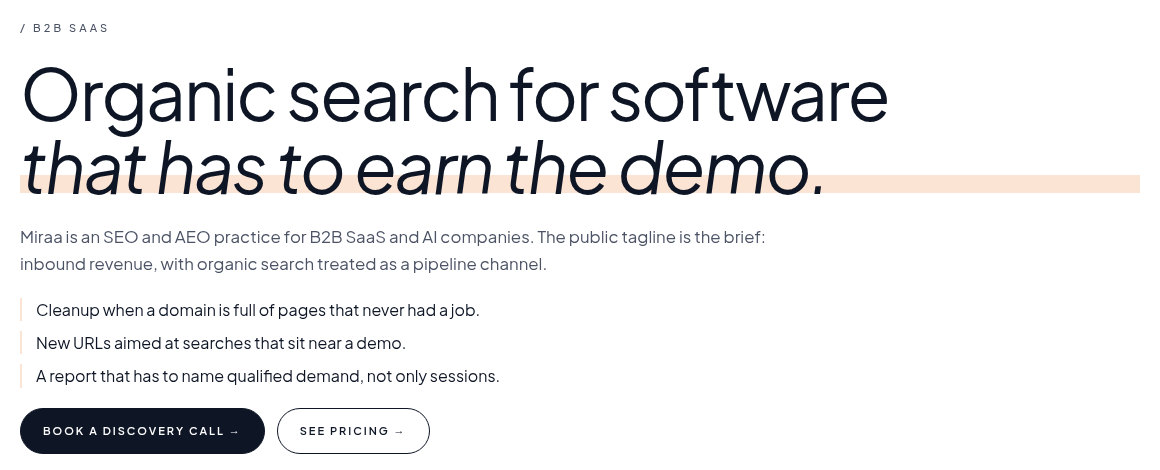
Miraa SEO and AEO practice for B2B SaaS, captured Nov 3, 2026
It builds its B2B SaaS SEO reporting around demos, SQLs and pipeline from organic and AI search. Hold it, and every other firm you consider, to the same questions above.

Miraa reports demos, SQLs and pipeline from search, captured Nov 3, 2026
The costs side by side, and how to pick
Counted in full, none of these options is cheap. An employee at the information-sector median costs roughly $12,500 a month by my estimate once benefits are included. A part-time freelancer's bill depends on the rate and the hours, and someone inside still has to coordinate the work. The two SaaS-focused agencies I checked start at $5,000 a month, and fees climb as scope grows.
Pick the model that fills your biggest gap. If you lack product context, hire. If you lack a specific skill for a defined project, contract. If you lack hands and coordination across several disciplines, outsource. And if you're early, start with one internal owner and buy the rest, which keeps your options open while search proves its value. For the wider strategy any of these setups should serve, start with the B2B SaaS SEO guide.