
In a 23-country survey of 18,152 people published in April 2026, 21% said they'd used AI agents for financial product recommendations, and 14% had let AI choose a financial services provider for them. Your next customer may meet your product inside an AI answer before they ever reach your site.
That answer can be wrong. It can quote last year's fee, credit you with a license you don't hold, or skip you entirely, and your compliance team never got a say in it. That's what answer engine optimization (AEO) is for in fintech: making sure the sources AI tools read are accurate, approved and easy to quote.
Classic search hasn't gone anywhere, either. Core fintech keywords cost $30 to $90 a click in paid search, by one specialist agency's estimate, so a page that ranks replaces real ad spend. (AEO vs SEO covers how the two overlap.) But a page only earns anything once it ships, and a draft about fees or licensing can sit in a legal queue for weeks.
So the best SEO or AEO agency for fintech is the one that ships content your compliance team will approve and keeps what AI says about you accurate. Eleven firms are judged below on what they publish, their review profiles and their public posts as of 15 Oct 2026. None was hired or tested.
TL;DR: the verdict
Miraa, if you sell a fintech product (payments, lending, infrastructure, embedded finance) and want category, integration and comparison pages, plus AI-answer work, that never claim more than your documents support. Entry is $2,500 a month, published.
ClearBrand, if you sell a consumer or small-business finance product and comparison sites own page one. Its KleerCard case is the closest public match, with leads arriving from Google AI Overviews within two months.
Omnius, if you're a B2B or SME fintech that wants AI-search tracking backed by a named fintech result: ANNA Money's AI search traffic rose 164.44% over six months.
The rest: First Page Sage for in-house financial writers and an audit trail; Momentence for payments, BaaS or financial data with published tiers and tracked prompts; Siege Media for consumer fintech that must out-link bigger brands; PipeRocket for B2B fintech SaaS on a $3,000 budget; AngleOut for SME-reviewed YMYL content; Ballistic Media for a written timeline; Breaking B2B for long B2B sales cycles; Garit Boothe Digital for crypto with the founder on the account.
At a glance
Agency | Best for | Starting price | AEO evidence | Key fact |
|---|---|---|---|---|
Miraa | Fintech product companies | $2,500/month | AEO/GEO service; AI-answer results only for anonymized non-fintech clients | Writes licensing and coverage claims only from your documents |
First Page Sage | Consumer finance, banking, lending | Not published | GEO/AEO service; claims a 66% average rise in fintech client AI mentions, no named client | In-house financial writers; content archived |
Siege Media | Consumer fintech competing on links | Not published | GEO service; a client review cites a 400%+ AI visibility gain (not fintech) | Clutch 4.9 from 48 |
ClearBrand | Consumer finance vs comparison sites | Not published | KleerCard leads from Google AI Overviews within two months | KleerCard: ~half of new customers from organic within six months |
Momentence | Payments, BaaS, financial data | $7.5K/month + $4,500 setup | Tracked prompts in every tier; no client result published | Turns away teams without a sub-one-month compliance turnaround |
Omnius | B2B and SME fintech | Not published | ANNA Money: AI search traffic +164.44% (Apr–Sep 2025) | Every financial claim sourced, dated and attributed to a named author |
Ballistic Media | Teams that want a written timeline | Not published | AEO and GEO listed as services; no result published | Meaningful results in 4–9 months, per its site |
AngleOut | SME-reviewed YMYL content | Not published | None found | Reviewers often CFAs or ex-risk leaders |
Breaking B2B | B2B fintech, long cycles | $4K+/month | None on its fintech page; Proposify (sales software) AI visitors +91% | Six- or twelve-month programs |
PipeRocket | B2B fintech SaaS | $3,000/month | GEO/AEO workstream with monthly prompt reports; no result published | 3-month minimum, no setup fee |
Garit Boothe Digital | Crypto and payments | $5,000/month | Says it ranks clients in AI Overviews and LLMs; no result published | Calls fintech its "#1 vertical" |
How we chose: four compliance signals and an AEO check
We checked every agency, Miraa included, against four compliance signals on its own site. ClearBrand and Omnius show all four. Miraa, First Page Sage, Momentence and PipeRocket show three, and the rest show one or two. Use the gaps as questions on the sales call.
A stated compliance workflow: a described process for review cycles, beyond a line saying the agency understands regulation.
Expert authorship or review: named reviewers, finance-trained writers, or SME interviews.
Fintech subcategory fit: payments, lending, banking infrastructure, wealth, crypto or B2B financial software, named explicitly.
Fintech proof or published pricing: a fintech case study, named fintech clients, or prices on the page.
Then we added a separate AEO check, because "we do GEO" is now on almost every agency homepage. We sorted each firm into one of four buckets:
A published AI-search result for a named fintech client: ClearBrand (KleerCard) and Omnius (ANNA Money).
An AI-search result, but for unnamed or non-fintech clients: First Page Sage, Siege Media, Breaking B2B and Miraa.
AI-answer work described on a service page, with no result attached: Momentence, PipeRocket, Ballistic Media and Garit Boothe Digital.
No AEO evidence we could find: AngleOut.
A described service isn't worthless. Momentence, for example, is unusually specific about what it tracks. But a service page is a promise, and a case is proof, so the buckets tell you how much you're taking on trust.
After Miraa, the order runs from consumer finance to B2B fintech to crypto.
Why fintech SEO is worth the hassle
Paid search in finance is expensive. Momentence cites Semrush data putting the cost per click on core fintech terms "well north of $40." AngleOut's page says such keywords "cost $30–$90 a click in paid." At those prices, a page that brings in a few hundred organic visits a month replaces real ad spend.
Links are hard to earn, though. Siege Media notes that authoritative finance outlets "prioritize trust and compliance," which makes link acquisition harder in this vertical than most.
Siege's research on "Best X" pages, shared on X on 10 Aug 2026, found a 61.1% median engagement rate, with the caveat that "High-intent researchers don't always convert." In fintech, a comparison page can look healthy in analytics and still need an approved path to the application or demo form.
Why AI answers raise the compliance stakes
Here's the uncomfortable part. Your legal team reviews every page you publish, but nobody reviews the paragraph an AI assistant writes about you. It's assembled from your site, your docs, review profiles, old press coverage and whatever comparison sites say, then served to a buyer as if it were settled fact.
And buyers do notice errors. In G2's March 2026 survey of 1,076 B2B software buyers, 64% said they run into inaccurate AI chatbot recommendations often or very often. In fintech, an inaccurate recommendation can mean a misquoted APR or a coverage claim your regulator would object to.
So AEO in fintech is mostly a compliance and accuracy job, not a growth hack. In practice it comes down to five habits:
Keep one approved fact sheet. Rates, fees, licenses, coverage and security attestations live in one place, and every public page pulls from it. Momentence calls this a "pre-approved claims and disclosure library."
Make the docs win. If your landing page and your developer docs disagree, an AI answer may blend both. Miraa's fintech page puts it bluntly: when they conflict, "the landing page loses."
Fix the third-party copies. Old fee tables on partner pages, review profiles and directories get quoted too. Momentence's fintech AEO section stresses "consistent product facts across your site and third-party profiles."
Check what assistants say, on a schedule. Pick a fixed set of prompts ("best business account for freelancers UK," "is [you] licensed in [state]") and log the answers monthly. Our guide to measuring AI search visibility walks through a setup.
Treat a wrong answer as a content bug. You can't edit the model, but you can correct and clarify the pages it learned from, then re-check.
One more rule: distrust any agency that guarantees placement in AI answers. Momentence's page says it does "not promise placement in any AI answer," and that's the honest position.
Compliance workflows compared
Agency | Compliance approach and services (per its site) | Pricing | Reviews | Clients and proof |
|---|---|---|---|---|
Miraa | Ten SEO, AEO/GEO, content and link services; licensing and coverage claims written only from your documents, with your review before publishing | From $2,500/month, published | No Clutch or G2 profile yet | Clients named (Salesforge, Icypeas, Upsolve and others); no fintech case study |
First Page Sage | In-house financial writers; claims verified before compliance review; content archived | Not on fintech page | Clutch profile, no reviews | Testimonials; named fintech clients not confirmed |
Siege Media | Publishes YMYL guidance (cites Bankrate's editor-and-reviewer bylines) | Not published | Clutch 4.9 from 48 | Ramp content with Eric Wu |
ClearBrand | Drafts flag claims, rates and disclosures; nothing ships until your team approves | Not published | Clutch 4.8 from 2 (both Jan 2023) | KleerCard |
Momentence | Compliance workflow built in "from month one" | $7.5K to $50K+/month, published | No Clutch or G2 reviews found | No named client cited |
Omnius | Fact-checking protocol; claims dated and attributed to a named author; works inside your compliance review | Not published | Clutch profile, no reviews | ANNA Money case; Payoneer, WorldFirst and Sigma360 among logos |
Ballistic Media | Built for "defensible claims" and E-E-A-T | Not published | Unconfirmed Clutch profile, no reviews | No named client cited |
AngleOut | Writers paired with SMEs (often CFAs, ex-risk and payments leaders) | Not published | Clutch: no reviews yet | No named client cited |
Breaking B2B | In-house team, no outsourcing | From $4K+/month (£3,000+) | No Clutch or G2 reviews found | No named client cited |
PipeRocket | Expert-authored and expert-reviewed pages with named, credentialed authors | From $3,000/month, published | Clutch 4.7 from 18 | Spendflo, HyperVerge |
Garit Boothe Digital | Founder-led SEO | From $5,000/month | No Clutch or G2 reviews found | No named client cited |
1. Miraa
Miraa is a B2B SaaS SEO and AEO agency with a fintech SEO page. That page says fintech buyers in payments, lending, financial infrastructure and embedded finance "compare infrastructure in public, often before a sales call," and that Miraa's job is to make the product "findable and hard to mis-describe."
For fintech, the page describes four page types: category pages that editors strip of any license, geography or partnership you haven't documented; integration pages written to match engineering; fair alternatives pages that "can take a position" but can't invent a competitor's defect; and AI-answer work built on the reasoning that "a summary that invents a license is worse than no summary." On compliance, it says Miraa writes about licensing and coverage "only from documents you provide, and only with your review before publish," and that Miraa "does not decide whether a claim is legally permitted." It also says it won't stamp out a templated page for every bank or rail.
The AEO angle is accuracy first. The page wants category language "in words a buyer and a model can repeat," and it treats any gap between your docs and your marketing pages as a risk, because a generated answer built from both inherits the error.
Services
The service menu is the same ten offerings Miraa runs for every client:
Product-led SEO: category, product and integration pages that describe what the platform actually does.
Content-led SEO: topic plans built around the questions finance buyers search before a demo.
Technical SEO: rendering, indexing and site structure fixes.
On-Page SEO: tightening existing pages, from titles and headings to internal links.
SEO Site Migration: keeping rankings intact through a rebrand, CMS move or domain change.
SEO Website Recovery: finding and fixing the cause of a traffic drop.
AEO/GEO: answer engine optimization and generative engine work for AI-written answers.
Content Writing: drafted pages and articles ready for your review cycle.
Link Building: earned links and mentions rather than bought placements.
Agentic SEO/GEO: AI agents used inside the research, writing and monitoring workflow.
Pricing
There's no separate fintech price. A fintech company pays the same as any other client: $2,500 a month for Basic Growth, $3,500 for Growth+ or $5,000 for Hyper-Growth, per Miraa's published plans.
Reviews
No Clutch or G2 profile found.
Clients
Named clients include Salesforge, Icypeas, Upsolve, ResumeBuild, Wrenly and Redora AI. None of them is a fintech company, and Miraa's fintech page says "a fintech company is not identified in the case studies."
Its newest case study does show how it handles a multi-product company, which matters for fintechs with separate brands per rail or region. For five sibling cold-outreach products (Salesforge, Mailforge, Warmforge, Primeforge and Infraforge), Miraa gave each domain its own intent territory so they stopped competing, and Search Console showed quarterly clicks across the five rising 117.7% to 75,416 between Apr–Jun 2025 and May–Jul 2026. The other three studies are anonymized SaaS results.
On AI search specifically, the case studies page reports placements only for anonymized, non-fintech clients. For an unnamed AI ad platform, it says GEO and on-page work "secured featured placements inside Perplexity and ChatGPT" for "AI ad optimization" queries within 60 days. There's no fintech AI-citation result to point to.
Summary
Miraa's fintech page is the most careful on this list about what it won't write: no license, geography or partnership you haven't documented, and no invented competitor defects. That restraint is exactly what a compliance team wants to hear, and it's the right instinct for AEO too, since AI answers repeat whatever your pages imply.
The cons are plain. There's no fintech case study, so you'd be its first public fintech example, and its AI-answer results so far are anonymized and outside finance. There are no third-party reviews. And Miraa says outright that it doesn't decide whether a claim is legally permitted, so your counsel still owns that call.
Pick Miraa for fintech product companies that want category, integration and comparison pages kept true to their docs. Skip it if you need proven fintech results from a past client, or a consumer finance brand fighting comparison sites.
2. First Page Sage
First Page Sage has a dedicated fintech SEO and GEO practice covering banking and lending platforms, payments and transfers, and personal finance and credit apps.
Services
Its fintech page says "experienced financial writers, all in-house" produce six to seven monthly deliverables. On compliance:
Every claim about "rates, terms, or regulation clears verification and your compliance review before it exists in public."
Every published piece is "archived and traceable," which is the part your compliance team will likely care about.
Reporting leads with sign-ups, funded accounts or MQLs, depending on your model, followed by how you show up on AI platforms.
The AEO offer is spelled out. The page (published 27 Jul 2026, updated 10 Aug 2026) lists GEO/AEO work on "what the models believe about you," a GEO/AEO consulting option for fintech teams that keep production in-house "often for compliance reasons," and agentic search optimization for a future where AI agents compare rates for customers. It also says it isn't a fit if you've "decided AI optimization is schema markup, FAQs, and dashboards," which is a fair warning against checkbox AEO.
Pricing
The fintech page carries no prices, so expect a scoped quote.
Reviews
First Page Sage has a Clutch profile with no reviews.
Clients
The fintech page includes client testimonials, but we couldn't confirm named fintech clients on the live site. Ask for references in your subcategory.
Its AI-search proof is an aggregate. Among its fintech stats, the page claims a "+66% increase in fintech client mentions in AI results," with no named client or date range behind it. Ask which clients that average covers and how mentions were counted.
Summary
First Page Sage has the most rigorous claims process described here: verify first, then compliance, then archive. Its consulting-only GEO/AEO option is useful if your compliance rules keep writing in-house. What it lacks is outside proof, with no Clutch reviews, no fintech client we could confirm and an AI-mention figure you can't trace to a named account.
Built for consumer finance, banking and lending teams that want in-house financial writers and an audit trail. Look elsewhere if you need a price or named fintech references before a call.
3. Siege Media
Siege Media is a content and GEO agency with a fintech SEO practice and one of the more thorough public fintech SEO guides.
Services
Siege sells content, links and GEO rather than a fintech-specific package. Its fintech guide points to Bankrate's model of showing an editor and a reviewer on each post, with bios, as a trust signal. It also suggests using funding-round news to earn links.
That guide was last updated on 13 Jun 2025, so it's older than our 12-month window, but it already told fintech teams to structure definitions and data points so AI summaries can extract them.
Pricing
No rates appear on its fintech pages.
Reviews
Siege's Clutch average is 4.9/5 across 48 reviews. Neither of the two newest (read 15 Oct 2026) is from a fintech client, but both speak to process. A Content Director at an online therapy platform (Aug 31, 2026) headlined theirs "They were punctual, thorough, and incredibly open to feedback," and the body of that review says AI visibility on the client's high-priority tracked prompts climbed more than 400% from August 2025 to August 2026. Pacaso's Director of Paid Digital Advertising (Jul 10, 2026) wrote that "Siege Media's organization and documentation procedures are very impressive."
Clients
Siege features Eric Wu, SEO, GEO and CRO lead at Ramp, in a piece on how Ramp tracks AI traffic. On 13 Oct 2026 it posted on X that Ross Hudgens's new GEO book includes a Bluevine case study. Bluevine offers small-business banking. We haven't read that case, so we can't report its numbers. The fintech guide itself cites no fintech case with revenue numbers.
Summary
Siege is the strongest link earner on the list, and its fintech guide is honest that two-word finance terms often need a brand advertising budget too. Its AI-search proof is real but sits outside finance (the therapy platform review), and its fintech proof is thin: one Bluevine case in a book, no fintech revenue numbers.
Siege fits consumer fintech that has to out-publish and out-link bigger brands. Skip it for B2B infrastructure with few searches and long cycles.
4. ClearBrand
ClearBrand runs a fintech SEO program built around money queries: "the searches people make right before they choose a card, an account, or a platform."
Services
The compliance setup is spelled out:
"Every page goes through a review path your compliance team can live with."
Drafts "flag every claim, rate, and disclosure that needs sign-off, and nothing goes live until your team approves it."
Content comes from interviews with your product, risk and finance people, checked against regulators, filings and your own data.
On AI search, ClearBrand says it doesn't run "a separate AI search project," on the view that pages that rank and answer clearly are the ones AI tools cite. It puts a direct answer near the top of each section and keeps facts current. It also tracks how AI tools describe you today: "If they get your product wrong or leave you out of a category answer, that's a content gap we can close." Its free audit includes that AI readout.
Pricing
ClearBrand quotes on request.
Reviews
Clutch shows 4.8/5 from 2 reviews, both from January 2023, so neither covers the current fintech SEO program.
Clients
KleerCard, which issues credit cards with expense management for churches and nonprofits. On a case page last updated in June 2026, ClearBrand says Bankrate, Divvy and Ramp owned page one when it started. It reports that:
Clicks grew more than 30% and impressions more than 250%.
Leads arrived from Google AI Overviews within two months.
About half of new customers came from organic search within six months.
Its fintech page adds that KleerCard's "best of" articles "earned the top recommendation in AI Overviews for its target queries."
Summary
ClearBrand meets all four compliance checks and has a named fintech AI result, and the KleerCard case started from a page one owned by Bankrate, Divvy and Ramp. Its habit of auditing what AI tools say about you is exactly the accuracy check a regulated brand needs. The weak point is reviews: two on Clutch, both from January 2023, before the current program.
Card issuers and consumer finance products up against comparison sites should put it on the shortlist. B2B infrastructure companies should skip it, because its money-query model fits consumer choices.
5. Momentence
Momentence builds "organic and answer-engine visibility for payments, lending, banking infrastructure, and financial data companies."
Services
Content "ships through your compliance review, with the workflow built in from month one." The page lists what it builds for each segment:
Payments: API documentation, reconciliation and processor comparison pages
Cross-border: corridor coverage, FX transparency and licensing by region
BaaS: sponsor bank model and security disclosures
Open banking: connectivity coverage, consent flows and developer onboarding
It has the clearest written definition of fintech AEO on this list: "improving the public evidence AI assistants use when they describe financial products." That means crawlable pages, consistent product facts across your site and third-party profiles, clear licensing and security information, and original material worth citing. It tracks "observed citations for a defined set of fintech prompts" and says it doesn't promise AI placement.
It also publishes its own research. An AI discovery hygiene benchmark fielded on 9 Aug 2026 crawled 160 software sites and found 38% publish no JSON-LD at all.
Pricing
Published, on a 6-month minimum. Ignite is $7.5K/month plus a one-time $4,500 implementation fee. Momentum is $15K/month, Category Leadership $30K/month, and Custom starts at $50K/month. The AEO scope scales by tier: 5 observed prompts in Ignite, 20 in Momentum and 50+ in Category Leadership.
Reviews
We found no Clutch or G2 profile with reviews for Momentence.
Clients
No public client list on the page we reviewed, and no AI-search result for a fintech client.
Summary
Momentence is the most honest about fit: it says you're not a client if your team "cannot get any compliance review turnaround inside a month." Published tiers, a compliance workflow from month one and a fixed prompt count per tier are rare. No reviews, no named clients and no published AI result are the gap, and a $4,500 setup fee plus six-month minimum makes it a real commitment.
Momentence fits payments, BaaS and financial data companies with a working compliance process. Skip it if your legal queue runs longer than a month, or your budget sits under $7.5K.
6. Omnius
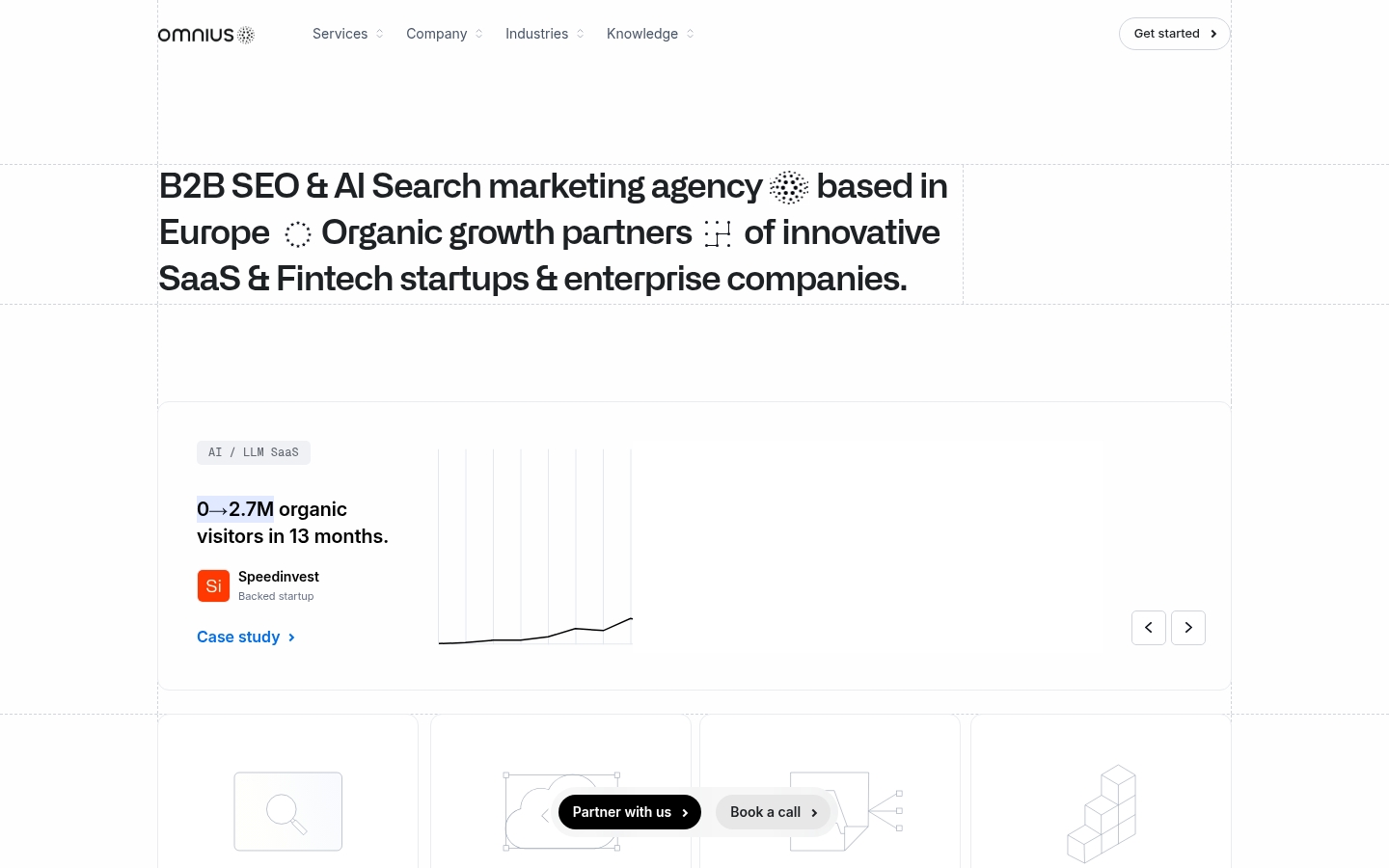
Omnius is a London-based B2B SEO and AI search agency that works only with SaaS, fintech and AI companies. Its fintech page names cross-border payments, sanctions screening, digital banking and embedded finance as client segments.
Services
The page describes an eight-part process, and two parts matter most for fintech:
LLM and GEO optimization: AI prompt analysis for fintech, AI Overview and AI Mode snapshot tracking, schema for financial products, an llms.txt file and monthly GEO reports. It frames the risk well: "a rate or fee misquoted in an AI-generated answer is a trust problem, not just a missed click."
Financial content accuracy and compliance: every financial and regulatory claim "sourced, dated, and attributed to a named author," plus a fact-checking protocol that integrates with your compliance team's review "rather than replacing it."
It also does technical SEO, BOFU content, programmatic pages, link earning and landing page development, all with in-house staff.
Pricing
Not published. The fintech page says pricing is set per project and that Omnius onboards up to 8 clients a year. Its Clutch profile lists a $5,000+ minimum project size.
Reviews
Its Clutch profile shows no reviews.
Clients
The headline case is ANNA Money, a UK business account and company-formation platform. Published 15 Dec 2025 and updated 1 Mar 2026, it covers April to September 2025, so the data is just over a year old. Omnius reports:
weekly signups up 60%
AI search traffic up 164.44%
AI Overview keywords growing from 183 to 837 between May and September 2025
top-3 keywords up 314%
The AI work was concrete: entity-based targeting, schema, short definitions and concise FAQs built for AI Overview snippets, alongside hundreds of city- and profession-specific programmatic pages. Its fintech page also shows Payoneer, WorldFirst, Sigma360, Paypercut and Native Teams among its logos, and a testimonial from an ANNA Money product owner.
One caution: the case studies page mixes client work with teardown studies of companies such as Stripe and Wise. Those aren't client results, so check which is which.
Summary
Omnius has the best named fintech AEO result on this list: a dated ANNA Money case with AI traffic and AI Overview keyword counts, from a firm that writes about misquoted rates as a compliance risk. It meets all four compliance checks on paper. The gaps are no Clutch reviews, no published price and a programmatic playbook you'll want legal to approve page by page.
Omnius fits B2B and SME fintechs that want SEO and AI-answer tracking from one specialist team. Skip it if you need a published price or third-party reviews before you take a call.
7. Ballistic Media
Ballistic Media runs a specialist fintech SEO service as part of a broader fintech marketing offer. It serves "Payments platforms, lending and credit products, wealthtech and investment platforms, neobanks, insurtech providers, and regulated B2B financial software."
Services
The page describes fintech SEO as needing "structured content, defensible claims, strong E-E-A-T signals." Services include technical SEO, schema and entity work, AEO and GEO, and authority building.
On AI search, it lists "Structured data for AI search engines, entity-first architecture, and Answer Engine Optimization (AEO)," plus an "AEO + GEO Alignment" stage in its process. Its fintech audit includes AI search visibility. For compliance, it mentions "pre-approved templates, content governance, and modular frameworks."
Pricing
Ballistic Media doesn't show prices for its fintech SEO service.
Reviews
We found a Clutch profile for "Ballistic Media Group" with no reviews, but couldn't confirm it's the same company as ballistic.media.
Clients
No public client list on the page we reviewed. The page shows a "+178%" organic traffic figure without naming a client, and we found no AI-search result.
Summary
Ballistic Media is the only firm here that writes down a realistic timeline: early movement in 8 to 12 weeks, meaningful results over 4 to 9 months. Its AEO offer is described but unproven. Beyond that, there's little to check: no prices, no named clients and no confirmed review profile.
The right buyers here are payments, lending, wealthtech, neobank and insurtech teams that need a timeline to show the board. The wrong ones need verifiable proof before they shortlist.
8. AngleOut
AngleOut is a fintech-only SEO agency focused on YMYL-grade content.
Services
AngleOut pairs "fintech-native writers" with "named subject-matter experts and reviewers, often CFAs, former risk and payments leaders," and builds review workflows around your "risk, legal and compliance stakeholders." Services:
Technical SEO for regulated, multi-jurisdiction sites
YMYL content with SMEs
Programmatic and comparison SEO
PR-led authority links
We found no AEO evidence for AngleOut. Its fintech page doesn't mention AI answers or AI search, and we found no AI-citation case study. Its homepage shows an illustrative AI-answer graphic, but that's a design element, not a client result.
Pricing
Quoted per engagement; nothing is listed on the site.
Reviews
Its Clutch profile has no reviews yet.
Clients
The page we reviewed names no clients.
Summary
AngleOut's pairing of writers with named experts (often CFAs or former risk and payments leaders) is the best answer to YMYL on this list. Expert-reviewed pages are good raw material for AI answers too, but AngleOut doesn't sell or report AEO work, so you'd need to handle that elsewhere. With no reviews and no case study, ask for a sample reviewed page and the reviewer's byline.
AngleOut fits venture-backed fintech that needs SME-reviewed YMYL content. Skip it if you want proof of results more than proof of process, or AI-answer work in the same contract.
9. Breaking B2B
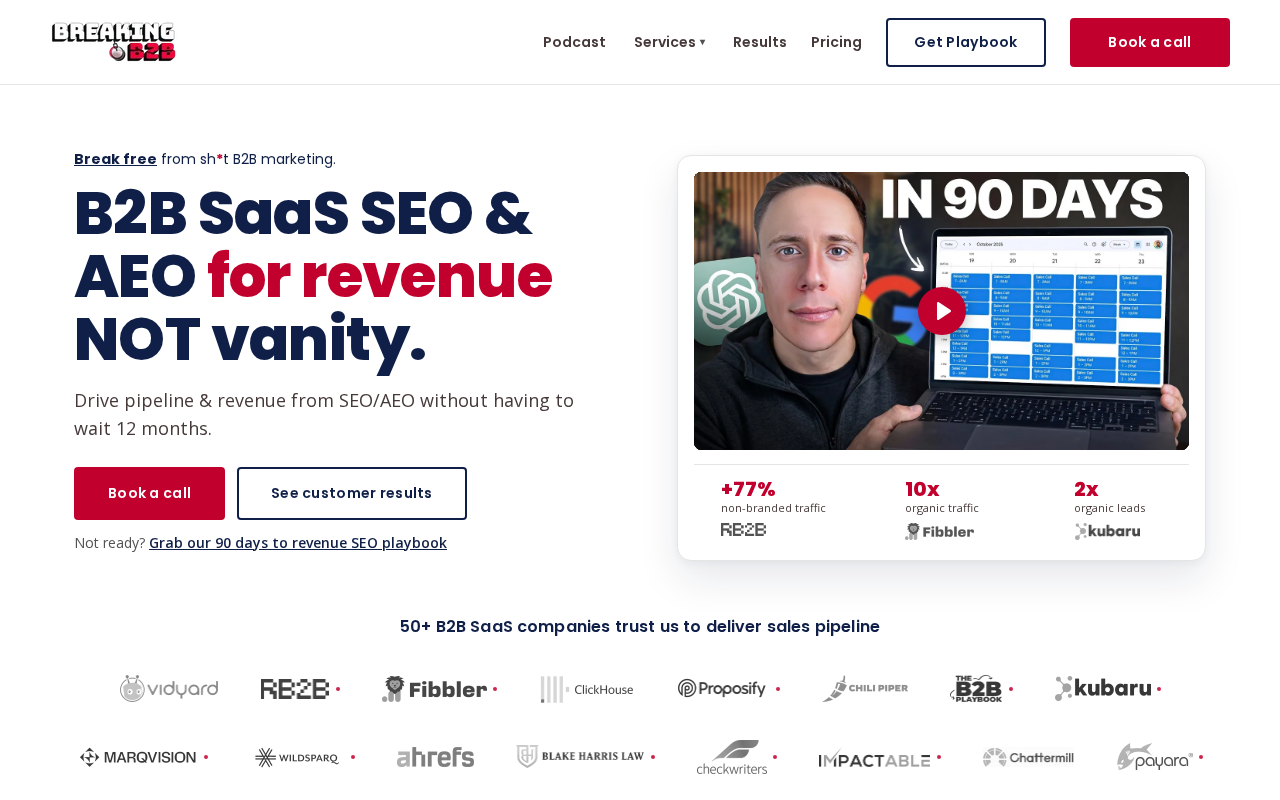
Breaking B2B focuses on B2B fintech: payments, lending, compliance and data analytics companies with "long sales cycles, multi-stakeholder decisions, and complex buyer journeys."
Services
Everything is done by an "in-house team of specialists," with "no outsourcing." Programs run six or twelve months, and senior SEOs work on every account.
Its fintech page doesn't mention AI answers at all. The wider site does sell AEO, describing itself as "Senior-led SEO, GEO and AEO for B2B and SaaS teams."
Pricing
Plans start at "$4k+ /mo (£3,000+ per month)." The site says average spend for a fast-growth B2B SEO program is "$7k+ monthly."
Reviews
No Clutch or G2 reviews turned up for Breaking B2B.
Clients
No fintech client is named on the page we reviewed.
Its AI-search proof comes from outside fintech. The Proposify case, dated 28 Apr 2026, reports AI search visitors up 91% for the proposal software company, with content rebuilt to surface in ChatGPT, Perplexity and AI Overview citations.
Summary
Breaking B2B's six- and twelve-month programs suit fintech deals that take months to close, and the senior staffing is stated plainly. Its AEO work is proven on a sales-software client, not a regulated one, so ask how it would handle compliance review on AI-facing content. No fintech client is named on its fintech page, and the stated average spend of "$7k+ monthly" is well above the entry price.
Strong choice for B2B fintech with long sales cycles, but not if you want a short trial or a consumer fintech playbook.
10. PipeRocket
PipeRocket is a B2B SaaS marketing agency with a fintech SEO practice covering "Payments, KYC / identity, embedded finance, lending, treasury / FinOps, BaaS, banking, and crypto-adjacent SaaS."
Services
"Expert-authored and expert-reviewed content with named authors and credential lines"
"Compliance-aware framing" on every page, so "approval cycles get shorter, not longer"
Links from "editorial link building and digital PR into financial trade press"
The page doesn't describe a review cycle, so ask how drafts move through your legal team.
Its GEO and AEO workstream is described in detail: question-form headings with a direct answer under each, comparison tables, Organization, Service and FAQPage schema, and monthly tracking of which prompts surface you in ChatGPT, Perplexity, Google AI Overviews, Gemini and Claude. It also says it writes so AI engines surface you when buyers ask "is X compliant with Y," a prompt where accuracy really matters.
Pricing
Published. The fintech page says retainers start at $3,000/mo, with a 3-month minimum and no setup fee.
Reviews
Clutch shows 4.7/5 from 18 reviews. Two recent review headlines (checked 15 Oct 2026):
Jul 25, 2026, Head of Digital Marketing at LatentView Analytics: "PipeRocket Digital is very results-oriented and driven to make things happen."
Jun 26, 2026, Founder at One.finance: "They were always available on Slack and ready to answer any query I had."
Many of the reviewed projects are paid media, so ask which reviews cover SEO.
Clients
Named clients on the fintech page include Spendflo (it reports an 81% traffic rise) and HyperVerge, an identity-verification company. HyperVerge's 51 MQLs came from performance marketing, not SEO. We found no published AI-search result for a fintech client.
Summary
PipeRocket is the cheapest named-client option for B2B fintech, at $3,000 a month with a three-month minimum, and its AEO workstream is one of the most specific on the list. Read its proof carefully: HyperVerge's 51 MQLs came from performance marketing, many Clutch reviews cover paid projects, and there's no AI result yet.
PipeRocket fits B2B fintech software sold to finance and risk teams on a tight budget. Skip it if you need a described legal review cycle; the page doesn't explain one, so ask.
11. Garit Boothe Digital
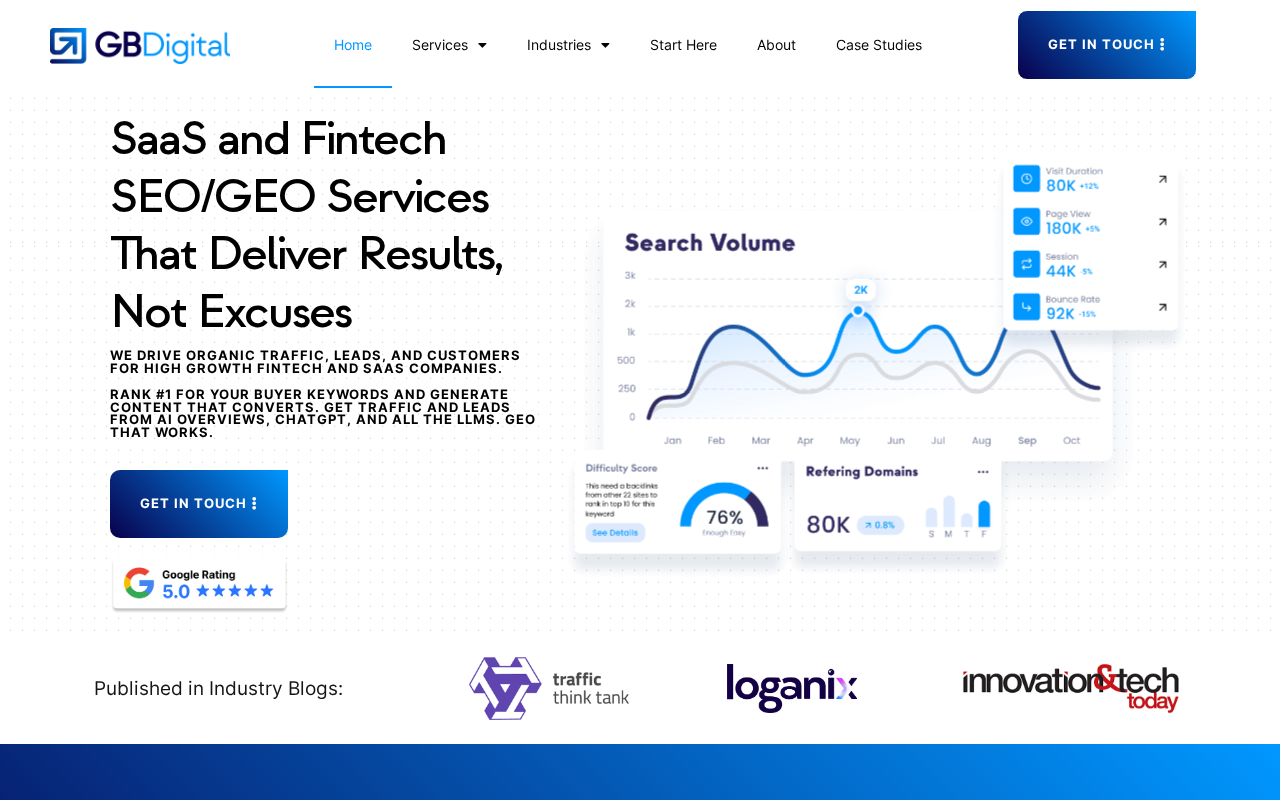
Garit Boothe Digital only does SEO, and says fintech is its "#1 vertical." It also runs dedicated cryptocurrency SEO and payments services.
Services
Technical SEO, content, link building and visibility in Google AI Overviews and LLMs such as ChatGPT and Perplexity. The fintech page now bills it as a "FinTech SEO Agency & GEO Agency" and says, "We rank clients in traditional search engines, Google AI Overviews, and LLMs like ChatGPT & Perplexity." It doesn't show a result for that claim.
Pricing
It's one of the few that says what it costs: "Pricing for financial technology companies starts at $5,000 per month," with most fintech clients spending "$5,000 to $10,000 per month."
Reviews
We found no Clutch or G2 profile with reviews for Garit Boothe Digital.
Clients
No public client list on the page we reviewed. Testimonials on the page include Zeni.ai's VP of Marketing and Credit Suite's content lead, but none mentions AI search.
Summary
Garit Boothe Digital is SEO-only, calls fintech its top vertical, and publishes a floor. It's a founder-led shop with no client list, reviews or AI-search result we could find, so references are everything.
Crypto and payments companies that want the founder on the account should shortlist it. Pass if you need a large team or a compliance workflow in writing.
The budget reality
Five of the eleven publish a number. Here's how those compare:
Agency | Entry price | Commitment | What the entry tier is for |
|---|---|---|---|
PipeRocket | From $3,000/month, no setup fee | 3-month minimum | Scope-based retainer |
Miraa | $2,500/month | Not stated | Basic Growth tier; Growth+ $3,500 and Hyper-Growth $5,000 |
Breaking B2B | From $4K+/month (£3,000+) | Six or twelve months | B2B fintech programs; average spend "$7k+ monthly" |
Garit Boothe Digital | From $5,000/month | Not stated | Most fintech clients spend $5,000 to $10,000 |
Momentence | $7.5K/month + $4,500 setup | 6-month minimum | Ignite tier with 5 observed prompts; top tiers run $30K and $50K+ |
First Page Sage, Omnius, AngleOut, Siege Media, Ballistic Media and ClearBrand quote on request.
Fintech SEO isn't cheap. Compliance review and expert reviewers add cost to every page, and minimum terms are long. Ballistic Media's estimate of 4 to 9 months for meaningful results shows why. AEO doesn't make it cheaper, either: someone still has to keep every public fact consistent and re-check AI answers monthly. If your board wants payback in one quarter, paid search is the more honest answer.
If you're evaluating fintech agencies, here's what to watch out for
Fintech is where a weak agency does the most damage, because the mistakes aren't just wasted spend. They can put an inaccurate rate or an unapproved claim in public, and now an AI assistant can repeat it to thousands of people. These are the red flags to watch for in proposals and sales calls:
"We understand regulation" with no process behind it. Every agency says this. Ask them to walk you through what happens to a draft between the writer and your legal team, step by step. If they can't describe the handoff, they haven't run one.
No named reviewer. Expert review only counts if someone with credentials puts their name on it. Ask for a sample byline with the reviewer's credentials, the way AngleOut, Omnius and PipeRocket describe them.
A turnaround promise that ignores your queue. If your legal team takes three weeks, a plan that ships eight pages a month is fiction. Momentence's one-month bar is a useful benchmark. Tell them your real turnaround and watch how the plan changes.
Rates and fees in drafts with no source. Ask how they handle rate and fee claims. First Page Sage's answer (verify before review, archive after publishing) is the standard to compare against.
No archive. If a regulator or partner bank asks what a page said six months ago, someone needs to produce it. Compare their answer with First Page Sage's "archived and traceable" claim and ClearBrand's "nothing goes live until your team approves" line.
Generic subcategory proof. Lending SEO and payments SEO target different queries and different reviewers. A wealthtech case doesn't prove much for a BaaS company. Ask for an example from your subcategory.
Templated pages per bank, rail or state. Mass-produced near-duplicates are a quality risk in a YMYL category, and each one is another page compliance has to approve.
"GEO" with no baseline. If an agency can't tell you what ChatGPT, Perplexity and AI Overviews say about you today, it can't show you a change later. ClearBrand's audit and Momentence's observed prompts are the models here.
AI work that skips compliance. Answer-ready summaries, FAQs and schema are still public claims. If the agency treats them as technical tweaks that don't need legal review, walk away.
Guaranteed AI placement. Nobody controls what a model says. Prefer agencies that, like Momentence, promise tracking and not placement, and ask whether AI-referred sign-ups are reported separately from Google organic.
Questions worth asking on every call:
Who writes, who reviews, and what are their credentials?
What's your average compliance turnaround with current clients?
Show me a page you shipped in my subcategory, and the version legal sent back.
What do you do when legal strikes a claim the page depends on?
Which prompts will you track, and what do AI assistants say about us right now?
When an AI answer misstates our rate or license, what will you change, and how fast?
How long is the minimum term, and what do you expect to show by the end of it?
A compliance-ready content workflow
Whichever agency you hire, it helps to agree the workflow before the first brief. A version that works for many fintech teams looks like this:
Source pack first. Before writing, your team supplies the documents a page can rely on: license details, coverage maps, fee schedules, security attestations and approved product language. Anything not in the pack doesn't go in the draft.
Claims flagged in the draft. Every rate, fee, regulatory statement and comparison claim is highlighted for review, so legal reads the risky lines first instead of the whole page. ClearBrand describes exactly this.
Named expert review. A credentialed reviewer checks substance before compliance checks permission. Their name and credentials appear on the page.
One compliance round, with a deadline. Agree a turnaround and a single consolidated set of comments. Endless rounds are where calendars die.
Archive on publish. Save the approved version, the reviewer and the date. When rates change, the archive tells you which pages need an update.
Push approved facts outward. Once a rate or license detail is approved, update the same fact on your docs, review profiles and partner listings, so AI tools don't find two versions.
Scheduled re-review. Pages with rates or fees get a review date when they go live, not when someone notices they're stale. Re-run your AI prompt set at the same time.
An agency that already works this way will recognize every step. One that pushes back on steps 1, 5 and 6 will probably create work for your legal team rather than save it.
How subcategory changes the plan
Fintech isn't one market, and the search behavior differs a lot between segments:
In payments and cross-border, buyers are technical. They read API docs, compare processors and check corridor coverage, FX transparency and licensing by region, which Momentence's segment list maps well. Lending and credit look different: high-cost paid keywords, comparison sites on page one and strict disclosure rules on any rate claim. That makes AI answers that quote a rate the riskiest kind for lenders.
Banking infrastructure and BaaS have few searches and long cycles, with buyers who care about the sponsor bank model and security disclosures. Wealth and investing reward expert-led content, where reviewer credentials matter most. And in crypto, regulation shifts by region, so pages go stale quickly and need regular re-review, and so do the AI answers built from them.
Ask each agency which of these it has actually worked in. A firm strong in consumer lending may be the wrong pick for a BaaS company, even if both are called fintech.
How to choose: pick by your situation
If you sell payments, lending or infrastructure software and your biggest risk is pages, or AI answers, that overstate licenses or coverage, pick Miraa.
If you sell a card, account or consumer lending product and comparison sites own page one, pick ClearBrand.
If AI answers already misdescribe your product and you want a team with a named fintech AI result, pick Omnius or ClearBrand, and ask both for a baseline audit of what assistants say about you today.
If you're in payments, BaaS or financial data and your legal team turns drafts around inside a month, pick Momentence. If it doesn't, fix that before hiring anyone.
If you need an audit trail a regulator or partner bank could inspect, pick First Page Sage. If compliance rules keep your writing in-house, its GEO/AEO consulting option is worth a look.
If your budget is around $3,000 a month and you sell to finance teams, pick PipeRocket.
If expert bylines are your main YMYL gap, pick AngleOut, and plan your AEO work separately.
If you're a crypto company, pick Garit Boothe Digital, and plan for regular re-review as rules shift by region.
Whoever you pick, weigh AEO the same way: favor a named result over a service page, a tracked prompt set over vague "AI visibility," and a compliance step for every answer-ready summary.
If you plan to publish steadily for years, consider an in-house content lead who sits next to compliance; they learn what legal will accept faster than any outside firm. Many fintech teams pair that owner with an agency for writers, reviewers and technical work.
Bottom line
In fintech, a wrong rate or an unapproved claim can turn into a regulatory problem, and AI answers can spread it further than any single page. A generalist agency carries real risk.
Start with the compliance question. An agency that can describe its review workflow in detail has likely done this before. The compliance-first guide to fintech SEO sets out a workflow you can compare against. Then ask what AI tools say about you today and how the agency would change it. Then compare subcategory fit and price; Momentence, Breaking B2B, Garit Boothe, PipeRocket and Miraa all publish numbers.
If your firm sells B2B financial services rather than a fintech product, Miraa also has a financial services SEO page.