
Last updated: October 31, 2026
In a survey of senior US marketers fielded in January 2026 by a US business school, 41.5% of the leaders who answered a question on how their company uses AI in marketing said it uses AI for generative engine optimization, the work of getting content to appear in AI-generated search results. That's 78 of 188, with a margin of error of ±7.1 points. It measures adoption, and the survey doesn't ask what that work costs.
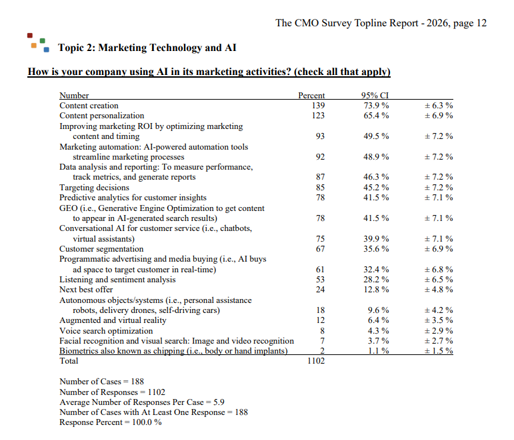
CMO Survey 2026: 41.5% use AI for generative engine optimization.
That gap is the problem with most pricing advice on this topic. Plenty of companies are doing the work. Very few publish what they pay, and the numbers that circulate mostly come from agencies with a reason to set expectations.
If you want a number: agencies that publish AEO prices mostly start B2B programs at $3,000 to $5,500 a month, and published monthly prices run from $950 to $15,000, with custom tiers starting at €15,995 at one agency (its own euro list price) and $20,000 at another. AEO doesn't have a market price yet, though, so anyone who quotes you one figure is guessing. Work out what you're buying, pick the pricing model that matches it, and estimate the cost from the inputs (hours, content, tools and outreach). You'll end up with a number you can defend.
New to the term? The AEO pillar guide explains what answer engine optimization covers, and AEO vs SEO explains how it overlaps with work you may already pay for.
What you're actually paying for
AEO is a bundle of services, and the price depends on which parts you need. Most proposals mix these six:
An audit. A review of how AI assistants currently describe your company and category, which prompts you appear for, and which sources they cite instead of you. Usually a one-off.
Content. New or rewritten pages that answer buyer questions directly: definitions, comparisons, pricing explanations, integration pages. This is often the largest cost, because it takes the most labor.
Technical work. Making sure crawlers can reach your pages, structured data matches what's on the page, and important content isn't hidden behind scripts or logins. Often small after the first round.
Mentions and coverage. Getting your company named on the third-party sites AI engines cite: industry publications, review sites, communities, partner pages. Slow and labor-heavy.
Measurement. A repeatable prompt set, run on a schedule across the engines your buyers use, with results tracked over time. The guide on how to measure AI search visibility covers what a sound process looks like.
Tools. Software for prompt tracking, crawling and reporting. You may already pay for some of this through your SEO stack.
When you compare proposals, map each one to these six. Two quotes that look far apart often turn out to cover different parts of the bundle.
The main pricing models
AEO work is usually sold in one of five ways, and each rewards something different.
Model | How it's billed | Best for | Watch for |
|---|---|---|---|
Monthly retainer | Fixed fee per month | Ongoing content, mentions and measurement | Vague deliverables that shrink over time |
Project or audit | Fixed fee for a defined scope | A first audit or a technical cleanup | Audits that end with a sales pitch, not a plan |
Hourly or day rate | Time billed | Advisory work for an in-house team | Open-ended hours with no output targets |
Add-on to an SEO retainer | Extra fee on existing work | Teams already paying for SEO | Old work relabeled as AEO |
Performance-based | Fee tied to an outcome | Rarely a good fit | Outcomes the provider can't control or prove |
Retainers are the most common for ongoing work, because the content and mentions parts never really finish. Project pricing suits the first audit. Hourly works if you have people to do the work and want an expert to steer.
Be careful with performance pricing. AI answers vary by run, account and model version, so a promise to get you cited for a fixed number of prompts is one nobody can keep or prove with confidence. If a provider offers it, ask exactly how they'll measure it and who controls the prompt set.
What agencies publish
Most agencies don't publish AEO prices, so the only hard numbers available are from the ones that do. The table draws on the pricing or service pages of seven agencies, checked on October 21, 2026, that list AEO or GEO prices on their own sites. Treat the table as a snapshot of published prices, not a market survey. Agencies that quote only on a call may charge more or less.
Agency | Published price, checked Oct 21, 2026 | Terms stated on the page |
|---|---|---|
Quint-IA Vantage | $950, $1,750 and $2,750 a month; $500 one-off diagnostic | 3-month minimum on the first tier, 6 months on the others |
Digital Estate Media | $1,500, $3,500 and $7,500 a month for AEO, GEO and LLMO packages | Most retainers month to month with 30 days' notice |
RevenueZen | $3,000, $5,000, $7,000, $10,000, $12,000 and $15,000 a month | Month to month, with 6- and 12-month options at discounted rates |
MADX Digital | $5,500, $9,500 and $14,500 a month; Enterprise from $20,000; $4,500 one-off roadmap | Billed monthly on a 12-month term, or a rolling contract with a three-month minimum at a higher price |
SimpleTiger | GEO Jumpstart at $4,000 a month for three months, $12,000 in total | No long-term commitment |
LoudFace | Engagements from $5,000 a month | Scoped on an intro call; fixed scopes have a 3-month minimum |
Discovered Labs | €6,995 and €10,995 a month; €4,370 one-off diagnostic; custom work from €15,995 a month | Its own euro list prices, not converted; shown for a 6-month commitment, and month to month costs more |
These aren't like-for-like packages. RevenueZen's lower tiers are content and SEO programs with AI brand monitoring, and its full GEO program starts at the $10,000 tier. Digital Estate Media mainly serves local businesses such as dentists and contractors, though it names SaaS and B2B too. Discovered Labs prices in euros and charges €1,000 and €2,000 a month more for month-to-month than the 6-month rates shown. MADX's listed prices are for its 12-month term; the plans say they save 15% (Authority) or 17% (Growth and Scale) against rolling monthly, and the rolling contract has a three-month minimum.
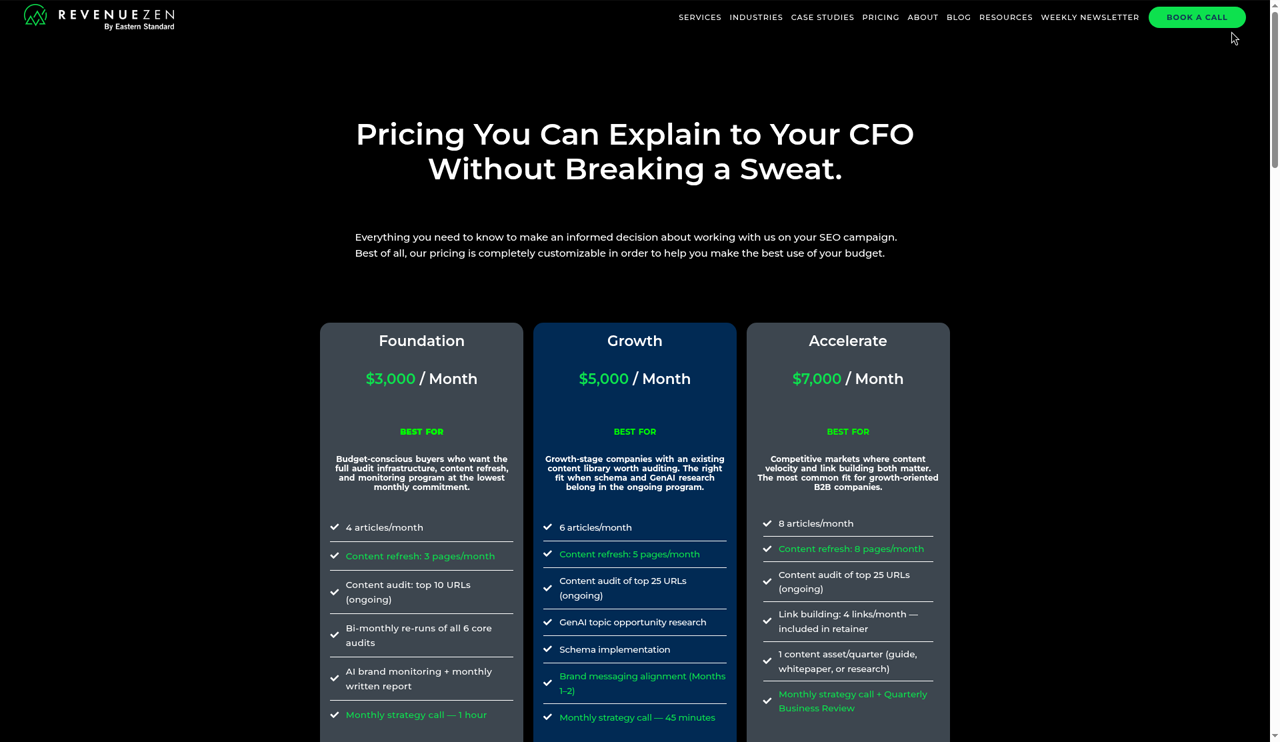
RevenueZen's pricing page: tiers from $3,000 to $7,000 a month.
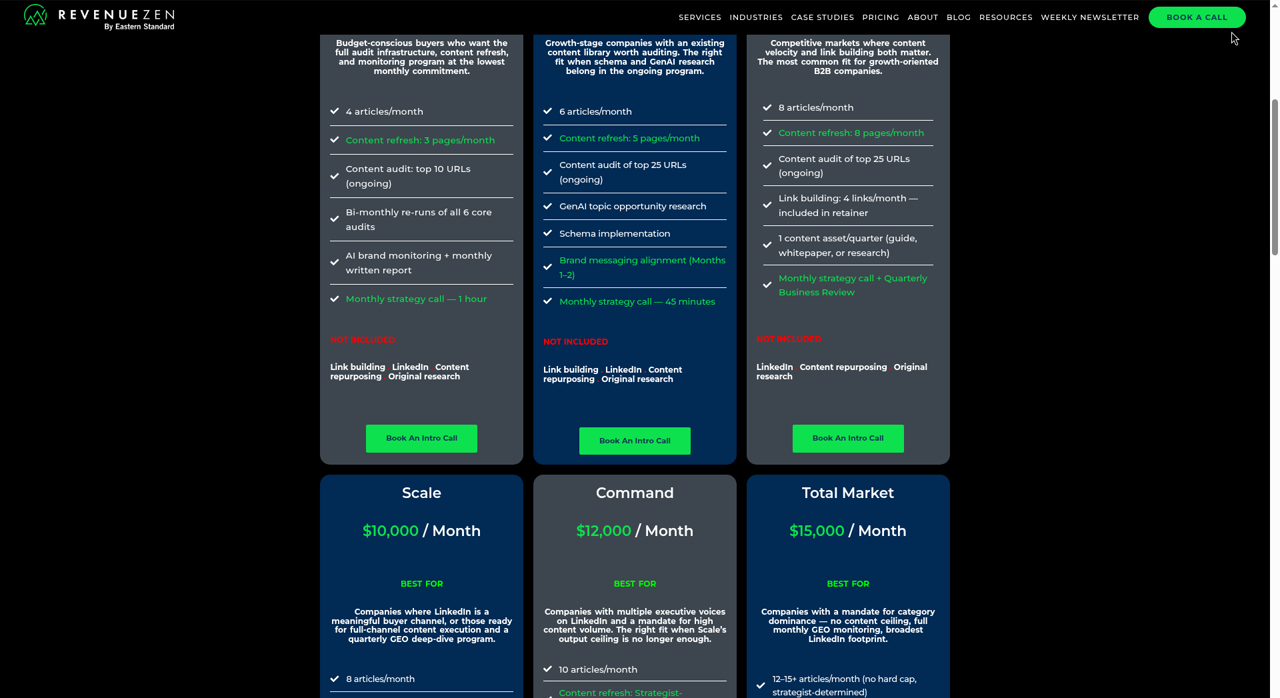
RevenueZen's upper tiers: $10,000 to $15,000 a month.
Miraa, which publishes this blog, lists plans at $2,500, $3,500 and $5,000 a month on its pricing page, with GEO and AI search visibility included in each plan.
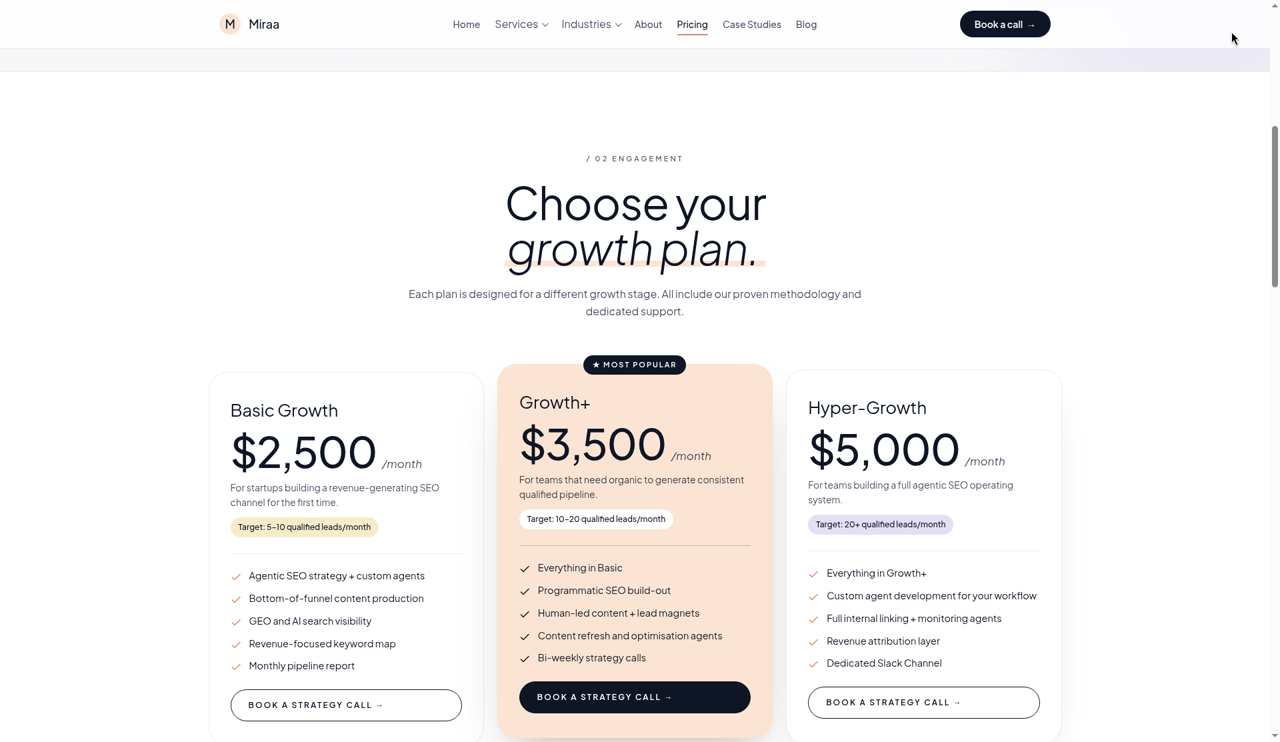
Miraa pricing page: plans at $2,500, $3,500 and $5,000 a month.
How to estimate cost by stage
The bands below line those published prices up against a company's stage. Like the table, they're a snapshot of prices on October 21.
Early stage, pre-product-market fit or a small team. You probably need an audit, a handful of foundational pages and a basic prompt set. The lowest published monthly retainers in the sample start at $950 (Quint-IA Vantage) and $1,500 (Digital Estate Media). One-off diagnostics run from $500 (Quint-IA Vantage) to $4,500 (MADX Digital's roadmap) and €4,370 (Discovered Labs).
Growth stage, a defined category and a few competitors. You need regular content, some coverage work and monthly measurement. Most published entry prices for B2B-focused programs sit between $3,000 and $5,500 a month: RevenueZen from $3,000, SimpleTiger's three-month Jumpstart at $4,000, LoudFace from $5,000 and MADX Digital from $5,500 on a 12-month term (more on its rolling three-month contract).
Later stage, several products or markets. You need everything above, by product or region, plus coordination with PR, product marketing and documentation teams. Published top tiers in the sample run from $7,500 (Digital Estate Media) and $14,500 (MADX Digital) to $15,000 (RevenueZen), with Discovered Labs at €6,995 and €10,995, custom work from €15,995 and MADX Digital's Enterprise tier from $20,000.
Two cross-checks help. Compare the result with what you already spend on SEO and content, since much of AEO is the same work. Then check it against your overall marketing budget. In the same survey, marketing expenses averaged 8.96% of company revenue among the 154 leaders who answered, with a median of 5%. As an example, a company with $10 million in annual revenue spending at that average would have a marketing budget of about $896,000 a year. A $5,000 monthly retainer is $60,000 a year, or about 6.7% of that budget. If your AEO estimate takes a large share of your budget, scale it back or phase it.
What it costs to do it in-house
The in-house option looks cheaper on paper and often isn't, because the costs are spread across people who also have other jobs.
People. Someone has to own it, usually a content or SEO lead who already has a full job. Count the share of their time AEO takes, plus writer or freelance time for the content itself. Your own payroll supplies the salary side of that sum.
Tools. Search Console is free. Prompt-tracking tools publish a wide spread of prices. OtterlyAI's pricing page, checked October 21, 2026, lists $29 a month for 15 prompts, $189 for 100 and $489 for 400, with Claude, Gemini and Google AI Mode as paid add-ons and custom plans from 1,000 prompts. Profound's pricing page, checked the same day, lists a free 7-day trial and custom Enterprise pricing, with no list price. If you build your own monitoring through an AI provider's API, check the current price list. For example, Google's documentation for grounding with Google Search lists 5,000 free search requests a month across Gemini 3 and newer models, then $14 per 1,000. A single prompt can trigger more than one billable search, so multiply your prompts by your runs per prompt and by the average searches per run before comparing with the free allowance.
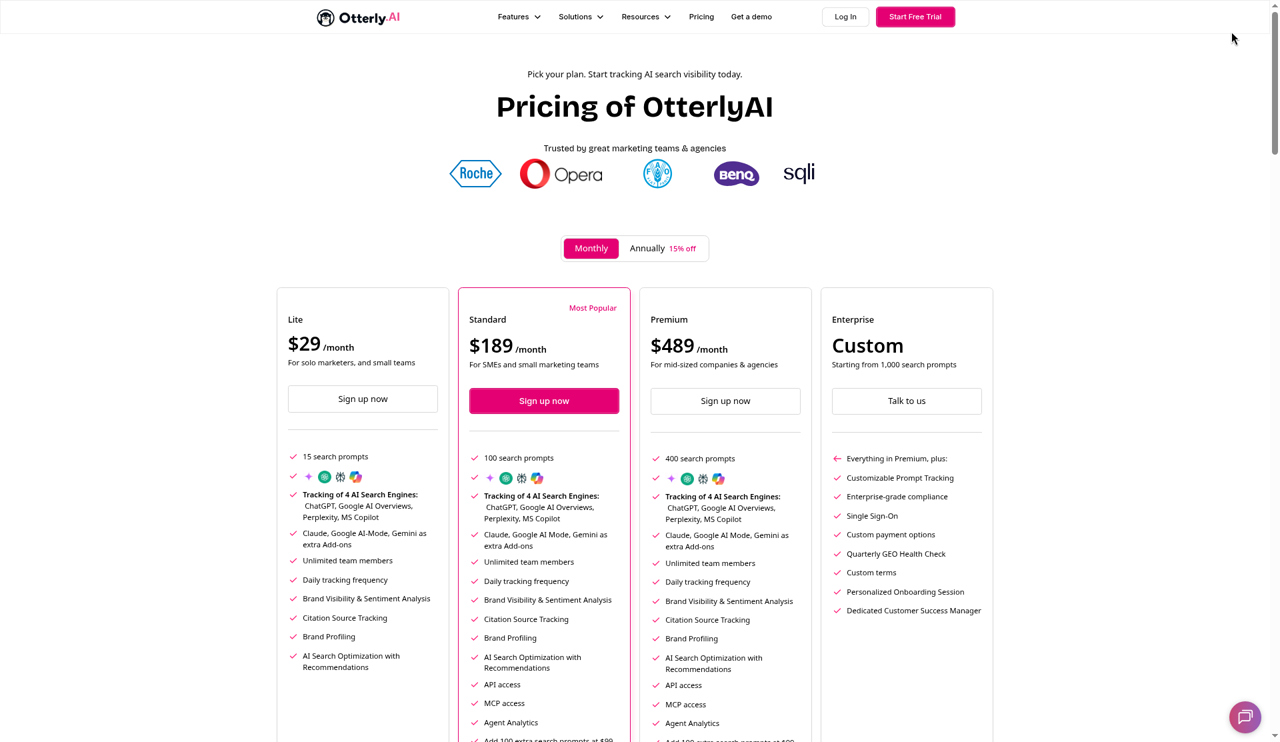
OtterlyAI plans priced by number of prompts tracked.
Here's how that plays out for a 100-prompt set checked once a day. On OtterlyAI's Standard plan it costs $189 a month, or $2,268 a year. Built on Gemini grounding, 100 prompts over 30 days is 3,000 requests. At two searches per run that's 6,000 searches, 1,000 past the free tier, so about $14 for the month. Push it to three searches per run and the bill is $56. Either way the API line is small. Read Gemini's wording closely, though: the free allowance is shared across Gemini 3 and newer models, so other grounded calls on the same account count against it. The bigger cost is the person who builds the tracker and reads it, which takes us back to the people line above.
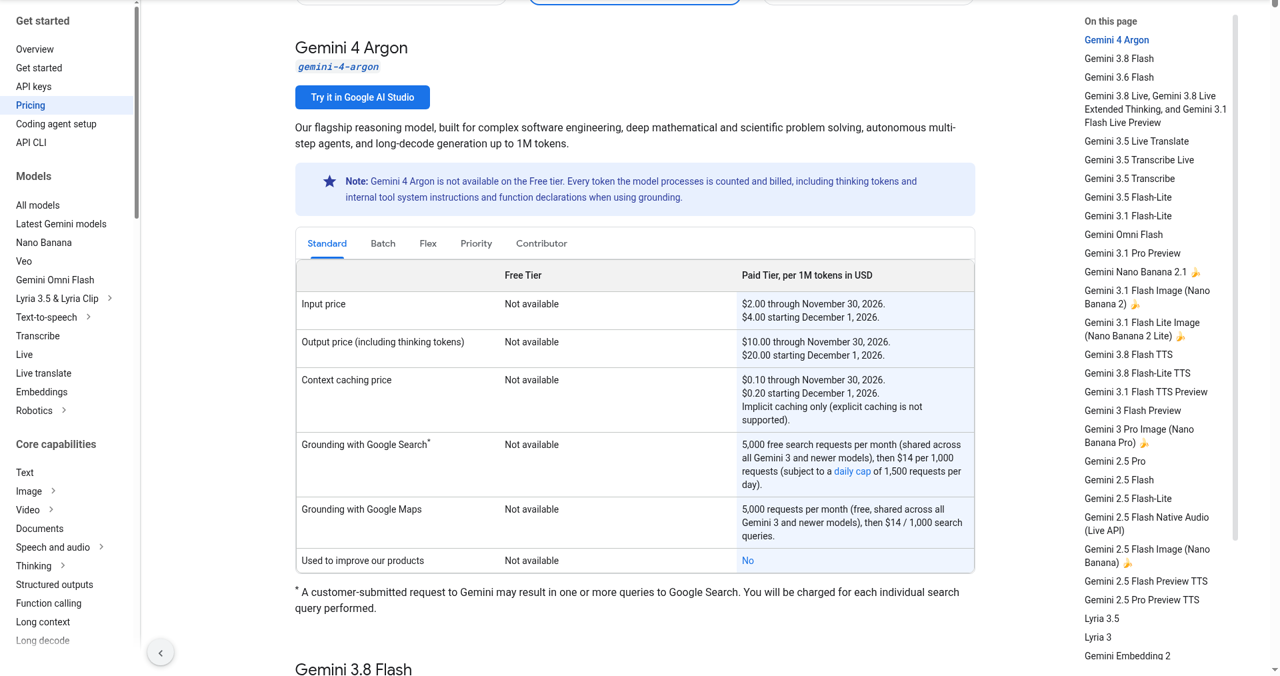
Gemini API pricing: free search requests, then $14 per 1,000.
Time to competence. An in-house team learning AEO from scratch will take a while to get the process right. That's a real cost, even if it doesn't show up on an invoice.
The survey gives useful context on how companies split this. Leaders said a mean of 33.59% of their digital marketing activities are currently performed by external agencies, partners and services, expecting 34.27% two years from now. Asked how they build new marketing capabilities, they put a mean of 59.52 of 100 points on training or hiring their own people and 15.48 on partnering with agencies. Most companies, in other words, lean on in-house capability with outside help for parts of the work.
If you're choosing between an agency and in-house, the roundup of the best AEO agencies for B2B SaaS shows what the agency side typically includes, and the comparison of AI visibility tracking tools covers the software you'd need either way.
Which situation are you in?
You already pay for SEO and content. Start by asking your current provider what they'd change to cover AI answers. A modest add-on may be enough, as long as the deliverables are specific and measured.
You have no SEO program. Don't buy AEO on its own. The foundations are shared, and most of the early work is the same: crawlable pages, clear answers, and a site that explains what you do.
You have a strong content team. Pay for expertise and keep the writing with your own people. An audit and a few months of hourly advisory work may cost less than a retainer and leave your team more capable.
You're under pressure to show AI results this quarter. Be wary. Measurement can be set up quickly, but the content and mentions work takes months. Budget for a phased plan with a modest first month.
Red flags in AEO proposals
Guaranteed citations. Nobody controls what an AI assistant says. A guarantee means the provider either doesn't understand the work or plans to measure it on prompts that already favor you.
New files as the main deliverable. Some proposals lead with technical files for AI crawlers. They may be a small part of the work, but they're rarely the main one. The guide to llms.txt explains what that file does and doesn't do.
Screenshot reporting. A screenshot of one answer, on one day, in one account, isn't measurement. Ask for a fixed prompt set, run several times on a schedule, with the raw results.
No content or mentions work. If the proposal is all audit and tooling, it won't change much. The work that moves AI answers is content and coverage.
Long lock-ins. A twelve-month minimum for a new kind of service is a lot to commit to before you've seen any results. Ask for a shorter first term.
What to watch out for
Comparing quotes that cover different work. Map every proposal to the same six components before comparing prices.
Ignoring overlap. Much of AEO overlaps with SEO, content and PR you already pay for. Don't pay twice for the same pages.
Agency-published benchmarks. As noted at the top, most "average AEO cost" figures come from agencies that sell the service. A list price tells you about one agency and nothing more.
Measuring too soon. Content and mentions take months to show up in AI answers. Set a review date that matches.
The survey behind this guide
The CMO Survey is run by Duke University's Fuqua School of Business, with Deloitte and the American Marketing Association as sponsors, which the survey says provide intellectual and financial resources. Deloitte sells consulting services, including marketing work, so it has an interest in how companies buy outside help. The 2026 edition was in the field from January 7 to 29, 2026. It invited 2,111 marketing leaders at US for-profit companies, got 308 responses for a 14.6% response rate, and 97% of respondents were VP level or above. Individual questions were answered by fewer people, so each figure in this guide gives its own base. All respondents work at US for-profit companies, and a market outside that may look different.
Final thoughts
The published range at the top is a starting point. The number worth defending comes from mapping a proposal to the six parts, picking the model that fits, and pricing the inputs yourself. Anyone promising outcomes they can't measure deserves the most skepticism.