
Last updated: November 13, 2026
On October 30, 2026, the biggest web search provider announced plans to honor a shared AI training opt-out in robots.txt, built on work from an internet standards working group. When a site uses the shared token to opt out and doesn't name the company's own AI training crawler, the company will read it as a block on that crawler too. Sites that explicitly allow that crawler stay eligible to have their pages used, and clicked, in the company's assistant answers. Support is planned for 2027. At a large software company, the person most likely to add a blanket opt-out is a lawyer or a security engineer, and the person who loses assistant visibility is in marketing.
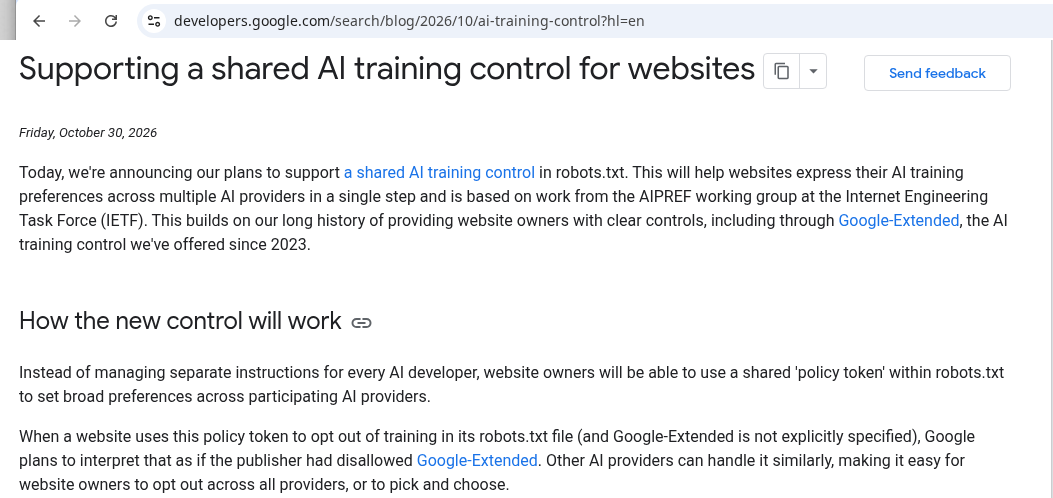
Shared AI training control post, Oct 30, 2026, captured Nov 3, 2026
Enterprise SaaS SEO is SEO for software companies with large, multi-product, often multi-region sites and many people who can change them. The tactics overlap with any B2B SaaS program. The work that decides results is coordination: who owns each technical control, how changes ship, and how one site serves a whole buying committee.
How enterprise SaaS SEO differs
A growth-stage SaaS company usually has one marketing site, one blog and one person who can publish. An enterprise SaaS company has several products, acquired brands, documentation and community sites, regional teams and a release process. Most of the differences come from that.
Area | Growth-stage SaaS | Enterprise SaaS |
|---|---|---|
Who can change the site | One marketer or a small web team | Web, product, docs, regional marketing, security and legal |
Site structure | One site, one blog | Several products, acquired brands, docs and community on subdomains, many locales |
Shipping changes | Publish any time | Change tickets, release trains, code freezes |
Buyers | A champion and a budget holder | A committee including security, IT, procurement and finance |
Measurement | Signups and trials | Pipeline and account influence over long cycles |
Biggest risk | Publishing too little | One change that breaks thousands of URLs at once |
Most enterprise priorities follow from the last row. A startup's worst SEO week is usually a quiet one. An enterprise's worst week is a migration without redirects, a robots.txt edit pushed by another team, or a template change that strips canonicals from every product page.
Governance comes before tactics
Every enterprise SEO program needs a written list of the controls that affect search and a named owner for each. Without it, the SEO lead finds out about changes after traffic drops.
Control | Usual owner | What SEO needs |
|---|---|---|
robots.txt | Web platform or security | Review rights on every change, with a diff in the ticket |
Redirects | Web platform | A redirect map attached to any URL change or launch |
Page templates | Front-end engineering | A check of titles, canonicals and structured data before release |
hreflang and locales | Regional marketing and web | One source of truth for which pages exist in which language |
Bot management and firewall rules | Security | Search and AI crawlers handled by verified identity |
Content approvals | Legal and product marketing | Turnaround times that don't stall every page |
The new AI training token belongs in the first row. In Google's October 30 announcement, "Websites that specifically allow Google-Extended are eligible to appear in responses and receive clicks via grounding in Gemini Apps." On its common crawlers documentation page (last updated October 30, 2026), Google intends to support the shared signal, with the line user-agent: __usage_ai-training, in early 2027. The same page adds that Google-Extended has no effect on whether a site is included in Google Search and isn't used as a ranking signal there.
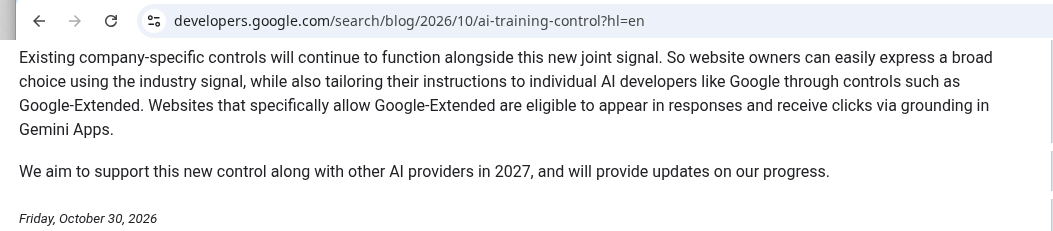
Google-Extended grounding and 2027 support, captured Nov 3, 2026
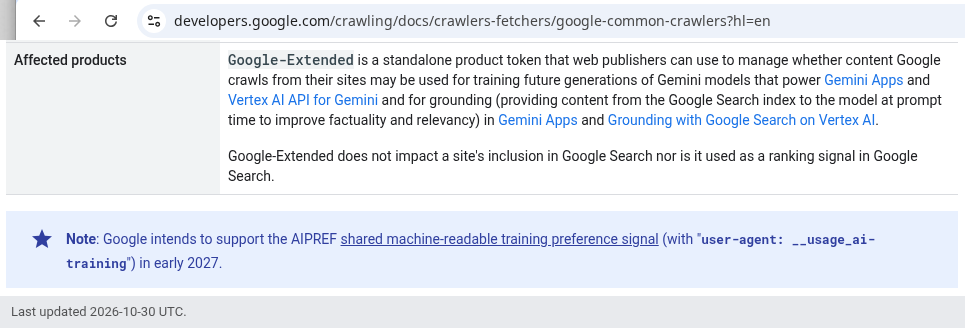
Common crawlers note, updated Oct 30, 2026, captured Nov 3, 2026
So the decision is about AI training and assistant grounding, separate from search rankings. Legal may have good reasons to opt out of training. Marketing may want the company's docs and product pages available to Gemini Apps. An explicit Google-Extended line records whichever choice the company makes, so the shared token can't make it by default. The AI crawlers and robots.txt guide covers the wider crawler list.
Technical priorities at scale
Crawl budget is rarely the real problem
Google's crawl budget guide (last updated July 22, 2026) is written mainly for sites with more than a million pages that change about weekly, or more than 10,000 pages that change daily. Most enterprise SaaS marketing sites are far smaller. Crawl budget matters for the parts that grow without limit: versioned documentation, community forums, programmatic integration pages and URLs with tracking or filter parameters.
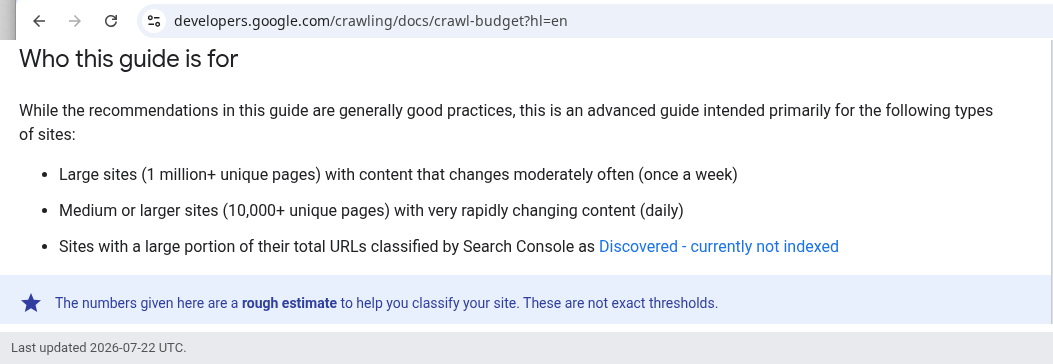
Crawl budget guide audience, updated Jul 22, 2026, captured Nov 3, 2026
For everything else, the usual issues are indexing quality. Duplicate templates across products, staging sites that leak into the index and old docs versions competing with current ones do more damage than any crawl limit.
Firewalls that block verified crawlers
Enterprise security teams run bot management, and crawlers get caught in it. Google's verification guide (last updated March 20, 2026) points large-scale checks to automatic matching of IPs against Google's published lists. In March 2026 Google moved those IP range files to a new path under /crawling/ipranges/ and planned to redirect the old location within six months. By November 2026 the old path redirected, so any firewall rule that still fetches it should point at the new path directly.

Manual and automatic verification methods, captured Nov 3, 2026
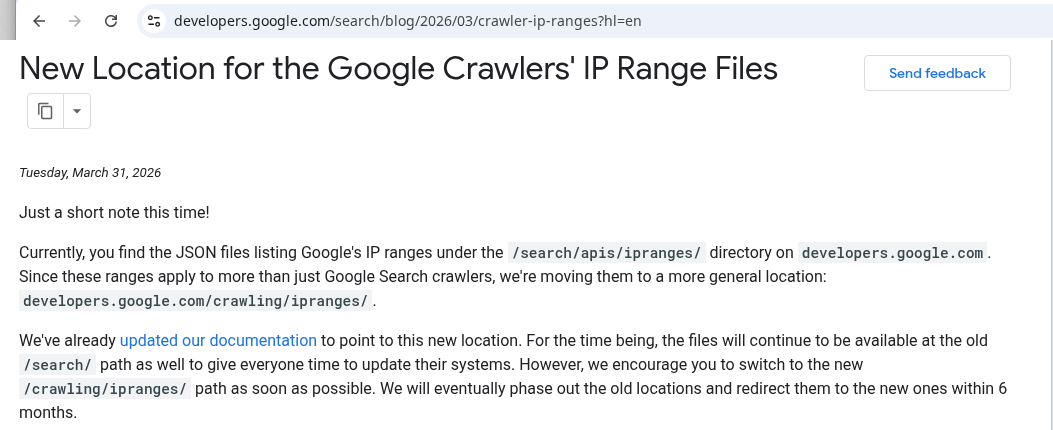
IP range files move, Mar 31, 2026, captured Nov 3, 2026
Subdomains, acquisitions and migrations
Docs, community, the app login and acquired brands often sit on separate hosts. Some of that is right for engineering reasons. The subdomain vs subfolder guide covers when the choice affects search, and documentation SEO covers making docs pages findable.
Acquisitions bring the riskiest projects. Folding an acquired brand's site into the main site is a migration with all the usual failure points, from missing redirects to lost internal links. The SaaS website migration guide has the checklist.
International sites
Multi-region SaaS sites need accurate hreflang across every locale. Google's localized versions documentation (last updated September 21, 2026) covers the methods. The common enterprise failure is drift: one region launches a page, another retires one, and the annotations stop matching.
Content for a buying committee
Enterprise deals involve people with different questions, and each tends to search for different things.
Security reviewers look for the trust center, compliance reports, data residency and subprocessor lists.
IT looks for SSO, SCIM, API limits and integration docs.
Procurement and finance look for pricing structure, contract terms and total cost.
End users look for how-to content and comparisons with the tool they use today.
Executives look for the business case and proof from similar companies.
Most enterprise SaaS sites serve the end user and the executive well and leave the other three to sales collateral. Security and IT pages are often gated or hidden in PDFs, even though these readers search for them before a call. Comparison pages for each major rival close another gap, since committee members compare vendors on their own.
Multi-product sites and cannibalization
Several products under one brand often target overlapping queries. A platform page, two product pages and a solutions page can all chase the same term, and none of them ranks well. The fix is one owner per query group and a clear hierarchy from platform to product to feature. The keyword cannibalization guide covers how to find and merge competing pages.
Measuring enterprise SaaS SEO
Signups rarely capture the value. Enterprise buyers research for months, often from many people at one account, and convert through sales. Useful measures include pipeline from organic first touch and later touches, visits from target accounts, and branded search growth in priority regions. The B2B SEO attribution guide covers the reporting model.
AI answers add a layer that analytics misses. Assistant mentions and citations need their own tracking, covered in how to measure AI search visibility. Search Console should have separate properties for each subdomain and major locale, so a problem on docs or one region is visible on its own.
A worked 90-day plan for a hypothetical enterprise SaaS
Take a hypothetical data security company with three products, one acquired brand still on its own website, docs on a subdomain, five locales and a robots.txt file that the security team edits directly. The new SEO lead has a quarter to set priorities.
Weeks | Priority | Owner | Why it comes here |
|---|---|---|---|
1 to 2 | Control list and owners, review rights on robots.txt and redirects | SEO lead, web platform, security | Prevents the next silent break |
1 to 2 | AI training and Google-Extended decision, written into robots.txt | Legal, marketing, security | The shared token arrives in 2027 and legal wants a position now |
3 to 4 | Firewall rules checked against the new IP range path | Security | Blocked crawlers undo every other fix |
3 to 6 | Index cleanup: staging leaks, old docs versions, parameter URLs | Web platform, docs | Removes duplicates competing with live pages |
5 to 8 | Query ownership across the three products | Product marketing, SEO lead | Ends cannibalization between product pages |
7 to 10 | Ungated security and IT pages | Security, solutions engineering | Serves committee members who search before calls |
9 to 12 | Migration plan for the acquired brand | Web platform, SEO lead | The riskiest project, planned once governance exists |
The order puts governance and access ahead of content. The acquired-brand migration waits until review rights and redirect rules are in place, because that's the project most likely to break thousands of URLs. Content for the buying committee starts in the middle of the quarter, once crawl and index issues stop hiding new pages.
What to watch out for
Treating robots.txt as an IT file. At enterprise scale it's a business decision about search and AI visibility with several owners.
A blanket AI opt-out by default. Without an explicit Google-Extended line, the shared token decides Gemini grounding for you.
Fixing crawl budget first. Most marketing sites are well below the sizes Google's guide targets.
Migrating before governance. A migration without review rights and a redirect owner is the most common way to lose a year of traffic.
One report for everything. A single Search Console property hides problems on docs, subdomains and smaller locales.
Content only for end users. Security, IT and procurement readers search too, and gated PDFs don't rank.
If you'd prefer a partner to run this across products and regions, Miraa does that as a B2B SaaS SEO agency. For a comparison of outside options, see the enterprise SaaS SEO agencies list.
FAQ
What is enterprise SaaS SEO?
It's SEO for large software companies, usually with several products, regions and teams that can change the site. The core practices match any SaaS program, with more weight on governance, technical scale and content for buying committees.
How is enterprise SEO different from regular SaaS SEO?
The tactics are similar. The differences are in who owns changes, how they ship, how many URLs one mistake can affect and how many people take part in a purchase.
Does crawl budget matter for enterprise SaaS sites?
Usually only for parts of the site that grow without limit, such as versioned docs, forums or parameter URLs. Google wrote its guide for sites past 1 million pages that change weekly, or past 10,000 pages that change every day.
Should an enterprise SaaS company block AI training crawlers?
That's a legal and business decision. Google-Extended doesn't affect Google Search rankings, but Google ties Gemini Apps grounding to sites that allow it. Whatever the choice, write it explicitly into robots.txt before the shared token arrives.
How long does enterprise SaaS SEO take to show results?
Technical fixes can show up within weeks once they ship. Content and authority work usually takes months, and release processes add time at large companies.
Getting an enterprise SaaS SEO program started
Start with the list of controls and owners, settle the AI training position, check that security rules let verified crawlers through and clean up the index. Then assign query ownership across products and build the security and IT pages buyers search for. Revisit the control list whenever a team, product or acquired brand joins the site.