

Last updated: November 11, 2026
On April 16, 2026, the largest search engine changed what happens when someone in the US clicks a link inside its AI search answers on its desktop browser: the page now opens next to the answer. The stated goal, in the announcement: "This makes it much easier to visit relevant websites, compare details and ask follow-up questions while still maintaining the context of your search." Its example has a shopper open a retailer's page beside the answer and ask a specific question, which gets answered "using context from the page and from across the web." For a SaaS team, that changes what a competitor analysis has to cover. A buyer can read your pricing page beside an answer built partly from rival pages, review sites and forum threads, so the analysis needs to record what those pages say about you as well as where they rank.
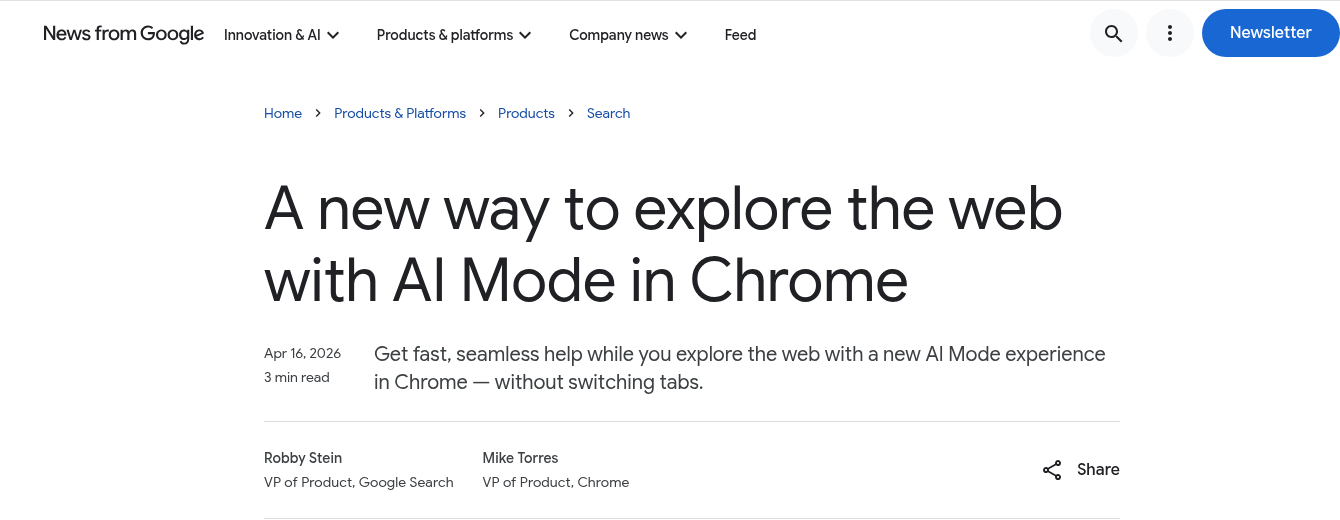
AI Mode in Chrome post, Apr 16, 2026, captured Nov 3, 2026
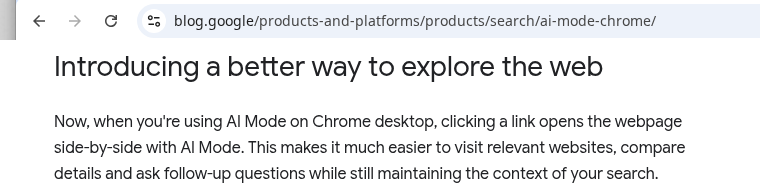
Links open side by side with AI Mode, captured Nov 3, 2026
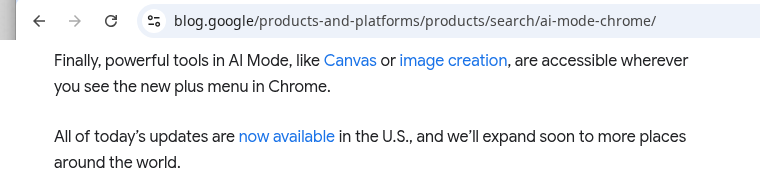
Updates available in the US, captured Nov 3, 2026
A useful SaaS SEO competitor analysis starts from the queries buyers type, records everything that ranks for them, and only then decides which sites count as competitors. The six steps here end with a worked analysis for a hypothetical company and a way to rank what it finds.
Business competitors and search competitors are different lists
Ask a SaaS founder who the competitors are and the answer is three to five products that show up in deals. Ask the search results and the list is longer and stranger.
For a query like "best expense management software for startups," the first page might hold two rival vendors, a review marketplace, a finance publisher's roundup, a community thread and a video. Each of those takes clicks from the same buyer. Some of them, like the review marketplace, also decide which vendors the buyer sees at all.
Search competitors also change by query type. A rival that owns every comparison query may have no presence on integration or how-to queries, where documentation sites and developer forums rank instead. A competitor analysis that studies only the rival's own site misses most of what ranks.
So keep two lists. The business list tells you whose pages to study. The search list tells you who you're actually up against for each query.
Step 1: build the query set before the competitor set
Start with 50 to 150 queries that matter to revenue, sorted by intent:
Category queries: "[category] software," "best [category] for [segment]."
Comparison queries: "[rival] alternatives," "[you] vs [rival]," "[rival] vs [rival]."
Problem queries: the pain your product removes, phrased the way buyers phrase it.
Integration queries: "[tool] integration with [system]."
Pricing queries: "[category] pricing," "[rival] pricing."
Pull candidates from Search Console, sales call notes, support tickets and review-site categories. Search Console only shows queries you already appear for, so the rival-name and category queries usually come from sales and from keyword tools.
Tag each query with the product area and the page type that should answer it. That tag becomes the spine of the analysis.
Step 2: record who ranks for each query
For each query, record the top ten organic results and any search features on the page: AI Overview, video block, forum results, ads. A rank tracker or a keyword tool can export this in bulk. Spot-check a sample by hand in a private window, since tool snapshots miss features and change by location.
Classify every result by type:
Result type | Example | What it means for you |
|---|---|---|
Rival vendor | A competitor's alternatives page | Direct content competition |
Review marketplace | A category grid on a software review site | Get listed and reviewed there; it also feeds AI answers |
Publisher roundup | A "best tools" list on a media site | Pitch for inclusion; hard to outrank |
Community thread | A forum or subreddit discussion | Buyers trust it; participate honestly or answer it on your own page |
Video | A walkthrough or comparison video | Format gap if you have no video |
Docs or developer site | An API reference or integration guide | Often wins integration queries |
Count the types per query group. If review marketplaces and publishers hold seven of ten spots on category queries, a new blog post won't move much there, and the plan should shift toward listings and inclusion.
Step 3: compare page types, not whole sites
The most useful output of a SaaS competitor analysis is a page-type inventory. For each rival on the business list, record which page types they publish and roughly how many:
Alternatives and comparison pages
Integration pages
Use-case or industry pages
Templates or free tools
Pricing page detail
Documentation that is public and indexable
Glossary and how-to guides
Then put your own counts beside theirs. A rival with sixty integration pages and a public API reference will keep winning integration queries until you publish the equivalent. A rival with a large glossary and thin product pages is winning traffic that may not convert, which is worth knowing before copying it.
For structure on the comparison pages themselves, the comparison pages guide covers what to include and how to stay fair to rivals.
Step 4: find gaps by intent
Keyword gap reports in SEO tools list queries where rivals rank and you don't. They're a starting point. Filter the list hard:
Keep queries that match a product area and a page type from Step 1.
Drop queries where the ranking rival page is a glossary entry or an off-topic post.
Group near-duplicates, so twelve variants of one question become one brief.
Note where you rank on page two already. Improve those pages before creating a new URL, since a second page on the same intent risks keyword cannibalization.
Treat traffic estimates in these tools with care. They model clicks from their own keyword panels and click curves, and they tend to undercount long, specific queries. Use them to rank gaps against each other, never as a forecast.
Step 5: compare authority and mentions
Links still matter, and so does who talks about each product. Record, for each rival:
Referring domains to the pages that win your target queries, not to the whole site.
Where those links come from: integration partners, review sites, publications, communities.
Brand mentions without links in roundups, forums and analyst-style lists.
The second and third items are more useful than any authority score. They show which publications and partners talk about the category, and that becomes an outreach list. How mentions and links each feed rankings and AI answers is covered in brand mentions vs backlinks.
Step 6: check AI answers for the same queries
Run a sample of the query set through the assistants buyers use, phrased as questions: "What's the best expense tool for a 30-person startup?" Record which products are named, which sources are cited and how your product is described, if at all. Then repeat a few pricing and setup questions with your own page open beside the answer, and again with a rival's, noting what the answer pulls in from other sites.
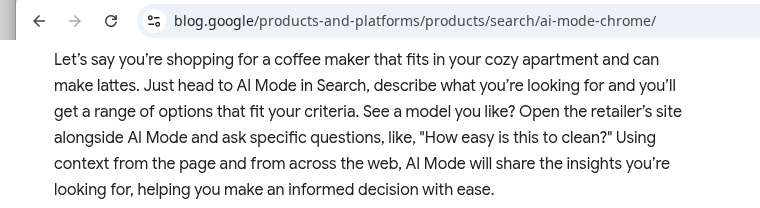
Coffee maker example from the announcement, captured Nov 3, 2026
AI answers often lean on the same review marketplaces and publisher roundups found in Step 2. When a rival is named in answers and you aren't, the fix usually sits on third-party pages, and another blog post won't reach them. The guide to getting recommended by ChatGPT covers which of those sources move answers, and prompt research for AEO explains how to build a prompt set that mirrors buyer questions.
A worked analysis for a hypothetical expense tool
Take a hypothetical expense management SaaS selling to startups with 20 to 200 employees. It has four business competitors, a blog of guides, a pricing page and no comparison or integration pages. The team builds a set of 80 queries and runs the six steps.
Query group | Who mostly ranks | Rival page types winning | Gap for this company | Action |
|---|---|---|---|---|
Category ("best expense software for startups") | Review marketplace, publisher roundups, one rival | Rival's segment landing page | No segment page; thin review profile | Build a startup segment page; refresh review-site profile and ask customers for reviews |
Comparison ("[rival] alternatives") | Rivals' own alternatives pages, review marketplace | Alternatives pages for every rival | No comparison pages at all | Publish four alternatives pages and a "vs" page for the closest rival |
Integration ("expense tool + accounting system") | Rival integration pages, accounting vendor's app directory | Sixty-odd integration pages at the largest rival | No integration pages | Build pages for the integrations the product already supports |
Problem ("how to stop receipt chasing") | Publisher guides, a forum thread, one rival blog post | Rival's how-to guides | Existing blog posts on page two | Rewrite two existing posts; no new URLs |
AI answers (sample of 20 prompts) | Rivals named most; review marketplace cited | Not a page type | Product rarely named | Prioritize review-site presence and inclusion in the roundups that answers cite |
The table changes the plan more than any traffic chart would. The team expected to need more blog posts. The analysis points to three page types that don't exist yet, two rewrites and a review-site push, with the blog mostly left alone.
The inputs here are hypothetical and the actions follow from them. A real analysis would size each gap by the revenue attached to the product area, not by keyword volume alone.
Turning the analysis into a ranked plan
Score each gap on three things, one to three each:
Revenue fit: does the query map to a product area sales wants more of?
Winnability: are rivals ranking with pages you can match, or are publishers and marketplaces holding the page?
Effort: a rewrite costs less than a new page type, which costs less than a new template system.
Sort by the total and take the top ten into the next quarter. Repeat the analysis twice a year, or after a major rival launches a new section of their site. Positions, page types and AI answers all drift over six months.
If a full audit of your own site is due at the same time, the B2B SaaS SEO audit guide covers that side.
What to watch out for
Copying a rival's content plan. Their glossary may be traffic with no pipeline behind it. Copy the page types that match buying intent and skip the rest.
Tool traffic estimates as fact. Modeled numbers rank gaps against each other. They don't predict your clicks.
Ignoring non-vendor results. Review sites, publishers and forums hold a large share of category results for many SaaS queries, and outranking them with a blog post rarely works.
One snapshot. Results vary by location, device and day. Check a sample by hand.
Analysis with no owner. Every gap in the final table needs a page type, an owner and a date, or the spreadsheet becomes the deliverable.
Studying only the four rivals sales names. A smaller rival or a new entrant may own the comparison queries already.
If you'd like this analysis handled inside an ongoing program, Miraa runs it for clients as a B2B SaaS SEO agency.
FAQ
How many competitors should a SaaS SEO competitor analysis include?
Three to five business competitors for the page-type inventory, plus whatever ranks for your query set. The search list is usually longer and includes review sites, publishers and forums.
What tools do you need?
Search Console for your own queries, a keyword tool for rival rankings and gap reports, a rank tracker for result snapshots, and a few hours in a private browser window. A spreadsheet holds it together.
How often should you redo it?
Twice a year, and after any rival launches a new site section or rebrand. A light monthly check on the top twenty queries catches big shifts.
How is a competitor analysis different from an SEO audit?
An audit looks inward at your own site's technical health and content. A competitor analysis looks outward at who wins your target queries and why. Most programs need both, usually in the same quarter.
Should you include AI answers in a competitor analysis?
Yes. Buyers ask assistants for shortlists, and the products named there are often the ones cited by review sites and roundups. Recording which rivals get named shows where third-party work is needed.
Running your first competitor analysis
Build the query set first, record every result type that ranks, compare page types against the rivals that matter, and score the gaps on revenue, winnability and effort. The first pass takes a few days. What it produces is a page plan built on the results buyers see.