
Last updated: November 19, 2026
One AI assistant cited 6.88 sources per answer on average, and another cited 16.35. The assistant with fewer citations relied much more on each page it cited. Independent researchers reported this in a preprint posted on April 28, 2026.
That gap sums up the SEO vs GEO question for a SaaS team. In SEO, you win a position in a list of links. In GEO, which stands for generative engine optimization, you try to become part of an AI answer. Sometimes that means a link in the answer. Sometimes it means your facts shape the text, with or without a visible link.
This post covers the day-to-day work. For definitions, read what GEO is and the AEO vs SEO comparison. AEO, answer engine optimization, is closely related to GEO.
Where Google draws the line
Google's position is short. From Google Search's point of view, optimizing for generative AI features is still SEO. AI Overviews and AI Mode run on its core ranking and quality systems.
Danny Sullivan said much the same in a Search Off the Record episode from December 17, 2025. He called AEO and GEO a subset of SEO, the way local SEO is a subset. He also allowed that new formats can need some specific work.
So most of the differences below come from AI tools outside Google Search. For ChatGPT, Perplexity, Copilot and the Gemini app, the inputs, the reports and the controls do change.
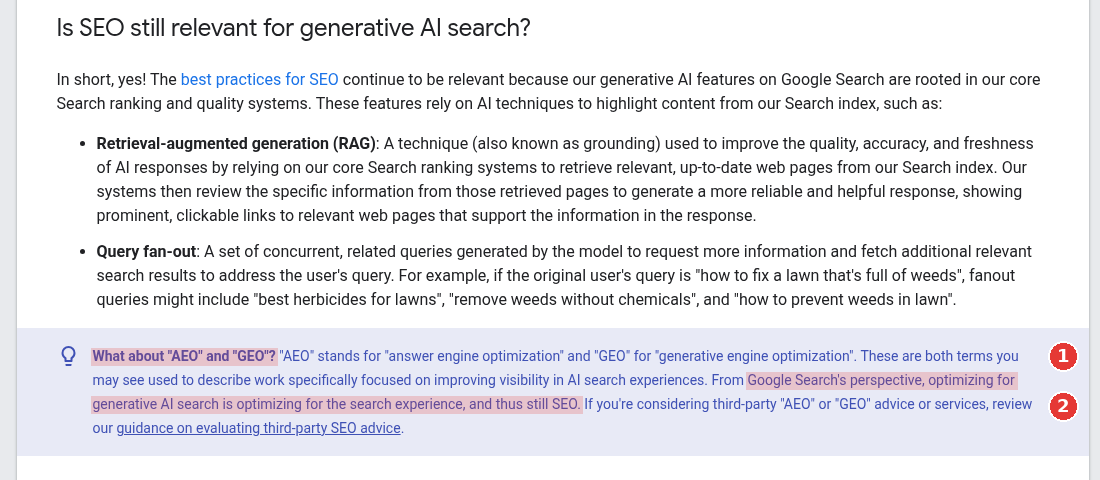
Google's AEO and GEO answer, captured Nov 17, 2026.
The nine differences at a glance
Area | SEO | GEO |
|---|---|---|
1. What you win | A ranked link | A citation or a mention inside an answer |
2. Which engines | Mainly Google Search | ChatGPT, Perplexity, Copilot, Gemini app and Google's AI features |
3. Content unit | A page that matches a query | A passage with facts the answer can use |
4. Off-site sources | Links to your site | Mentions in the places each AI tool reads |
5. System behind it | Google's index | Several systems, with Copilot reported by Bing |
6. Main console | Search Console | Search Console plus Bing Webmaster Tools and a prompt panel |
7. Main metric | Clicks, CTR, position | Citations, citation share, mentions |
8. Crawler controls | Googlebot rules | A separate crawler token for each AI company |
9. Tools and budget | Mature rank trackers, one monthly report | Sampled prompt tools, more manual checks |
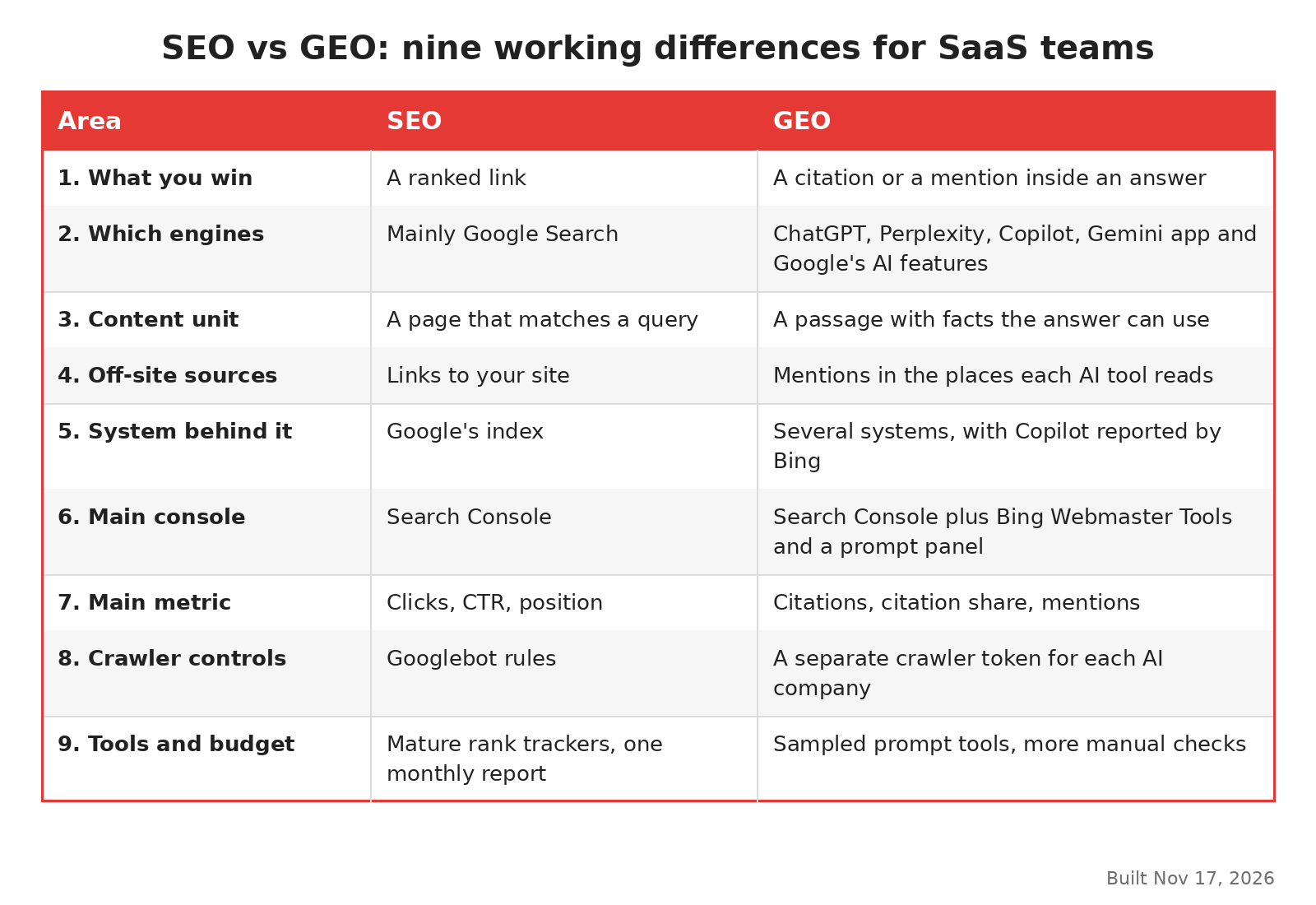
Nine working differences between SEO and GEO, built Nov 17, 2026.
How a 40-hour month could cover SEO and GEO
A SaaS marketing team in this example has 40 hours a month for organic work. Today all 40 go to SEO: content updates, technical fixes and a monthly Search Console report. These hours are inputs for this example, not a benchmark.
The team wants to add GEO without hiring. Our math on one split:
28 hours stay on SEO work. Google's AI features use the same systems, so this work covers part of GEO too.
6 hours go to a fixed panel of 30 buyer prompts, checked once a month in four AI tools. That is 120 answers to read.
4 hours go to off-site work, such as a demo video or a real answer in a community thread.
2 hours go to a second console and a short report on citations.
At 3 minutes an answer, the panel alone takes 6 hours. That is why the prompt list stays small. A bigger panel needs a tool or more people.
The nine differences in detail
1. What you are trying to win
A ranked link is visible and easy to count. A GEO target has two levels. The April 28, 2026 preprint calls the first one citation selection, where the AI tool picks your page as a source. The second is absorption, where your page actually shapes the words of the answer.
In that study, ChatGPT cited the fewest pages but drew far more from each one. Perplexity and Google cited more pages and took less from each. A SaaS team should track both: is the page cited, and does the answer repeat its facts?
2. Which engines you plan for
SEO plans for one main engine. GEO plans for several. For Google's own AI features, the SEO work is the GEO work. The extra effort goes into the assistants that sit outside Google Search.
3. The content unit
SEO thinks in pages and queries. GEO thinks in passages, the few lines an AI tool lifts into its answer.
The same preprint found that pages with high influence were longer and better structured. They also held more definitions, numbers, comparisons and steps. Q&A formatting on its own did not help. Q&A pages scored about 5.74% lower on influence than other pages, in relative terms.
So a SaaS pricing page with a clear table and plain numbers makes a good GEO asset. An FAQ page that only turns headings into questions does much less.
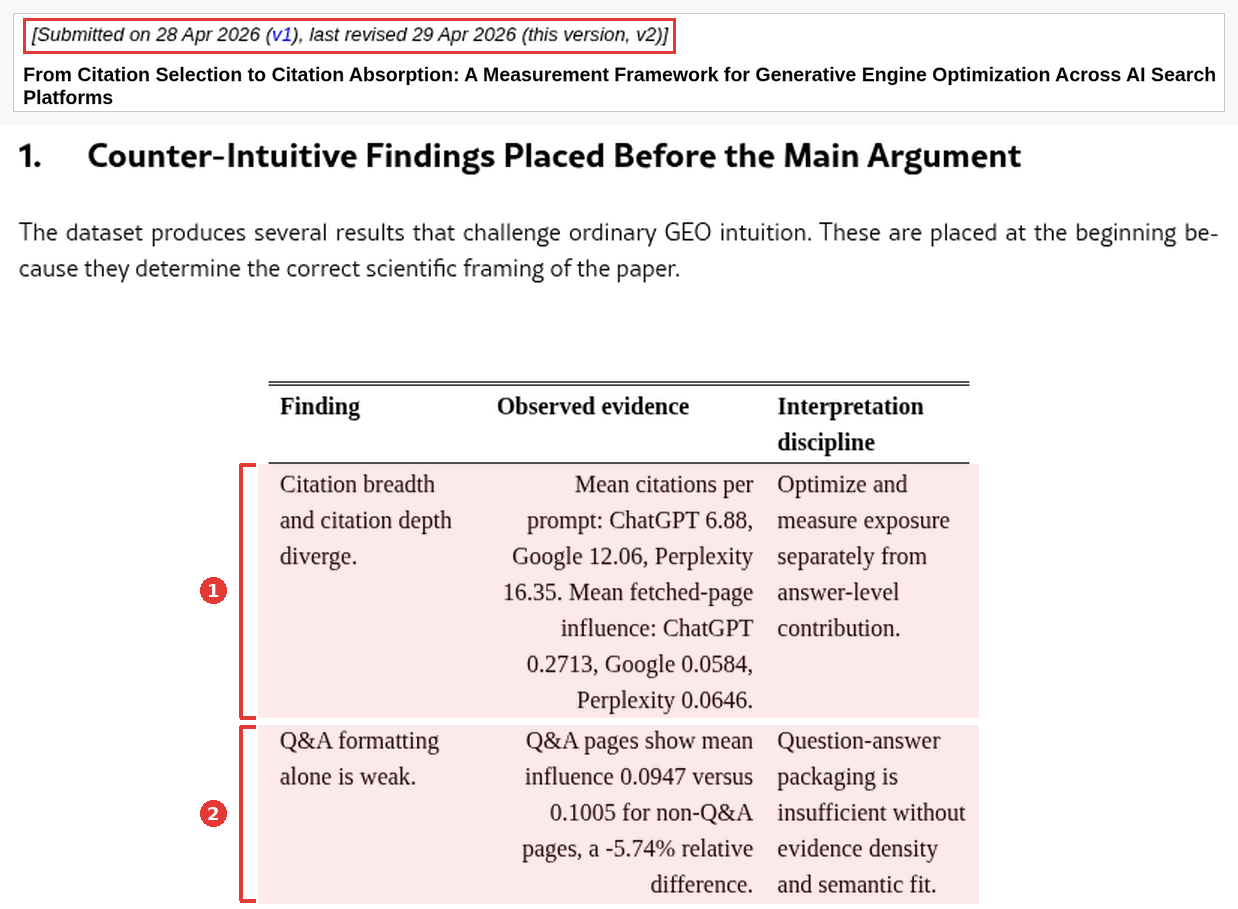
Citation breadth and depth by AI platform, captured Nov 17, 2026.
4. Off-site sources
For SEO, outside sites matter mainly through links. For GEO, mentions count as well. Google's AI features can show what people say about products in blogs, videos and forum discussions. Chasing fake mentions does little, because the same systems that block spam feed those features.
Each tool also draws on a different number of sources. In the April 28, 2026 preprint, Google's AI answers were in the middle at 12.06 sources per prompt. The study counted AI Overviews and Gemini together. ChatGPT and Perplexity were on either side of that. So one mention can carry more weight in a tool that cites fewer pages. Plan off-site work per engine.
5. The system behind the answer
Google's AI features draw on Google's Search index. Copilot citations show up somewhere else. Microsoft reports them in Bing Webmaster Tools, in an AI Performance report that covers Copilot, AI summaries in Bing and some partner AI tools.
If your SaaS site has never been checked in Bing Webmaster Tools, GEO is a good reason to start. The Copilot citation guide covers that setup.
6. The console you open each week
SEO lives in Search Console. Its Generative AI performance report, live for all sites since August 31, 2026, adds AI Overviews and AI Mode impressions.
GEO adds a second console. Bing introduced its AI Performance report on February 10, 2026. It shows total citations, cited pages, page-level citation counts and a sample of grounding queries. Grounding queries are the phrases the AI used to fetch your content. For other assistants, you still need your own prompt panel, as the AI search visibility guide explains.
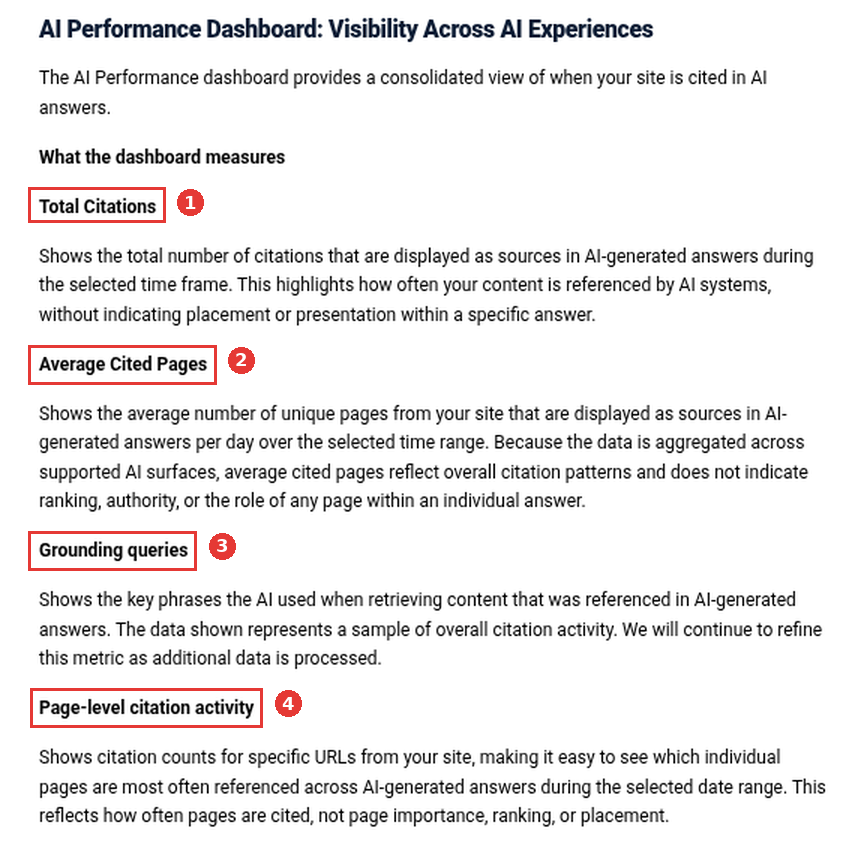
Bing's AI citation report announcement, captured Nov 17, 2026.
7. The metric you report
SEO reports clicks, CTR (clicks divided by impressions) and average position. GEO reports citations and mentions, and the two do not mean the same thing. On June 16, 2026, Bing added Citation Share. It measures the percentage of all citations for a grounding query that went to your site.
Bing is careful about what that number means. Citation Share does not rank sites or measure traffic. I would report it next to clicks, never in place of them. A citation count without any change in pipeline is a weak thing to show a CFO.
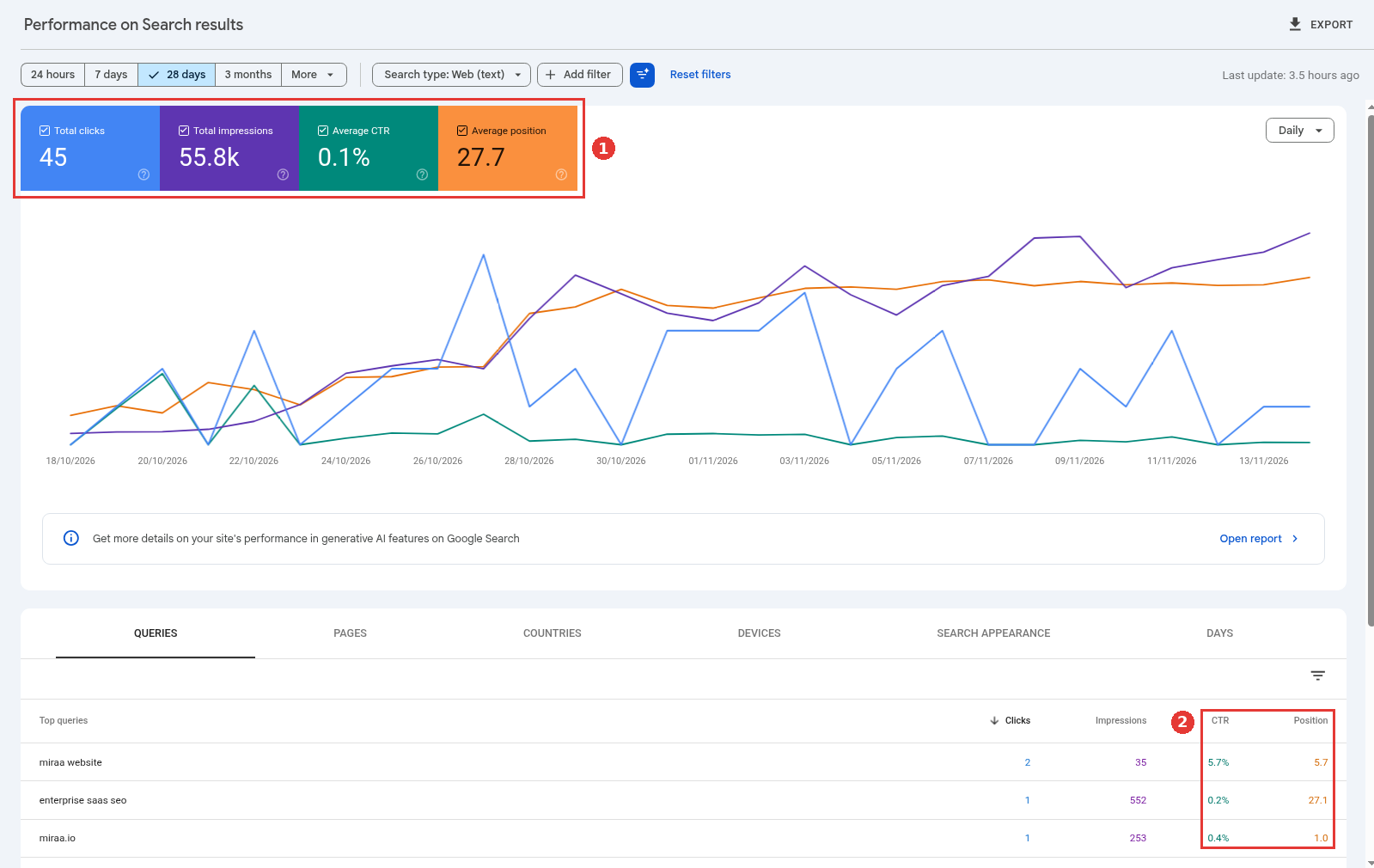
Search Console queries view on a healthy property, captured Nov 17, 2026.
8. Crawler controls
In SEO, robots.txt rules for Googlebot decide what Google Search can crawl. That also covers AI Overviews and AI Mode.
GEO adds more tokens. On October 30, 2026, Google wrote that sites that allow Google-Extended can appear in responses and get clicks through grounding in the Gemini app. The same post plans a shared AI training control for robots.txt, which Google aims to support with other AI providers in 2027. Other AI companies name their own crawlers, so check each one before you block or allow it.
9. Tools and budget
SEO tools have years of history, and the main data comes free from Search Console. GEO tools sample prompts and estimate the rest.
Third-party tools cannot see the ranking systems or the AI systems Google runs internally. That warning is fair for GEO tools in general. Before you buy one, read the buy or hire comparison. Ask how many prompts it runs, how often and in which countries.
Some teams find the panel, the second console and the off-site work hard to fit into one person's month. That is the point where a generative engine optimization agency can run the GEO side while the in-house team keeps SEO.
Where the two stay the same
The two still share a base. Pages have to be crawlable and indexable, meaning search systems can find them and store them. Content with first-hand detail that other pages lack still helps. Spam still hurts, since Google's AI features depend on the same systems that block it. A SaaS team that is weak at SEO will find GEO harder.
Questions SaaS teams ask
Should we start GEO before our SEO is in good shape?
For Google's AI features, no. The same work serves both. Fix crawling, indexing and thin pages first, then add a small prompt panel.
Does GEO replace SEO?
No. Google treats GEO for its own features as SEO. GEO adds work for the other AI tools on top of that base.
How long until GEO shows results?
No dated source gives a reliable timeline. Track a fixed prompt panel monthly for at least a quarter before you judge, and keep the prompts the same.