
Last updated: November 16, 2026
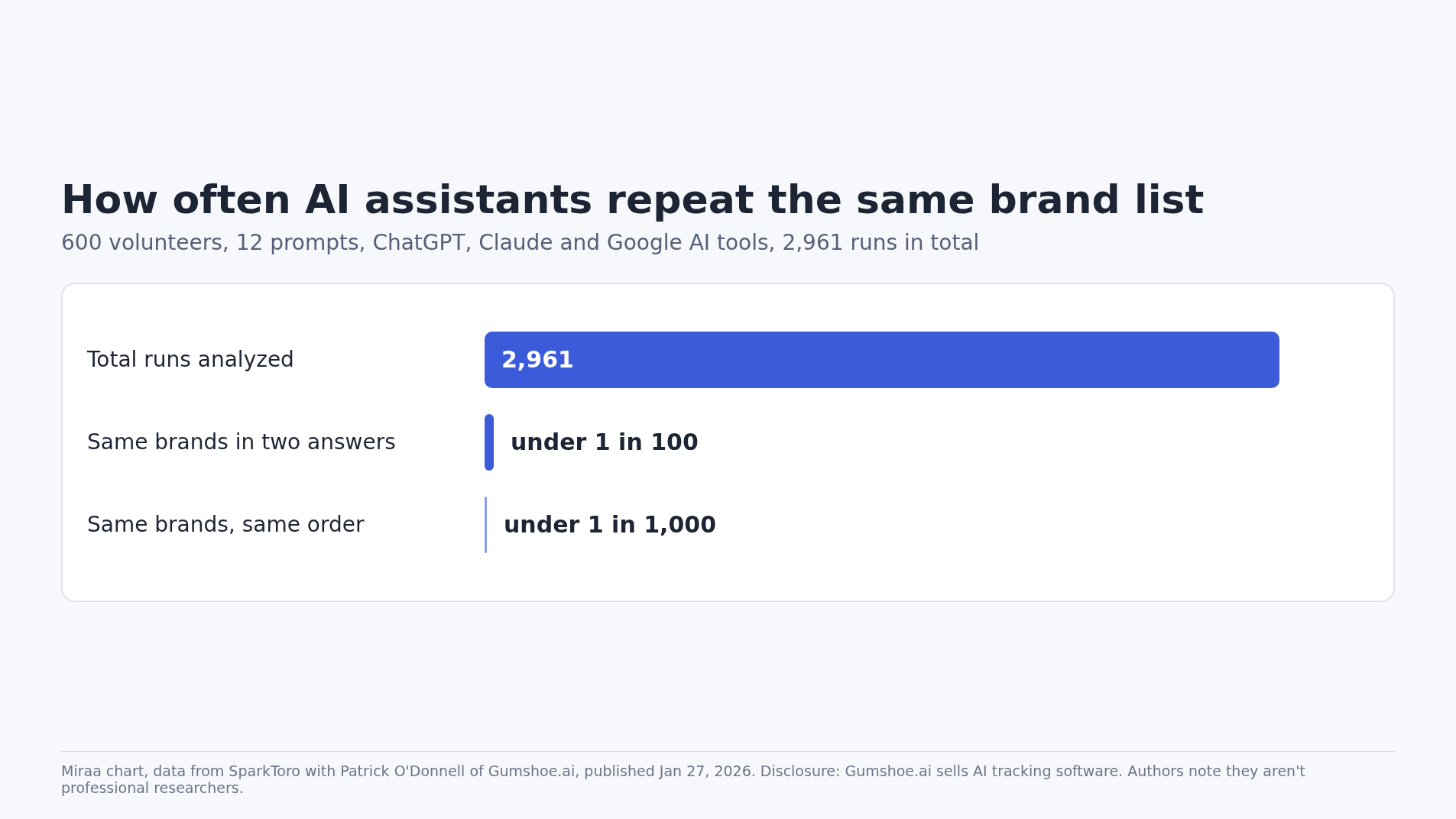
Ask an AI assistant the same buying question twice and you will probably get two different lists of brands. In a study published January 27, 2026, 600 volunteers ran 12 prompts through three popular AI assistants a combined 2,961 times. The odds that two answers listed the same brands were under 1 in 100, and under 1 in 1,000 for the same brands in the same order. The research came from an audience research software company working with an employee of a startup that sells AI tracking, and its authors note they aren't professional researchers.
Miraa chart, data from SparkToro and Gumshoe.ai, captured Nov 5, 2026.
The finding is about measurement. Any single answer is a weak sample, so a visibility number only means something when each question has been asked many times and the result is reported as a rate. That holds whoever runs the tracking: a tool, an agency or your own team.
The ai visibility tools vs geo agency decision comes down to budget, and staff time is the line most comparisons leave out. Software and an agency team do different jobs and get priced on different levers. If you've already settled on software, our roundup of AI visibility tracking tools compares individual products.
What AI visibility tools measure
Every tool in this category runs a list of prompts through a set of AI engines on a schedule and parses the answers. From those answers it reports whether your brand was mentioned, which competitors appeared alongside you, which URLs were cited as sources and, in many products, the tone of the description.
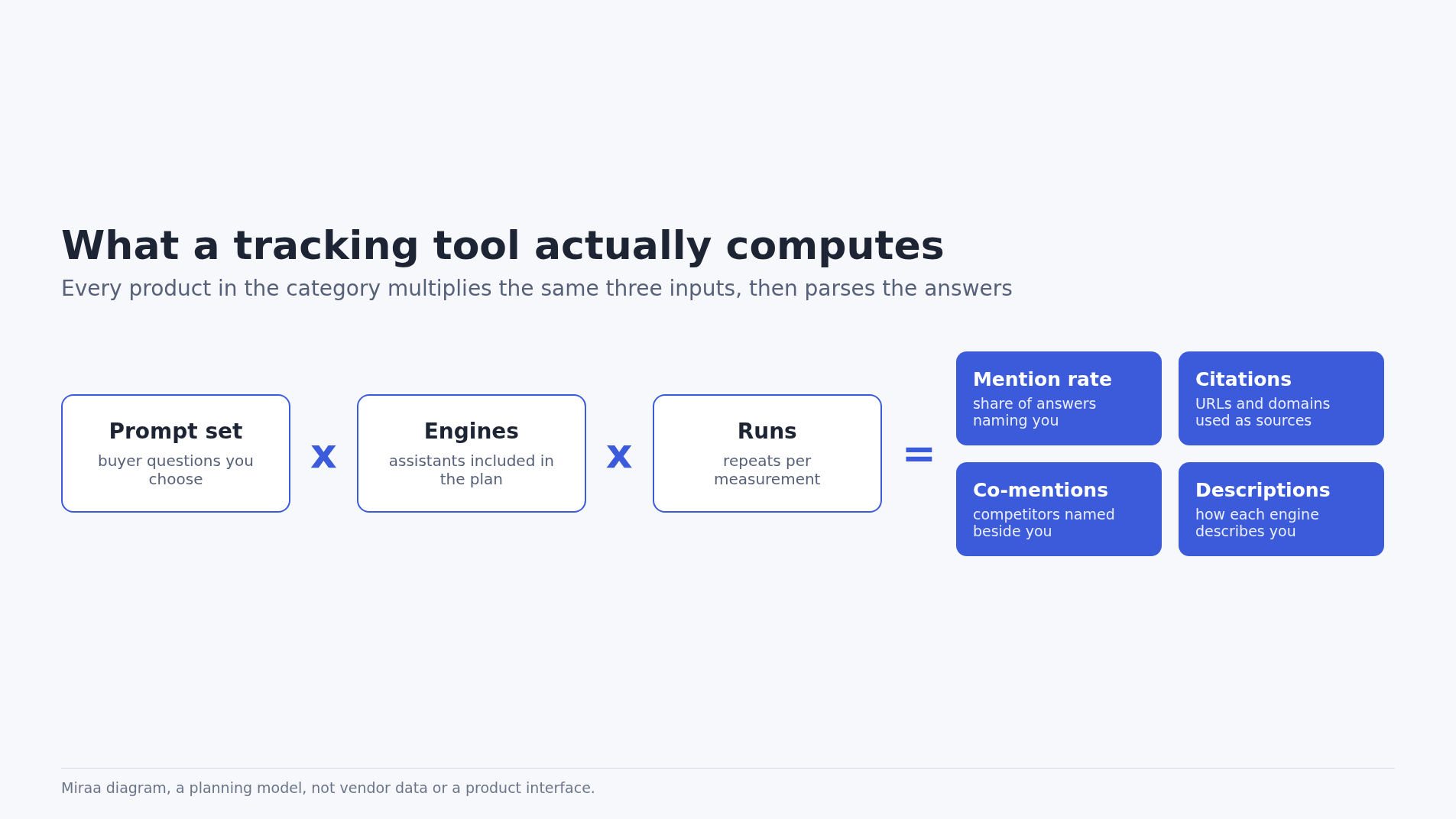
Miraa diagram of how tracking tools compute results, captured Nov 5, 2026.
The useful output is a rate. The study above, run by SparkToro with Patrick O'Donnell of Gumshoe.ai, a startup that sells AI tracking, concluded that visibility percentage across dozens to hundreds of prompts, each run multiple times, is a reasonable metric. It was much harsher on tools that report an AI "ranking position," which Rand Fishkin called "full of baloney" because order changed so often between runs. His practical advice was to ask the same question "usually at least 60-100X" before treating any set of recommendations as stable.
Wording is the second variable. When the researchers asked 142 volunteers to write their own prompt for the same headphone-buying need, the average pair of prompts had a semantic similarity of 0.081, which is barely related. Run repeatedly, those 142 prompts produced 994 responses, and the leading headphone brands still showed up in 55% to 77% of them. Brand presence held up across wildly different phrasing. List order didn't hold even for identical prompts. Both results lead to one reading rule: judge visibility by rates over many prompts and runs, never by a single answer.
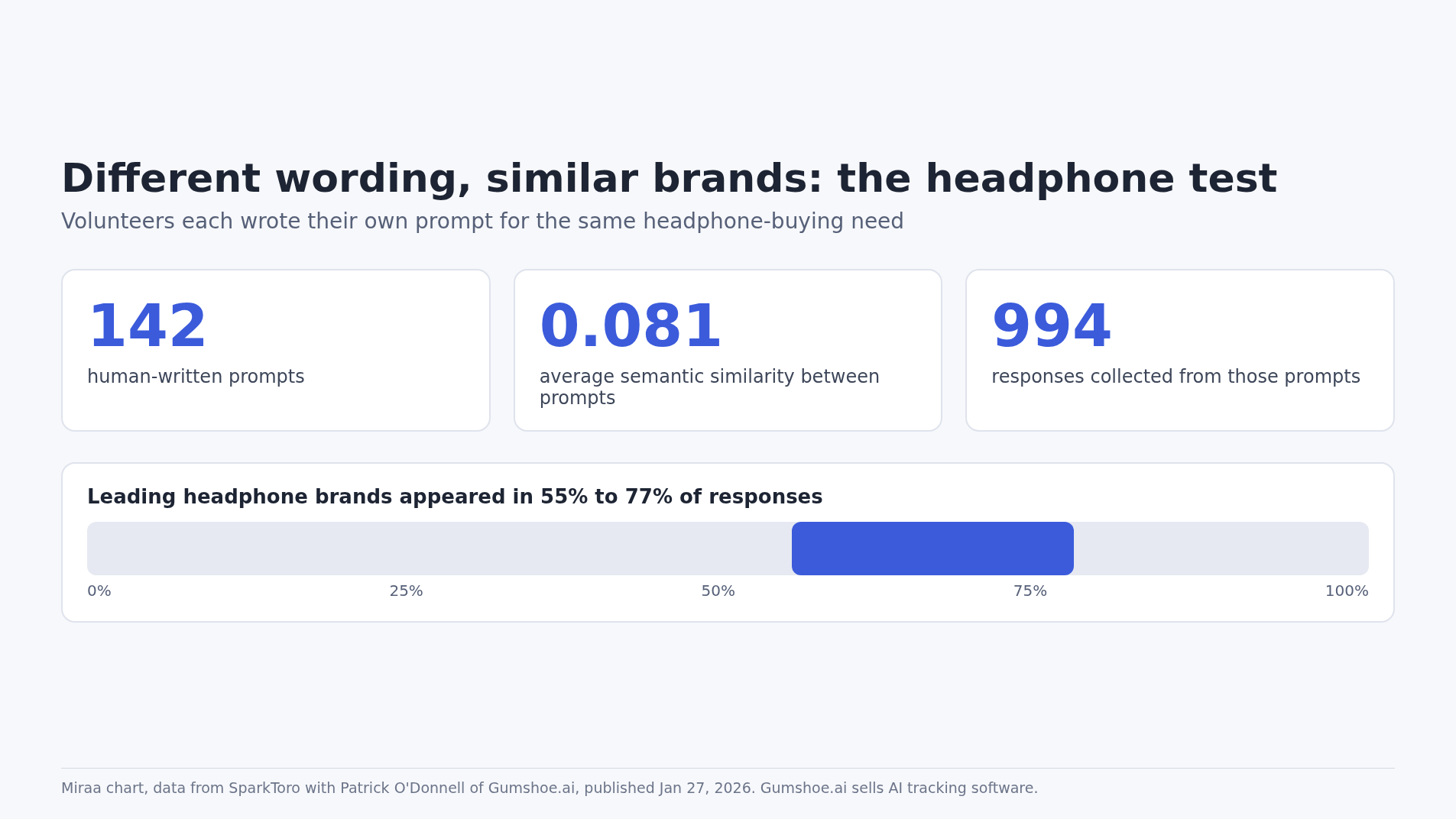
Miraa chart, data from SparkToro headphone test, captured Nov 5, 2026.
Measured that way, a good tool gives you:
A share-of-answers trend for a defined prompt set, useful for spotting gains or drops over months.
A list of the pages and third-party domains the engines cite for your topics, which tells you where coverage would help.
Competitor co-mentions, which show who the models group you with.
Snapshots of how each engine describes your product, so you can catch outdated pricing, retired features or wrong categories.
What a tool can't change
A dashboard can tell you that an assistant describes your product with last year's feature set. It can't rewrite the page that caused it. The work that moves AI answers falls into four areas, and none of them happens inside the software.
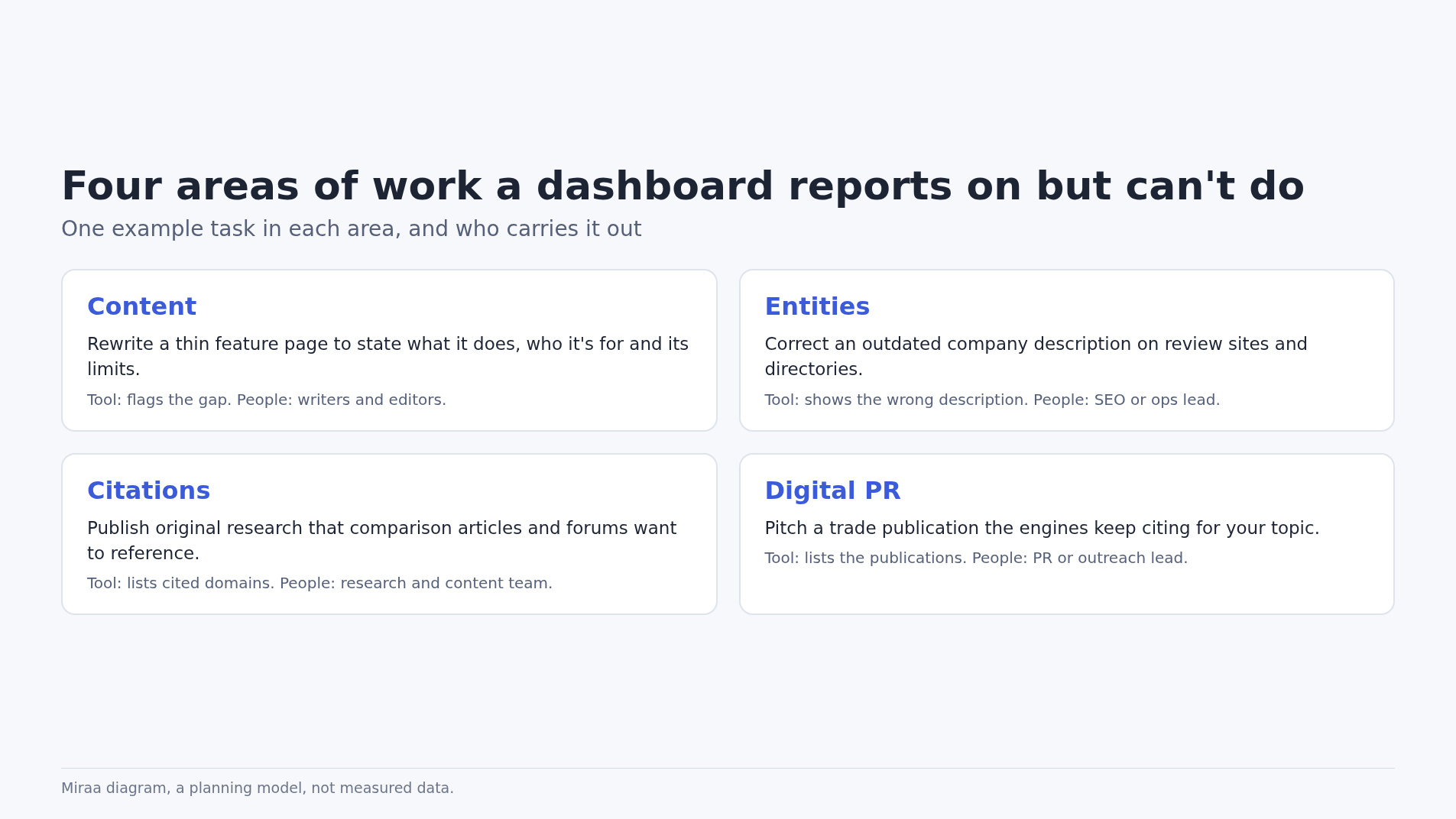
Miraa diagram of four work areas, captured Nov 5, 2026.
Content comes first. Models pull from pages that state clearly what a product does, who it's for, what it costs and where it falls short. If your feature pages are thin, your comparison content is missing or your documentation sits behind a login, the tool will keep reporting the same gap every week.
Entities come next. Assistants work out what your company is from consistent signals across your site, structured data, profiles on review sites and directories, and mentions in other people's content. Mismatched category labels or an old company description on a few high-authority profiles can outweigh a polished homepage. Fixing that means auditing every place your brand is described and correcting it, plus adding schema markup where it clarifies who you are.
Citations are the third area. Engines that show sources tend to lean on comparison articles, forums, review platforms and data-driven pages. Earning a place there involves publishing material others want to reference, such as original research, and then making sure the right people see it.
Digital PR rounds it out. Being named in trade press, analyst roundups and podcasts creates the third-party brand mentions that models use to decide which vendors belong in an answer.
Several vendors now bundle page audits, content suggestions or writing credits into higher plans. Those features help a team that already has editors and a publishing process.
What a GEO agency team does
A GEO agency sells execution. A typical engagement combines a strategist who chooses the prompts and topics worth winning, writers and editors who rebuild or create pages, a technical specialist who handles crawl access and structured data, someone running outreach or digital PR, and an analyst who reports results. Smaller shops may fold several of those roles into one or two people, so ask who will do the work each month.
Expect an agency to run a tracking tool as well, either its own or a third-party subscription, with reports that start from the same visibility metrics. The two options split after the report. A capable team turns a drop in mentions for a topic into a brief, a revised page, a pitch to a publication that keeps getting cited, or a fix to a stale directory listing.
Good agencies also say what they can't promise. No outside team has access to how a model was trained or can guarantee that a page gets cited. For example, our generative engine optimization agency scopes work around page changes, such as one canonical product description, limits stated beside claims and content refreshed when it goes stale, and reports on referrals, signups, demos and pipeline alongside visibility. Whoever you talk to, look for that kind of plain scope and avoid anyone who guarantees placements in AI answers.
How the costs compare
How tools are priced
Tool pricing rarely comes down to a flat fee. The vendor pricing pages we captured on November 5, 2026 build plans from a few levers:
The number of prompts you can track.
Which engines are included, with extra engines often sold as add-ons.
How often prompts run, sometimes expressed as a monthly allowance of responses or credits.
The number of brands, projects or workspaces.
Seats, which some vendors cap and others leave unlimited.
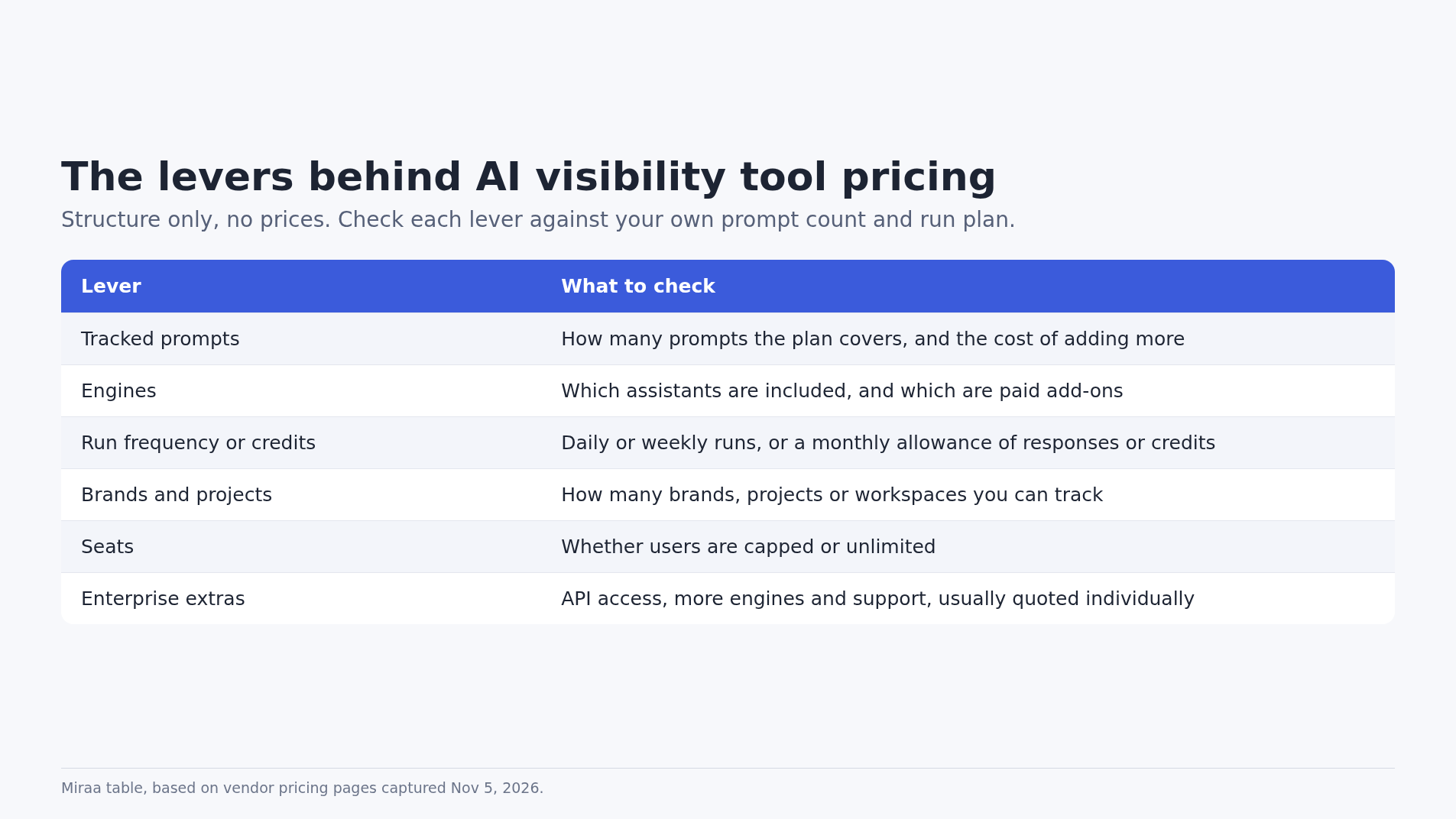
Miraa table, data from vendor pricing pages, captured Nov 5, 2026.
Entry plans cover a small prompt set on a few engines. Enterprise plans are quoted individually and add API access, more engines and support. Annual billing usually lowers the monthly rate. Since tracked prompts drive cost, sampling turns into a budget line: running each prompt many times multiplies the responses a plan has to cover. Plan details for each product are in our tools roundup.
How agencies are priced
When you collect agency quotes, check whether the fee is a monthly retainer, whether a paid audit or setup phase comes first, and how long the minimum term runs. Then look at what moves the number: pages written or rebuilt each month, whether digital PR is included, how much technical work is expected and how many markets or languages are covered. Ask too whether the tracking subscription is included, passed through at cost or left to you. Our guide to AEO pricing covers the wider range of what AEO and GEO retainers involve.
The cost a tool comparison usually skips
Buying only a tool still costs staff time. Someone has to choose prompts, read reports and then do the content, entity and PR work above. U.S. Bureau of Labor Statistics wage estimates for May 2025, released May 15, 2026, put the median pay for market research analysts and marketing specialists, the occupation group that includes search marketing strategists, at $37.87 an hour. Those figures cover employees only and leave out self-employed workers. Separately, the BLS employer cost survey for June 2026, released September 9, 2026, found that for full-time workers in private industry, wages accounted for 68.5% of what employers spend on compensation. Benefits cover the remainder.
A worked scenario
Take a hypothetical B2B software company that wants to track 50 buyer prompts across three AI assistants and act on what it finds. The math below is our own, built only from the figures cited above, and the hours are assumptions you should replace with yours.
Sampling first. If each prompt runs 60 times per measurement, the low end of the range Fishkin suggested, one full snapshot needs 50 x 3 x 60 = 9,000 responses. Check that against each plan's monthly response or credit allowance before you compare prices. A cheaper plan that runs each prompt once a day gives you a noisier read.
Then labor. Dividing the $37.87 median hourly wage by 0.685 gives a loaded cost of about $55.28 an hour per our calculation. The 68.5% share is a private-industry average, so treat that rate as an estimate. Suppose a marketer spends 20 hours a month on prompt upkeep and reports, and 60 hours a month on page rewrites, profile fixes and outreach. Those 80 hours come to about $4,420 a month (80 x $55.28) before the tool subscription. A full-time year averages about 173 working hours a month (2,080 / 12), so that's close to half of one person's time.
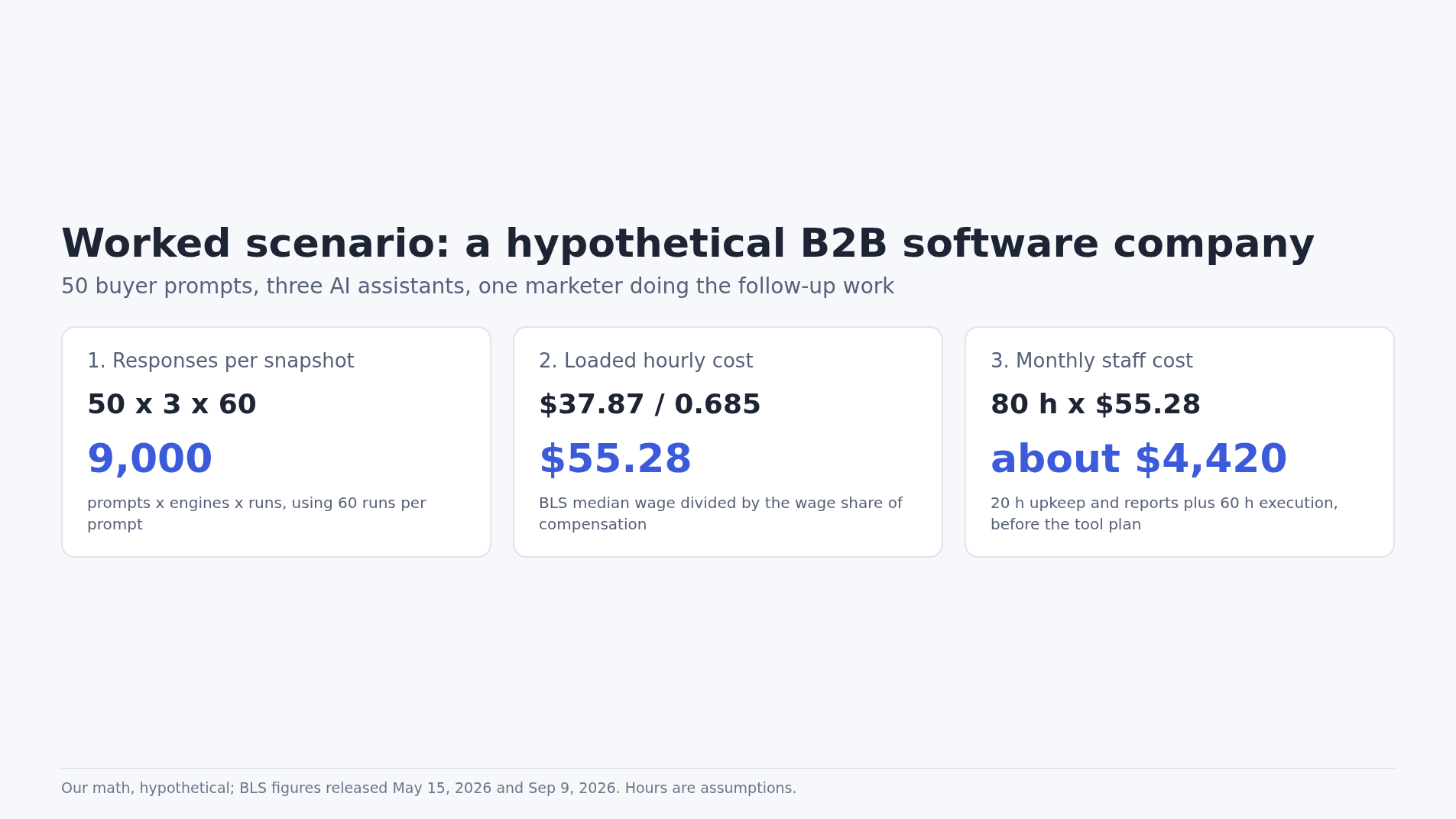
Our math, hypothetical, data from BLS releases, captured Nov 5, 2026.
Use that figure as your yardstick for agency quotes. If a retainer covering similar output costs about the same as $4,420 plus your tool plan, the agency brings specialists your marketer may not have, like PR contacts and technical skills. If the quote is far higher, ask what extra output it buys. If your team already has the 80 hours and the skills, a tool alone is the cheaper route.
Who should pick which
A tool on its own makes sense when you have writers, an SEO lead and someone who can pitch press, and you mainly need a way to see whether their work is changing AI answers. It also suits teams with a narrow product and a short prompt list, where one person can act on findings in a few hours a week.
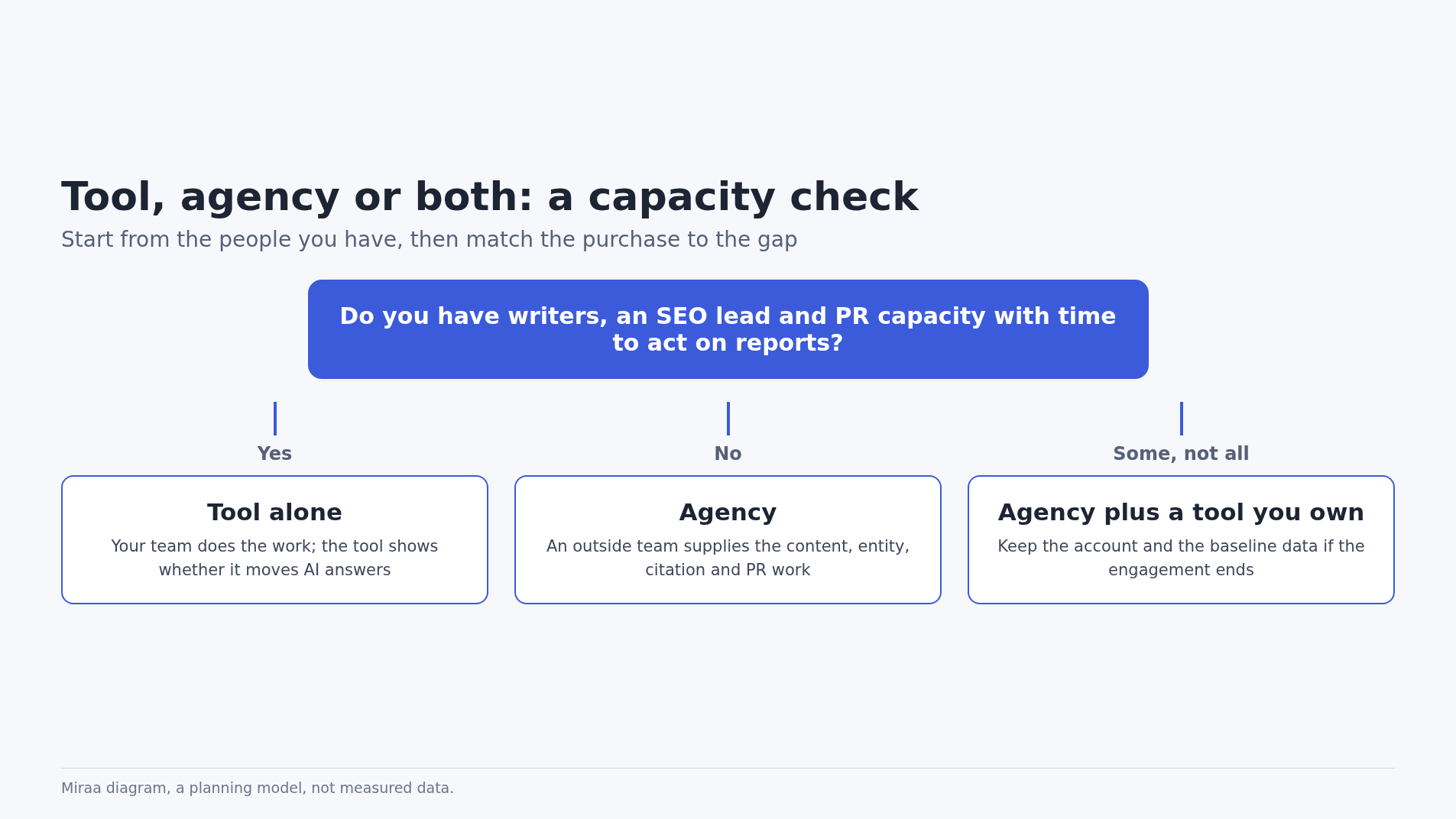
Miraa diagram of the tool or agency decision, captured Nov 5, 2026.
An agency makes sense when the reports keep showing the same gaps for months and nobody has time to close them. At that point another dashboard adds data to a team that is short on hours. The same goes for brand descriptions that are inconsistent across many third-party sites, or digital PR you need without the contacts. It also helps when leadership wants a named owner for AI search results along with someone accountable for traffic and pipeline.
Many companies end up with both. In that case, settle early who owns the tool account and the historical data, so you keep your baseline if the engagement ends. Also agree on which prompts define success before work starts, since a different prompt set can make any month look better or worse.
Some teams should wait on both. If you have few pages that explain what you sell and little organic demand, start with the basics covered in our guide to measuring AI search visibility and fix the core pages first.
Questions to settle before you sign
For a tool, ask how many times each prompt runs per measurement period, whether you can export raw responses, and whether reports show visibility rates or a single ranking position. Given how often order changes between runs, a tool that leads with position deserves extra scrutiny.
For an agency, ask:
Which prompts and topics they will target, and who picks them.
What gets produced each month in pages, fixes and outreach.
Which tool they use and whether you keep access and data afterward.
How they report results other than visibility, such as referral traffic from AI engines, signups and pipeline.
What happens at the end of the minimum term.
For background on the discipline itself, read what GEO is and how it relates to classic SEO.
FAQ
Can an AI visibility tool improve my brand's visibility by itself?
No. It measures mentions, citations and descriptions across a prompt set. The numbers move when your pages, third-party profiles and outside coverage change.
Does a GEO agency replace a tracking tool?
No. An agency still needs tracking data to report progress, and it may bring its own subscription or work in yours.
How many prompts should I track?
Enough to cover the main questions buyers ask at each stage, then run each one many times. In the headphone test, people phrased the same need so differently that a short, narrow list can miss how real buyers ask.