
Last updated: November 3, 2026
When Google shows an AI summary on a search, people make 39.8% fewer clicks out to websites from the results page, and their clicks on ads don't measurably change. That's the headline estimate from a randomized field experiment run by researchers at a business school in India and a US university.
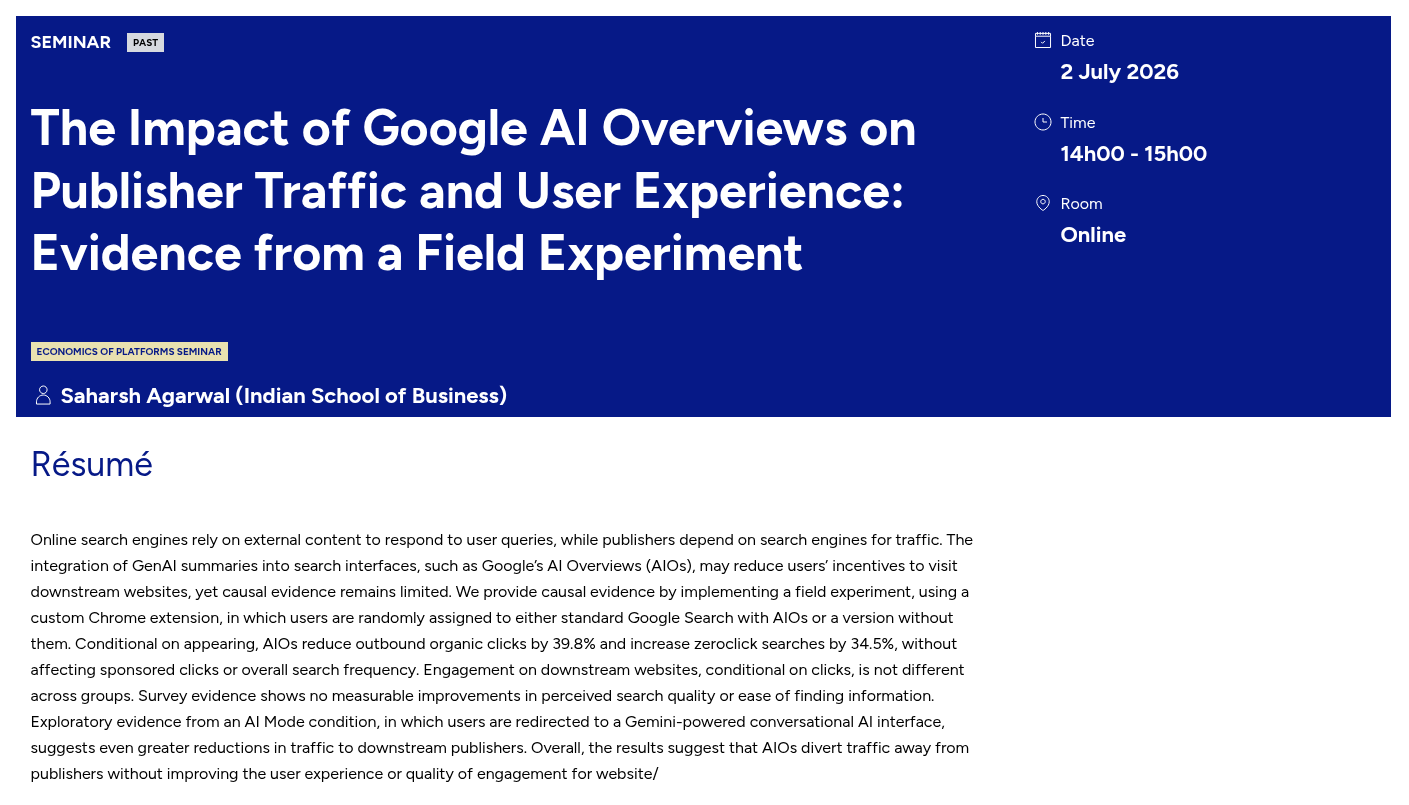
AI Overviews cut outbound organic clicks by 39.8% in this experiment.
A browser extension hid or showed the summaries for 1,065 US desktop Chrome users between January 7 and February 10, 2026, and the working paper is dated June 17, 2026. On searches where a summary would have appeared, people who never saw one clicked out 0.62 times per search, against 0.37 for people on the standard results page.
Use PPC for speed and for buying queries you can't win organically yet. Use SEO for the questions buyers research before they shortlist, which is also where AI answers find their sources. For most B2B SaaS companies the right answer is both, weighted by stage: pay for the clicks you need this quarter, and build pages for the answers you want to own next year.
What the AI Overviews experiment does and doesn't show
The study is by Saharsh Agarwal of the Indian School of Business and Ananya Sen of Carnegie Mellon University: "The Impact of Google AI Overviews on Publisher Traffic and User Experience: Evidence from a Field Experiment," dated June 17, 2026. Participants recruited online installed a custom Chrome extension and were randomly assigned to one of three groups: normal Google results, results with AI Overviews hidden, or a redirect to AI Mode. The 39.8% figure compares the first two groups.
It has limits if you sell software. The sample is US consumers on desktop Chrome, searching for whatever they normally search for, so it isn't a panel of software buyers. Ad clicks were rare, about 0.02 per search, and the authors say detecting an effect on them would take a much larger sample. "No measurable change" in ad clicks isn't proof of no change. The AI Mode arm also lost more participants than the others, which is why its even larger traffic drop is treated as exploratory.
Run the averages on 1,000 searches that trigger a summary. Without it, people make about 620 clicks out to websites. With it, about 370. Every site on the page splits those 250 missing clicks, so a vendor ranking third loses part of a slice that was already small. On informational queries, that turns organic search from a traffic source you count into a visibility source you have to measure some other way.
Even so, it's a randomized test, which is stronger evidence than the before-and-after comparisons most AI Overviews studies rely on.
What each channel buys you
Compare the two on what you still own after you stop spending, as well as on cost per lead.
PPC buys placement on demand. You choose the query, the message and the landing page, and you can be live by Friday. Traffic stops the moment you stop paying, and every click costs roughly what the auction says it costs, whether it's your first or your thousandth.
SEO builds an asset. A comparison page or a how-to guide takes weeks to rank and months to pay back. Once it ranks, each extra visit costs close to nothing, and the page keeps working while you build the next one. It can also be cited as a source inside AI answers, which no ad budget can buy.
PPC (Google Ads) | SEO | |
|---|---|---|
Time to first traffic | Days | Usually months |
Cost per extra visit | Roughly constant | Falls over time |
Control over message | Full, tested quickly | Partial; Google picks the snippet |
When you stop | Traffic stops | Traffic decays slowly |
Presence in AI answers | Ad slots around and inside them, where eligible | Can be cited as a source |
Best signal it gives you | Which queries convert | Which topics buyers research |
Where PPC wins
Launches and short windows. A new product, a pricing change or an event needs traffic in weeks.
Competitor-brand searches. Ranking organically for a rival's brand name is hard and often pointless. A well-built ad on queries such as "Asana alternative" can work within the platform's trademark rules.
Bottom-of-funnel terms you can't rank for yet. A young domain won't outrank established vendors for a term like "project management software" any time soon, and ads cover the gap while organic pages build authority.
Message testing. Run ten headline variants on paid traffic and you learn which pitch converts long before an organic test could tell you.
Paid search also makes sense when a category is new and query volume is tiny. A handful of exact searches a month rarely justifies a content program. It can justify a small ad group.
Where SEO wins
Organic search does the work that happens before a buyer is ready to click "book a demo."
Comparisons and alternatives. Pages for queries like "HubSpot vs Pipedrive" and "best CRM for startups" are where buyers decide, and AI answers on those queries lean on third-party and vendor content.
How-to and problem queries. Buyers looking for a fix to a problem your product solves rarely click ads, and ads on those queries are often expensive for what they return.
AI citations. Ads can now appear above, below or inside an AI Overview, labeled as sponsored. A citation as a source in the answer is something only organic content earns, and when summaries take organic clicks, it's how you keep some of that attention.
For a stage-by-stage plan of the organic side, see the B2B SaaS SEO guide.
What AI Overviews and AI Mode ads change for both
For PPC, the summary now takes the top of many results pages, and ads can run above it, below it or inside it. On December 19, 2025, ads inside AI Overviews expanded from the US to 11 more markets for English-language ads, including Canada, Australia, India and Singapore.
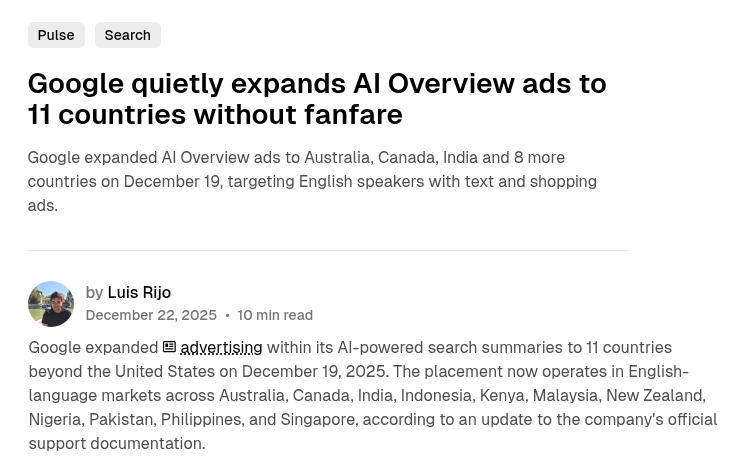
AI Overview ads reached 11 more countries in December 2025.
Two rules at that point shaped how SaaS accounts get in:
The placement inside the summary required broad match or keywordless targeting, through broad match Search campaigns, AI Max for Search or Performance Max.
You couldn't target the placement directly or opt out of it, and Google Ads didn't report it separately.
Exact match is loosening at the edges. A small Google experiment, reported in September 2026, lets exact and phrase match keywords serve text ads in AI Mode, but only on queries with explicit, direct intent.
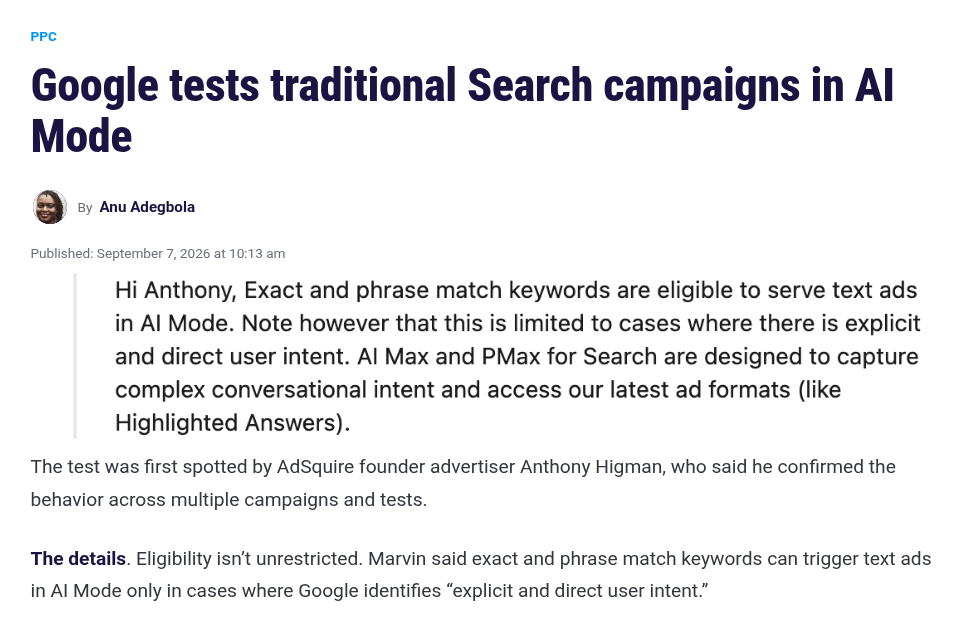
Exact and phrase match ads are being tested in AI Mode.
Longer, exploratory questions still belong to AI Max and Performance Max, which also carry the newer AI Mode formats.
Google's newer formats sit in AI Mode. In a May 20, 2026 post on new ad formats, Google said it was testing two ad types in AI Mode: Conversational Discovery ads, with creative built to answer the searcher's specific question, and Highlighted Answers, where a relevant ad can appear inside a list of AI Mode recommendations. Both are labeled "Sponsored." The same post announced Business Agent for Leads on May 20, 2026: a chat agent placed in the ad that would answer questions from your website in place of a static form. For a SaaS team, it would put something close to a demo request inside the ad. On October 28, 2026, Google extended ads in AI Mode from the US to 10 more countries, including Canada, Australia and India, with Brazil, Mexico and the UK planned for Q4 2026, and launched ads on follow-up questions in the US.
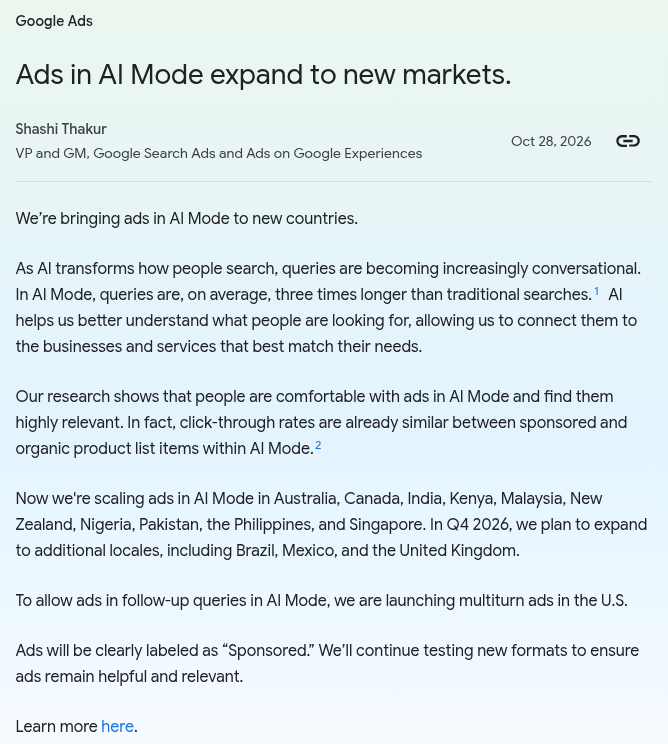
Ads in AI Mode expanded to 10 more countries in October 2026.
Treat AI Mode as one more reason to keep broad match campaigns healthy. It doesn't need a budget line of its own.
For SEO, the change is bigger. With fewer clicks on informational queries, a ranking is worth less as a traffic source and more as a source for the summary. Two practical shifts follow:
Judge informational pages by visibility and assisted pipeline as well as clicks.
Write sections that answer one question completely in a few sentences, so an AI system can quote them accurately and cite you.
How AI Overviews and AI Mode differ for B2B sites is covered in AI Overviews vs AI Mode. If you're also pricing out paid placement in ChatGPT, see the guide to ChatGPT ads for B2B SaaS.
A budget split by stage
No ratio is correct for everyone, and anyone who gives you one without knowing your deal size and sales cycle is guessing. As a general pattern, paid usually carries more of the load early and organic more later. Set the actual split with your own conversion numbers and revisit it after a quarter.
Seed and pre-Series A
Cash is tight and you need proof fast. Lean on tightly targeted paid campaigns on high-intent terms and competitor alternatives. Put a smaller share into a small set of organic pages that will matter in a year: the core category page, two or three comparisons and the integrations buyers ask about.
Series A to B
You have a repeatable motion and some data, so move toward a more balanced split. Paid keeps feeding the pipeline on proven terms. Organic takes on comparisons, alternatives and the problem-led guides your sales team sends to prospects.
Growth stage
Paid costs tend to rise as you run out of cheap queries. Shift the larger share to organic and content. Keep paid for brand defense, launches, new markets and high-value terms you can't rank for yet. Some teams at this stage bring in a B2B SaaS SEO agency for the organic side and keep paid in-house; the split logic is the same either way.
At every stage, cut a paid term once an organic page reliably ranks and converts for it, unless brand defense or a competitor's bidding gives you a reason to keep both.
Using paid search data to choose SEO targets
Paid search is the fastest keyword research tool you have, because it shows what converts as well as what gets searched.
Export the search terms report for the last 90 days. Sort by conversions, then by cost per conversion.
Mark the terms that convert well and cost the most. They're the strongest candidates for a dedicated organic page.
Look for converting queries phrased as questions or comparisons. They usually point to pages your site doesn't have.
Check which ad headlines and landing pages win, and use the winning angle in the organic page's title and opening.
Watch impression share on your top terms. A term where you lose many auctions on budget is often cheaper to win organically over time.
Once the organic page ranks, test lower bids on that term and watch whether total conversions from both channels hold.
Measuring what each channel contributes over months is covered in the guide to B2B SEO attribution.
Common mistakes
Running exact match only and expecting to reach the exploratory, question-style searches where AI answers appear.
Counting organic clicks as the only SEO result while AI summaries absorb informational traffic.
Paying for your own brand term without checking whether anyone else bids on it.
Building content for queries that never converted in paid search, then wondering why organic traffic doesn't turn into pipeline.
Cutting paid search the month organic starts ranking, before you know which terms each channel wins.
FAQ
Is SEO or PPC better for B2B SaaS?
It depends on the job. PPC is faster and covers terms you can't rank for yet. SEO covers comparisons and problem-led research, can be cited in AI answers, and gets cheaper per visit over time.
Do AI Overviews hurt paid search?
In the one randomized experiment published so far, ad clicks didn't measurably change when AI summaries appeared, but ad clicks were rare and hard to measure. Organic clicks fell much more clearly.
Can SaaS companies buy ads inside AI Overviews?
Yes, in the markets where English-language AIO ads run, through broad match Search campaigns, AI Max for Search or Performance Max. You can't target the placement on its own.
How long does SEO take compared with PPC?
PPC can send traffic within days. New pages usually take months to rank, longer on a young domain, which is why most startups run both.
Should paid search stop once a page ranks organically?
Not automatically. Test lower bids on terms where your organic page is strong, and keep paid where a competitor bids on your brand or where the term is worth both positions.