
Last updated: November 1, 2026
In the first three months of 2026, 37.32% of AI Overviews that carried citations linked to at least one major user-generated content platform, such as YouTube or Reddit. That's up from 14.16% in the last quarter of 2024, according to a study by researchers at two US universities of 351,568 AI Overviews with citations, captured by a US research project that records volunteers' real-world browsing. The study measures AI Overviews only. It says nothing about AI Mode, and its platform list doesn't include LinkedIn or software review sites.
That shift happened on one of Google's two AI surfaces. The other works differently.
For a B2B website, AI Overviews and AI Mode are two separate surfaces that happen to share an index. AI Overviews appear on top of a normal results page for a subset of queries. AI Mode is a conversation that replaces the results page. They can use different models, they cite different pages, and Search Console reports them in ways that make them hard to tell apart. Learn the differences before you change anything.
For how answer engines pick sources in general, see the AEO pillar guide.
What each surface is, and what triggers it
Google's documentation on AI features and your website describes both.
AI Overviews "help people get to the gist of a complicated topic or question more quickly." They appear at the top of a normal results page, above the classic links, and they're "only shown when our systems determine that it is additive to classic Search, and as such, often don't trigger." In other words, the searcher typed a normal query and Google decided a summary would help.
AI Mode is "particularly helpful for queries where further exploration, reasoning, or complex comparisons are needed." People "can ask nuanced questions that might have previously taken multiple searches." It's a separate experience: the searcher chooses it, or reaches it from a prompt on the results page, and can keep asking follow-up questions.
Both, Google says, "may use a 'query fan-out' technique," issuing multiple related searches across subtopics to build a response. And the key line for anyone comparing them: the two surfaces "may use different models and techniques," Google writes, so the responses and links shown "will vary."
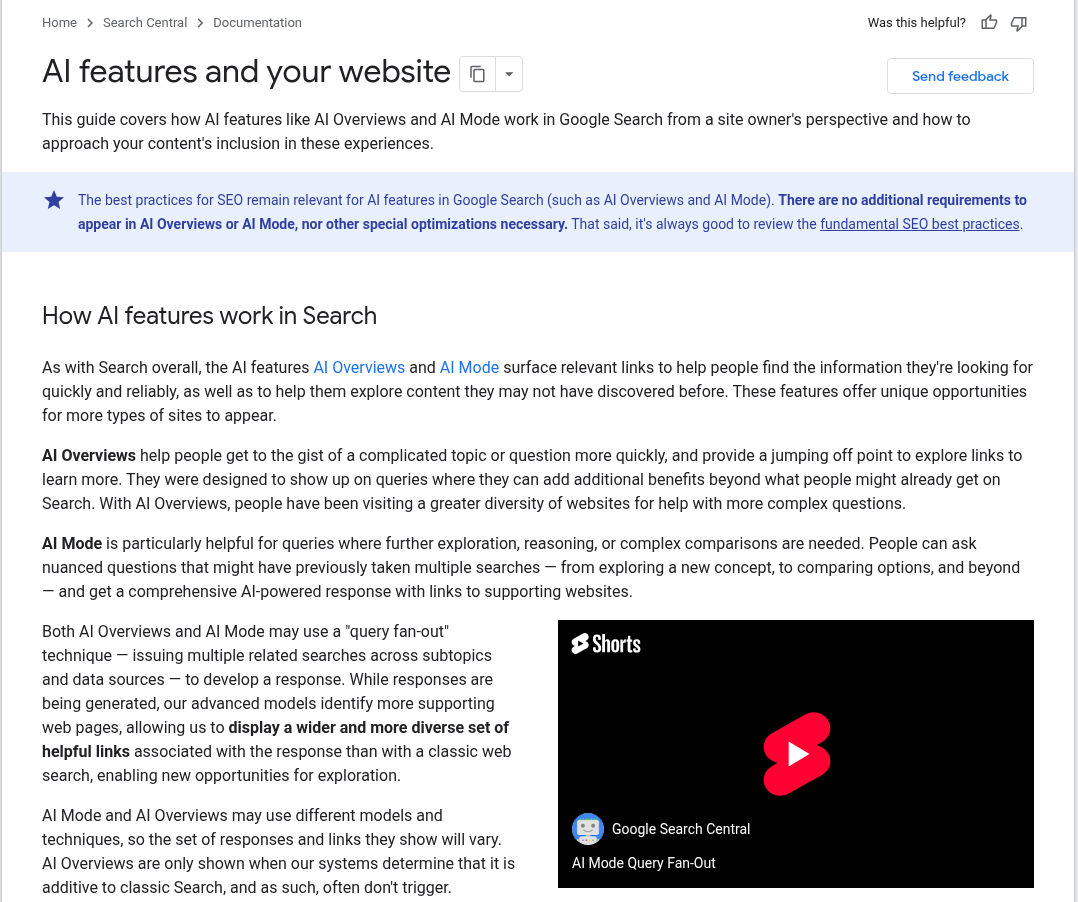
Google's documentation on AI features: AI Overviews and AI Mode.
Eligibility doesn't differ. Google applies one test to both surfaces: the page needs to be in the index and allowed a snippet. It lists no extra technical step and no special markup on top.
Side by side
Here's how the two compare on the points that matter for a B2B site, based on Google's documentation as of October 2026.
AI Overviews | AI Mode | |
|---|---|---|
Where it appears | On top of a normal results page | A separate conversational results page |
How it starts | Google triggers it for some queries | The user chooses it or follows a prompt to it |
Typical query | Short or medium, often a single question | Longer, multi-part, comparative |
Follow-ups | None inside the overview | Yes; each follow-up is a new query |
Query fan-out | May be used | May be used |
Models | May differ from AI Mode | May differ from AI Overviews |
Link placement | Inline links and supporting links attached to the summary | Inline links and supporting links, plus clickable creator names on video results in testing |
Search Console position | The whole overview has one position, shared by all its links | Counted the same way as a normal results page |
Generative AI report | Included, not separated | Included, not separated |
A note on ads, since people ask. Google's documentation for site owners doesn't cover ad placement in either surface, so I've left it out of the table rather than guess.
How Search Console counts each one
Google's help page on impressions, position and clicks treats the two surfaces differently. For AI Overviews: "An AI Overview occupies a single position in search results, and all links in the AI Overview are assigned that same position." For AI Mode: "Position in AI Mode follows the same methodology as a Google Search results page." And for follow-ups in AI Mode, the user is "essentially performing a new query", so the impressions and clicks are counted against the follow-up, not the original question.
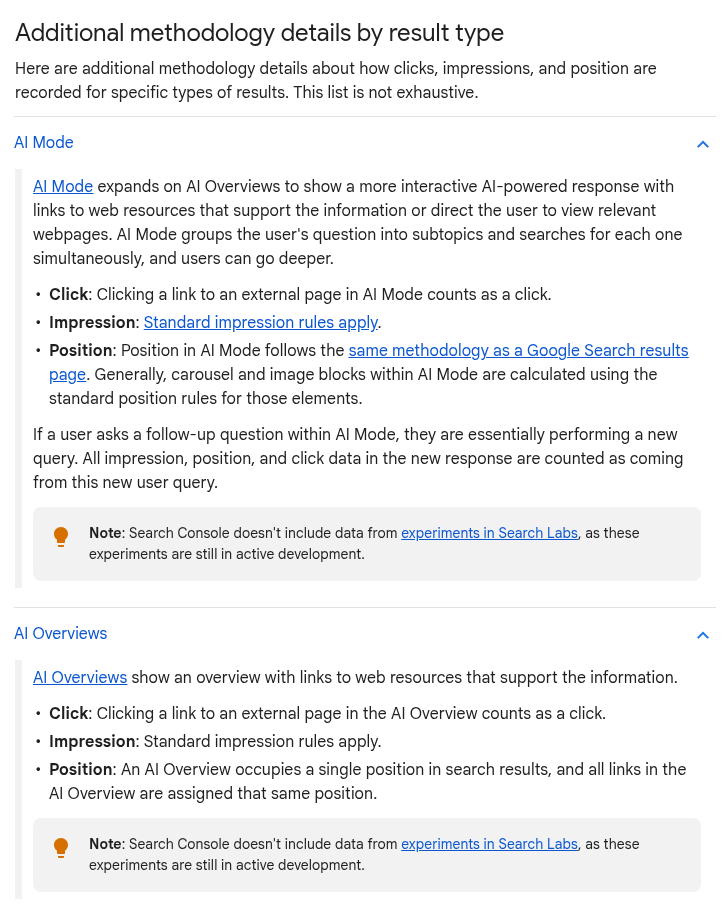
Search Console help: an AI Overview counts as one position.
That has three practical effects:
In your main Performance report, an AI Overview link can show a high average position even if your link was the last one in the list.
AI Mode follow-up questions show up as separate queries, often longer and stranger than anything you'd target.
Both surfaces are folded into the normal Web search type in the Performance report, alongside classic results.
To see the first effect under Google's counting rules, say your pricing page is the fifth of five links in an AI Overview at position 1, and it also ranks eighth in the classic results below. Per the same help page, Search Console records the topmost position your page held in each search, so that query logs position 1, not 5 or 8. A second query shows the page only as a classic result at position 9. Averaged across the two queries, the report shows (1 + 9) / 2 = 5. That middling number hides both the last-place overview link and the weak classic ranking.
The newer generative AI performance report counts impressions for both AI Overviews and AI Mode. It lets you break the data down by pages, countries, dates and devices, and filter by text or multimodal search. It doesn't offer a way to separate AI Overviews from AI Mode. So you can see how often your links appeared in Google's AI features, but not which feature. The guide to reading the Search Console generative AI report walks through it in detail.
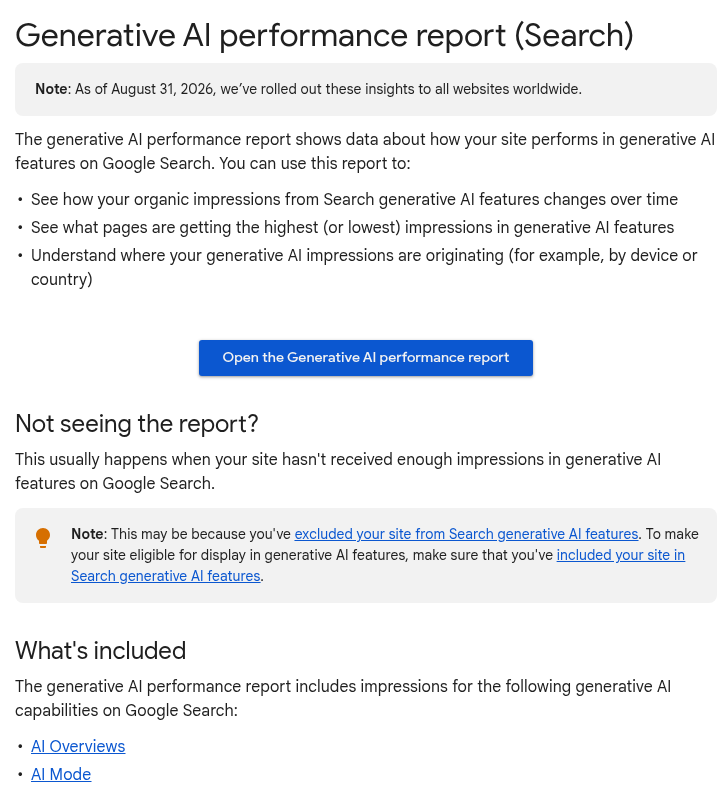
Search Console help for the generative AI performance report.
What the October 15, 2026 changes did
On October 15, 2026, Google announced five updates across what it now calls AI Search. Here's what each one means for a B2B site.
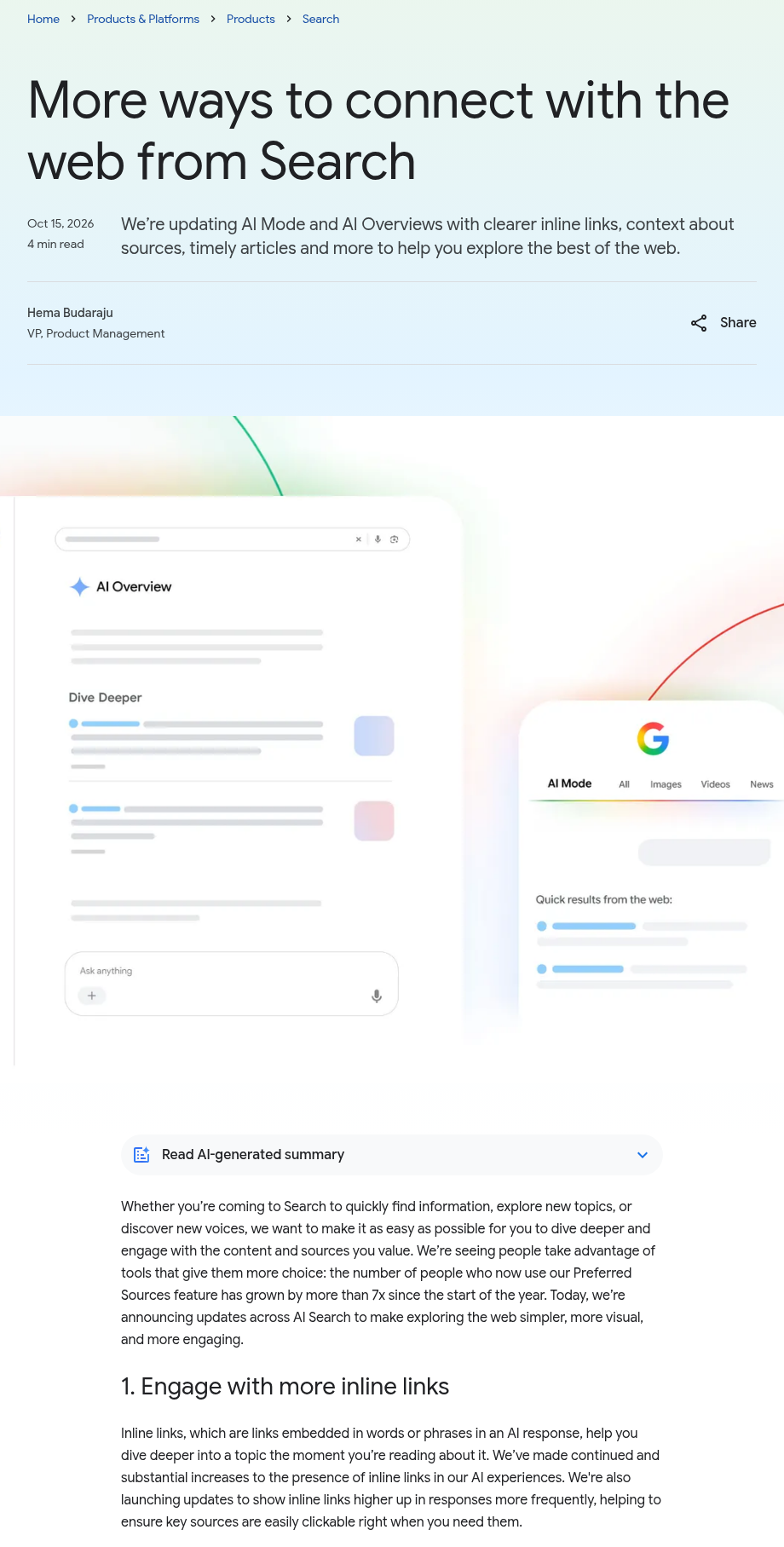
Google's October 15, 2026 post on AI Mode and AI Overviews updates.
Inline links higher up. Google says it has made "continued and substantial increases" to inline links, links embedded in words or phrases of the answer, and will show them "higher up in responses more frequently." If your page is cited, the link is more likely to sit next to the claim it supports.
A dedicated section for official pages, in testing. For tasks where "there are only one or two official places on the web," Google is testing a section at the top of the response with context about why each link is useful. For software companies, think of login pages, documentation, pricing or status pages. It's a test, so don't plan around it yet.
News carousels in more places. Carousels for timely articles are rolling out to more locations and languages, and they highlight the user's Preferred Sources. The same post says the number of people using Preferred Sources "has grown by more than 7x since the start of the year." Google didn't give a base number.
More prominent related links. The links at the end of some AI responses get image thumbnails and a "more clickable design."
Creator profiles in AI Mode. Google started testing clickable creator and publisher names on video results that link to their Search profiles in AI Mode.
The post doesn't say which changes apply to AI Overviews, which to AI Mode and which to both. The only one it places is the creator test, in AI Mode. Treat the rest as applying to both until Google says otherwise.
What the research says about the citations
Independent data on these two surfaces is thin, and most of it measures one at a time.
On AI Overviews, the study behind the opening figure is by Nick Hagar and Nicholas Diakopoulos, whose listed affiliations are Northwestern University and the University of Minnesota. It used AI Overviews collected by the National Internet Observatory, the Northeastern University volunteer-browsing project mentioned at the top, across 2024 Q3 to 2026 Q1. Most of that window falls before November 2025, including the 14.16% baseline from 2024 Q4, so treat the rise as long-run context and the 2026 Q1 figure as the current one. The share had already reached 37.33% by 2025 Q4, so the last two quarters were flat rather than still climbing.
In 2026 Q1, selected high-traffic US news sites appeared in 3.89% of citation-bearing overviews. Across the whole sample, the median overview cited three distinct domains. The PDF itself carries no publication date. It was presented at the Computation + Journalism Symposium at Northwestern on October 3, 2026, which is the firmest date available, and it isn't on arXiv.
On AI Mode, a University of St. Gallen paper, first posted April 8, 2026, ran eight prompts a day in each of four Swiss consumer categories between January 24 and March 20, 2026, across ChatGPT, Gemini, Google AI Mode and Perplexity. Google AI Mode showed the most concentrated citations of the four engines, with a Gini coefficient of 0.782, meaning a small set of domains took a large share of citations. The data came from Swiss servers in German, and the categories are consumer markets, not B2B software, so take it as a direction, not a benchmark.
Neither study compares AI Overviews and AI Mode on the same queries. I haven't found an independent one with 2026 data that does.
B2B query types and where they tend to land
This part is my reading of Google's descriptions, not measured data.
Definitions. A "what is" question about your category is the classic AI Overview query: short, common, with a settled answer. If you've written the best definition, you're competing for a link in a summary that sits above the results.
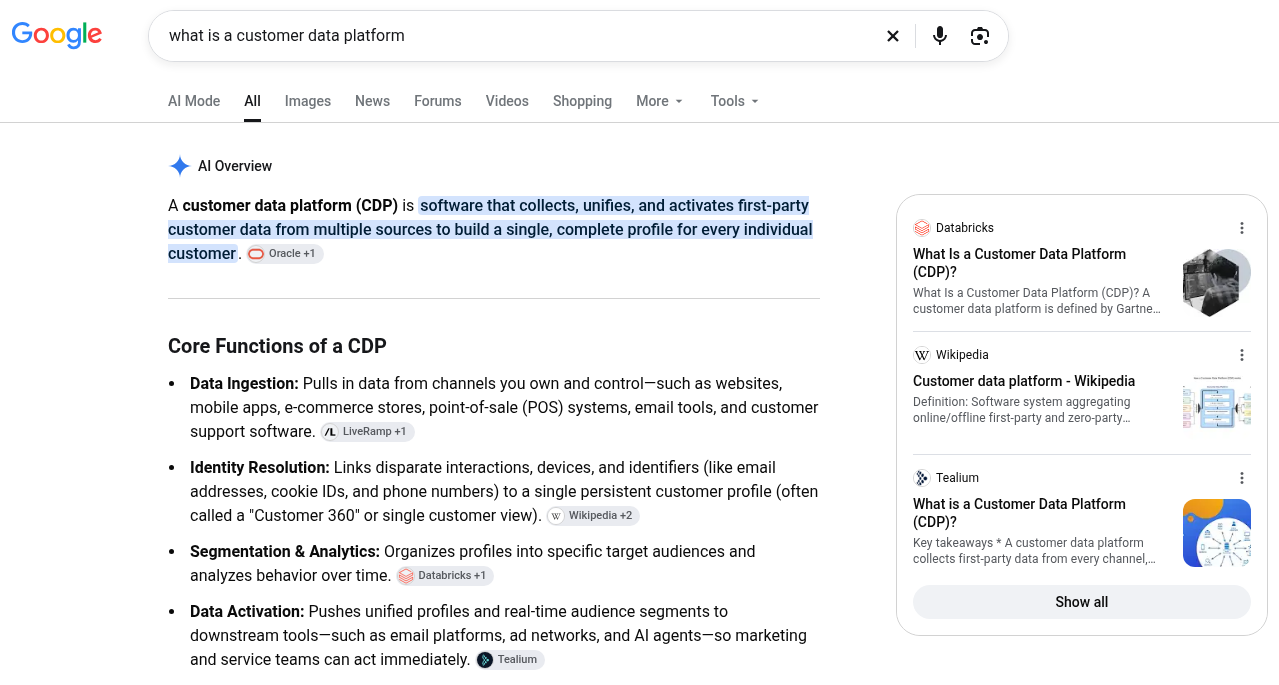
Google search showing an AI Overview with source links for a definition query.
Comparisons. Head-to-head product comparisons for a given team size, or "best" lists for a use case, are the queries Google describes AI Mode as built for. They invite follow-ups, and each follow-up is a new query in your data.
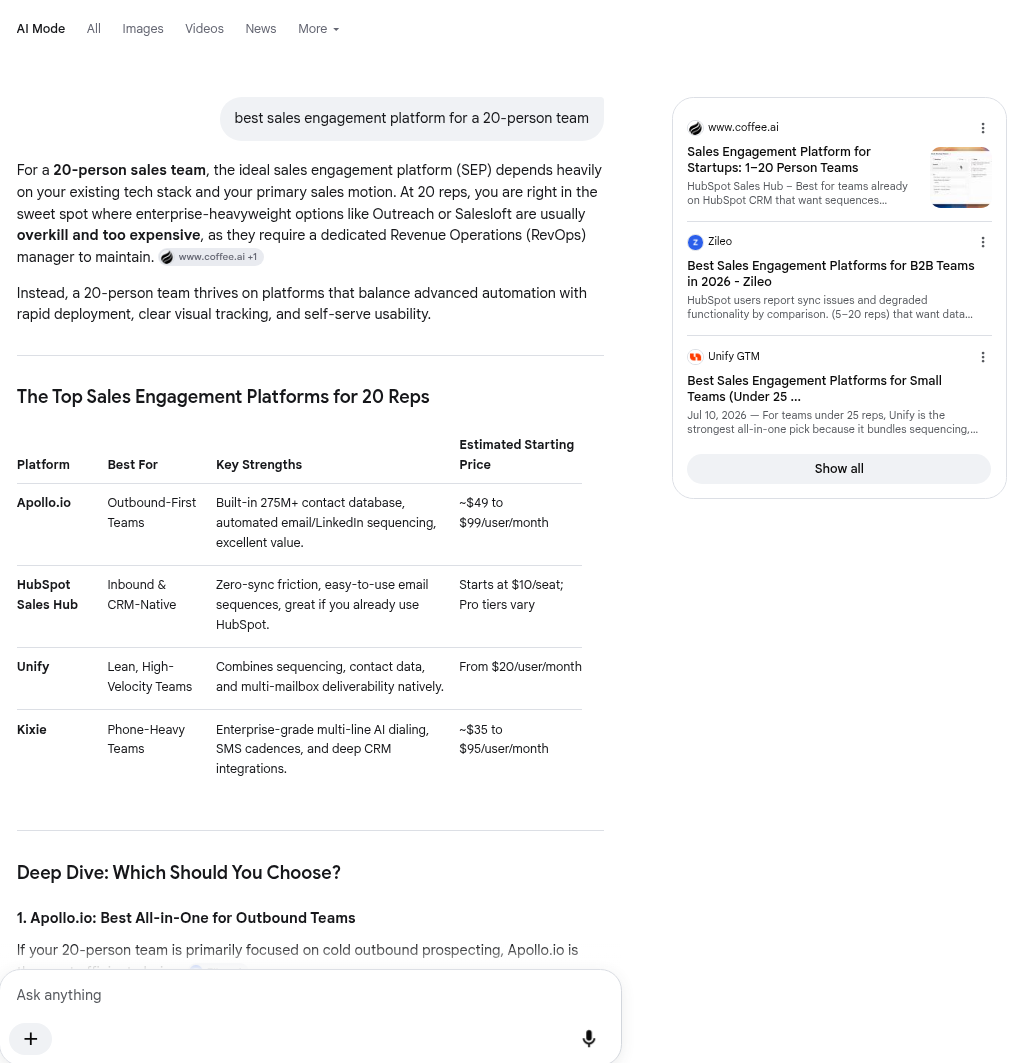
Google AI Mode answering a software comparison for a 20-person team.
Evaluation and buying questions. Questions about what a category costs, whether a product integrates with a given tool, or whether it's SOC 2 compliant can land in either. Short versions may trigger an overview; longer, conditional versions are more likely to be asked in AI Mode.
Navigational tasks. Searches for a product's login page, API docs or status page are where the official-links test could matter most, if it ships.
To find which of your B2B keywords trigger AI Overviews and still earn clicks, see the AI Overviews keyword audit. For the comparison side, the guide on how to get cited in Google AI Mode covers what that surface tends to pick.
Which situation are you in?
You mostly rank for definitions and how-to guides. AI Overviews are the surface to watch. Your positions in Search Console may look fine while clicks fall, because the overview sits above you and shares a single position.
You sell a product people compare. AI Mode is where those comparisons are moving. Expect long follow-up queries in your data and fewer clean head terms.
You have strong documentation. Watch the official-links test. If it rolls out, documentation and status pages could get a more prominent placement for task queries.
You report AI visibility to leadership. Don't present Search Console's generative AI numbers as "AI Overviews," for the reason covered above. The guide on how to measure AI search visibility covers how to report AI numbers honestly.
What to watch out for
Treating the two surfaces as one. A page cited in one isn't necessarily cited in the other.
Misreading position. As the worked example shows, a decent average can hide a last-place link.
Over-reading follow-ups. A sudden rise in long, odd queries may be AI Mode follow-ups rather than new demand.
Assuming announced changes have shipped. Two of the October 15 items are tests. Google rarely says when a test becomes permanent.
Single-surface studies. Don't use an AI Overviews figure to describe AI Mode, or the reverse.
Regional differences. The St. Gallen data is from Switzerland and the Hagar and Diakopoulos data is from a US volunteer panel. Features and sources vary by country and language.
Final thoughts
For a B2B site, the first job is to know which surface your queries are likely to land in and to read your data with that in mind. The answer engine optimization page describes how Miraa reviews a site's presence in Google's AI features.