
Last updated: November 20, 2026
Brands in the most popular fifth of their market were mentioned and cited 1.4 to 2.8 times as often as the average brand. That came from 19,200 answers by three AI search engines, covering 1,176 leading brands. A university team in Milan posted the audit on November 5, 2026.
The prompts were in Italian and covered insurance, travel, fashion and sport, so the exact numbers will not match a SaaS category. The pattern still explains a lot. AI engines favor names they already know, and turning on web search did not reduce that bias in the study.
So if you keep asking why AI recommends competitors instead of my brand, the first answer is often size and fame. It is rarely the only answer, though. Each engine finds and picks sources in its own way, and some reasons are fixable in weeks. Below are eight reasons, grouped by engine, with what to check for each.
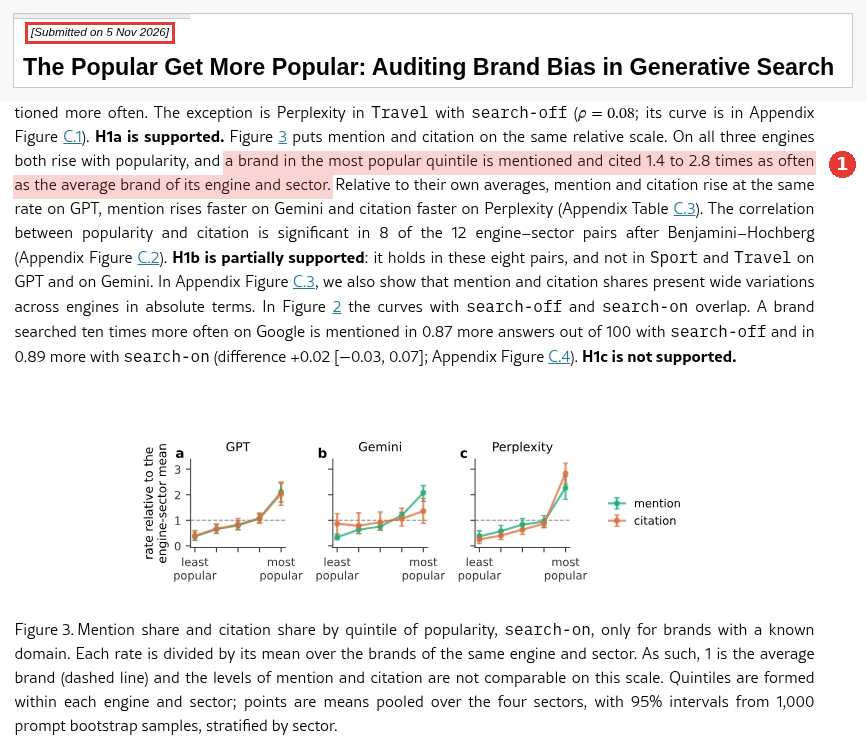
Mentions and citations rise with brand popularity, captured Nov 18, 2026.
ChatGPT
ChatGPT searched the web in 98% of the study's search-enabled calls, more than any engine except Perplexity. So for ChatGPT, the search step matters most.
1. It writes famous brand names into its own searches
OpenAI's help article on ChatGPT search covers how search works. ChatGPT usually rewrites a question into its own search queries before it looks anything up. The Milan team checked what went into those queries.
In travel prompts, 7% of the least popular brands that ChatGPT later named were already in its first search query. For the most popular brands, the share was 45%. In other words, ChatGPT often searches for the big names before it reads a single page. A smaller brand then has to appear in the pages that come back for someone else's name.
This is why "best payroll software" lists and "Gusto alternatives" pages matter so much. If you are listed next to the leader on those pages, a search for the leader can still bring you into the answer. The ChatGPT recommendation playbook covers how to get onto those lists.
2. Your pages do not state who you are for and what you cost
The same study added short buyer profiles before each question, such as a person who wants to spend as little as possible. With those profiles, the popularity bias got weaker on some engines. The search queries changed too. In three sectors, at least one search query contained a price word in 86% to 96% of calls with a profile. Without one, it was 25% to 46%.
For a SaaS brand, that is good news. Real buyers rarely type a bare category. They add a team size, a budget or a tool they already use. If your pages say clearly who the product fits, what it costs and what it connects to, those narrower searches have something to find. A pricing page hidden behind a sales form gives them nothing.
Perplexity
Perplexity searched in every call in the study and returned about 9 sources per answer, against 4.6 for ChatGPT. More sources should mean more room for smaller brands. Two things can still keep you out.
3. Its index does not hold your full pages
Perplexity's crawler will not index the text of pages that block it, per its help article on robots.txt, last modified on September 14, 2026. It may still keep the site name, the headline and a short factual summary. Perplexity also works with third-party crawlers to build its index.
So a robots.txt rule or firewall that blocks the crawler leaves Perplexity with a headline and little else. A competitor whose page it can read in full has a clear advantage. Check robots.txt, your CDN's bot settings and your logs. The Perplexity citation guide covers the rest of the setup.
4. It cites big brands' own sites even more than it names them
On Perplexity, citations rose with popularity faster than mentions did. A popular brand's own website was even more likely to be used as a source than its name was to appear in the text.
That means a leader's product pages, docs and pricing pages often become the evidence for the answer. If your own pages are thin, a reader may see your name once while the answer quotes a competitor's page three times. Pages that answer specific questions in full, with numbers, give Perplexity a reason to cite you.
Below is one signed-out Perplexity answer to a help desk question, captured on Nov 18, 2026. It named Help Scout, Freshdesk and Intercom. Its Links tab included best-of lists that Freshworks, which makes Freshdesk, and Intercom publish on their own sites. It is a single sample, so use it to see what to check in your own category.
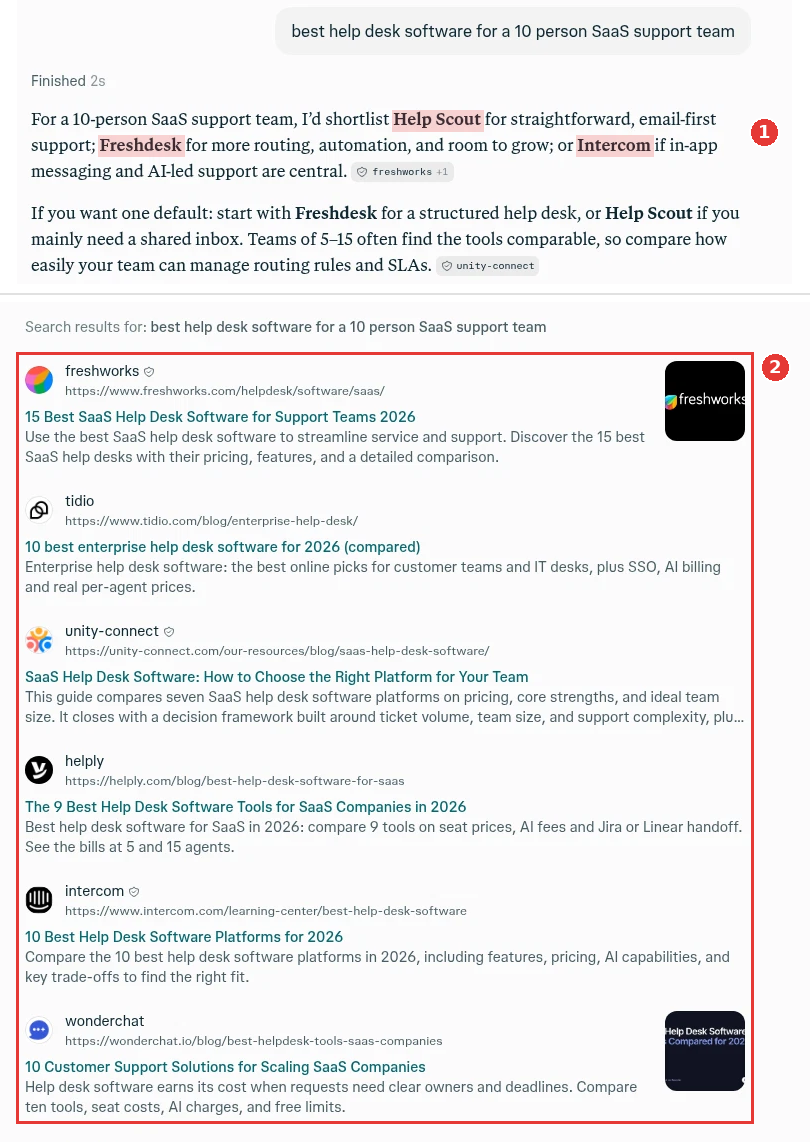
One signed-out Perplexity answer and its sources, captured Nov 18, 2026.
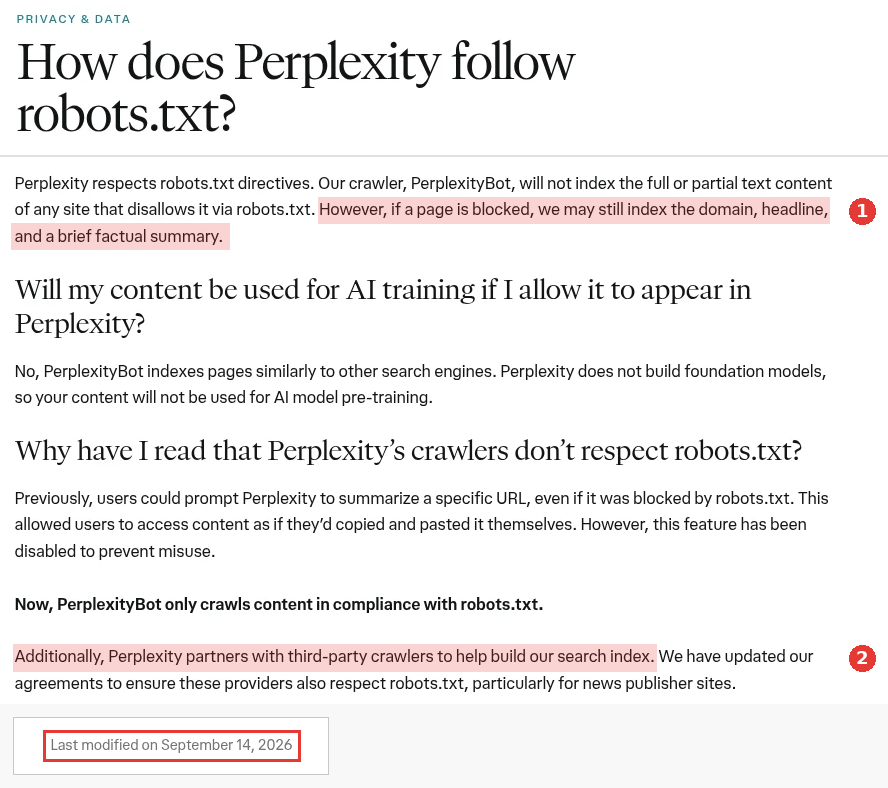
What Perplexity keeps from a blocked page, captured Nov 18, 2026.
Gemini
5. It often answers from memory without searching
Gemini searched the web in only 44% of the study's search-enabled calls. In the rest, the answer came from what the model learned in training. On Gemini, mentions also rose faster with popularity than citations did. Both point the same way: Gemini leans on stored knowledge of brands more than the other two engines tested.
Memory changes slowly. It reflects what the web said about you before the model was trained, often months ago. You cannot edit it directly. What you can do is make the pages most likely to be in training data describe you the same way. Those include your homepage, review profiles, partner listings and a few independent articles. The G2 and Capterra profile guide and the Reddit guide cover two common places those descriptions live.
Google AI Overviews
6. Your page is not eligible or does not rank for the related searches
AI Overviews draw on Google's normal index. Google's AI features documentation, last updated on Dec 10, 2025, sets two conditions for a supporting link. The page must be indexed, and it must be able to show with a snippet. AI Overviews and AI Mode may also run several related searches across subtopics to build one response.

The two conditions for an AI Overviews link, captured Nov 18, 2026.
So the usual SEO problems apply first. A page with nosnippet, a noindex tag or a weak ranking for the narrower subtopic searches will not be picked. A competitor that ranks for "pricing", "integrations" and "vs" searches around the main query has more chances to be the supporting link. The AI Overviews keyword audit shows which of your queries trigger an overview. The AI Mode vs AI Overviews guide explains how the two features differ.
Claude
7. It reads fewer pages, and none from Reddit or YouTube
A second study, posted on September 16, 2026 by researchers at the Max Planck Institute for Software Systems, looked at real chats that users donated. Claude sent about 1.8 web queries per question and got back about 17 pages. ChatGPT sent about 3.1 queries and got back about 43 pages.
Claude searched one query at a time and refined it as it went. ChatGPT often sent several queries at once, and also refined later ones. And reddit.com and youtube.com, which led ChatGPT's search results, did not appear in Claude's results at all.
So there are fewer places for a smaller brand to show up. A Reddit thread that helps you in ChatGPT does nothing here. For Claude, your own pages and the sites that rank for the exact question matter more. The Claude citation guide covers how to test.
One reason that applies to every engine
8. A familiar name beats the same facts under an unknown name
The second part of the Milan study is the hardest to accept. The team gave four models the same five product pages and asked them to rank the pages. Then they changed only the brand name on one page. With its real brand, the page ranked 0.44 positions higher on a five-place scale than with an invented brand.
They also rewrote the page in three styles that GEO guides often suggest. The facts stayed the same. The rewrites changed the rank by 0.02 positions, which was not a real effect. In this test, the name mattered and the polish did not.
Rewriting your own pages to sound more "AI friendly" is a poor use of time if the problem is that nobody knows your name. The slow work of getting mentioned on other sites is the main fix. It is the only one that changes what models know about you.
How the five engines compare
Engine | How often it searched in the study | Where answers come from | First thing to check |
|---|---|---|---|
ChatGPT | 98% of calls | Rewritten web searches, plus memory | Lists and alternatives pages for your category |
Perplexity | 100% of calls | Its own index and partner crawlers | Crawler access in robots.txt and your CDN |
Gemini | 44% of calls | Memory first, web search in some answers | How review sites and profiles describe you |
AI Overviews | Not tested | Google's index, several related searches | Indexing, snippets and related rankings |
Claude | Not tested | Fewer pages per search, no Reddit or YouTube | Your own pages for the exact question |
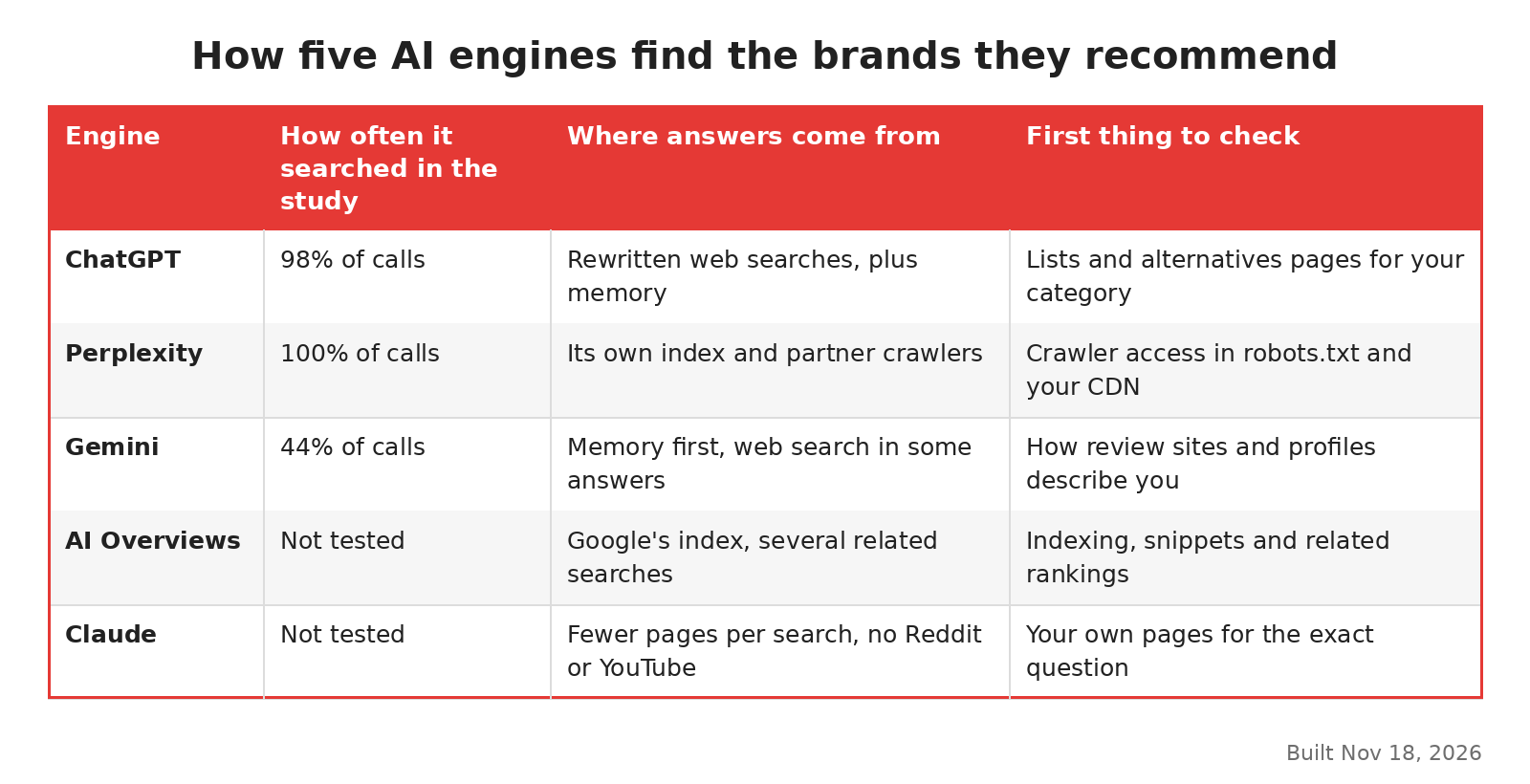
How the five engines find brands, built Nov 18, 2026.
A worked example
This example is made up. A 30-person company sells scheduling software to dental clinics. Its blog ranks on Google for several clinic scheduling terms. Yet when a clinic manager asks ChatGPT for the best scheduling software, the answer names three large general tools.
Run that through the reasons above. ChatGPT likely searched with the big names already in its queries (reason 1). The prompt had no clinic size or budget, so nothing pointed to a niche tool (reason 2).
Now try the prompt the way a real buyer would type it. Add the clinic size, a budget under $100 a month and the X-ray system the clinic already uses. The niche tool now has a chance, but only if its pages state the clinic fit, the price and the X-ray integration in plain text.
Next, the team checks its logs and finds the CDN blocking unknown bots, which hurts Perplexity (reason 3). That takes an afternoon to fix. The slow part is reason 8. The product needs to appear in two or three dental trade roundups and review sites, so models start to know the name.
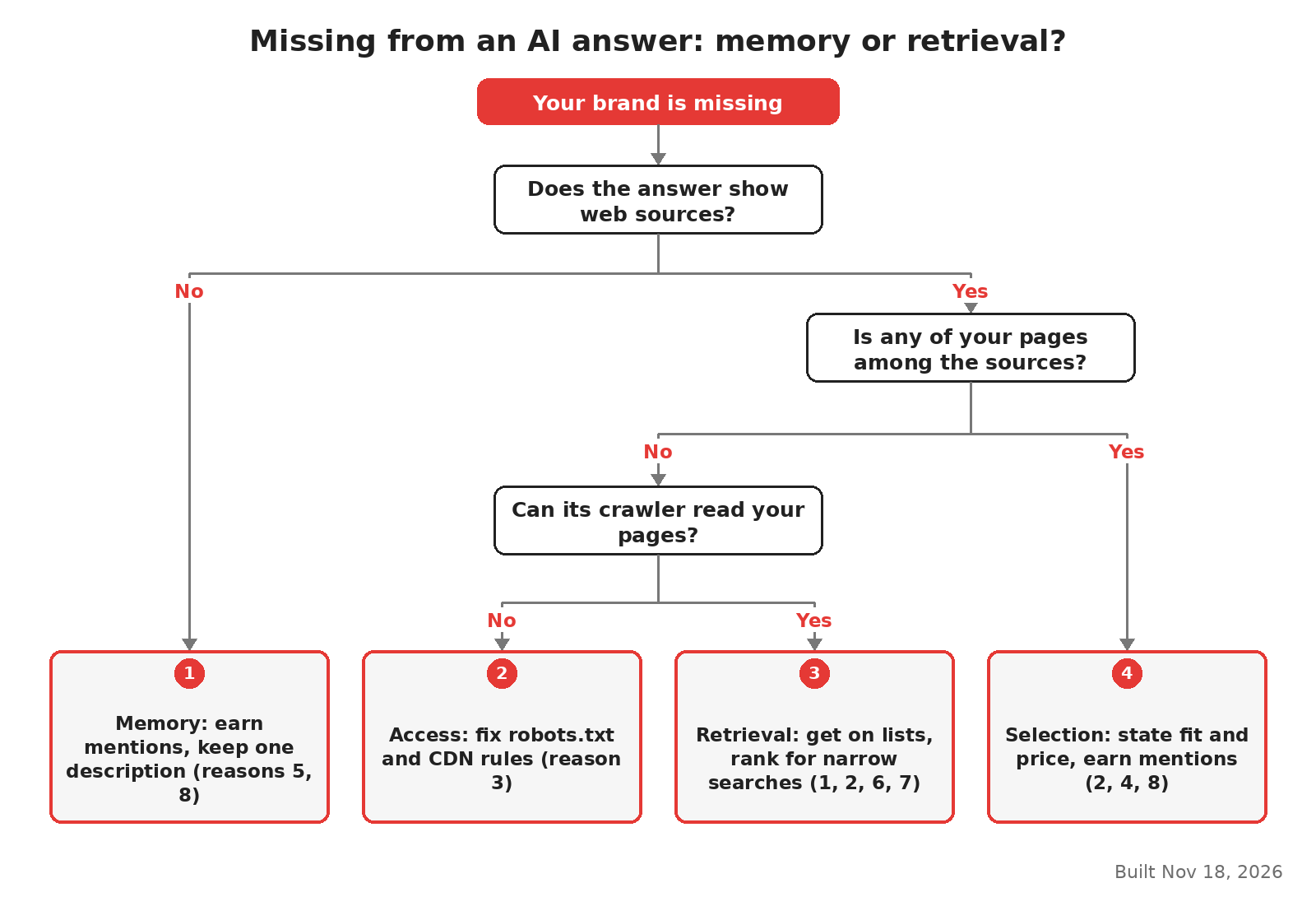
Memory or retrieval flowchart, built Nov 18, 2026.
Where to start
Fix access first, because it is fast: crawler rules and CDN settings. Then make your pages state fit, price and integrations in plain words, so narrow buyer prompts can find you. Treat third-party mentions as the long project, since the Milan study suggests nothing on your own site makes up for an unknown name. A generative engine optimization agency can run that work. You can also follow the steps in the ChatGPT recommendation playbook, since they apply to the other engines too.