
Last updated: November 12, 2026
In early October 2026, the most widely used search engine expanded its guidance on helpful, reliable, people-first content (page last updated October 5, 2026) with a new passage on how its human quality raters judge a page's main content. Under it, unreviewed, mass-produced AI text counts as little to no effort, and the next line reads: "Attribution or giving credit to other sources doesn't replace the need for original effort." Plenty of SaaS blogs run on well-cited summaries of other people's research. Under that wording, the citations no longer count as the work.

Effort passage on the helpful content page, captured Nov 3, 2026
E-E-A-T for B2B SaaS comes down to proving, on the page, that someone with real knowledge of the product and the buyer's problem made the content, and made it carefully.
What E-E-A-T means
E-E-A-T stands for experience, expertise, authoritativeness and trustworthiness. It is Google's term for qualities its ranking systems try to identify through many separate signals.
First, "E-E-A-T itself isn't a specific ranking factor." There's no E-E-A-T score to raise and no tag to add. Second, "Of these aspects, trust is most important." The other three feed into trust, and a page doesn't have to show all of them to be helpful.
Search quality raters apply these ideas when they grade sample results, but raters "have no control over how pages rank." Their ratings tell Google whether its systems are working, which makes the criteria a description of the target and a poor checklist for gaming it.
For a B2B SaaS company, each letter maps to evidence a buyer can see:
Letter | What it means for a SaaS page | Evidence a reader can see |
|---|---|---|
Experience | The writer has used the product or done the task firsthand | Real screenshots, setup notes, problems hit during rollout |
Expertise | The writer knows the field, not only the product | A named author with relevant work history, accurate detail |
Authoritativeness | Others treat the company or author as a go-to source | Mentions in trade press, reviews, partner listings, cited research |
Trust | The page is accurate, honest and safe to act on | Clear pricing, dates, contact details, a security page, corrections |
Is B2B SaaS a YMYL topic?
Most of it isn't. Google applies extra weight to E-E-A-T for "Your Money or Your Life" topics, defined in the same document as ones that "could significantly impact the health, financial stability, or safety of people." A project management tool or a design app rarely qualifies.
Some SaaS categories do. Payroll, payments, lending, expense management, health records and some security products all publish content that can affect someone's money or safety. For those pages the guidance is stricter: YMYL content "must be highly accurate and consistent with established expert consensus." The E-E-A-T and YMYL guide for fintech covers that higher bar in detail.
Main content comes first
Since the October update, the quality of the main content is "one of the most critical factors for assessing page quality." Main content is the part of the page that does its job, including text, media, interactive tools, tabbed sections and the headings.
Raters judge that content on four attributes: effort, originality, talent or skill, and accuracy. Applied to common SaaS page types, the gap between high and low effort is easy to spot.
Page type | High-effort version | Low-effort version |
|---|---|---|
How-to post | Walkthrough in the product, with real screens and the edge cases support sees | Rewrite of the top five ranking posts |
Comparison page | Stated criteria, tested claims, a date, links to the rival's own docs | Feature grid copied from rival sites |
Integration page | Real setup steps, field mappings, sync limits | One templated paragraph per partner |
Documentation | Tested steps with version notes | Auto-generated text nobody ran |
Research post | Your own data with the method shown | A roundup of other sites' statistics |
Pricing page | Actual plans and what each includes | "Contact sales" with no numbers |
A statistics roundup is the clearest case of attribution standing in for effort. A pricing page with no prices hides the one fact buyers came for, which is a trust problem on a page that converts. The case for showing numbers is made in should SaaS publish pricing.
Who, How and Why on a SaaS blog
On the same Google page, the practical checks come as three questions about every piece of content.
Who created it
Readers should be able to tell who wrote a page, and the byline should lead somewhere useful. Google "strongly encourage[s] adding accurate authorship information," and it treats the opposite bluntly: profiles built with "AI-generated headshots, made-up names, or false credentials" count as "a form of deception."

Fabricated author profiles called deception, captured Nov 3, 2026
Personas with invented names and generated photos are the obvious SaaS case. Posts ghostwritten under the CEO's name are fine when the CEO supplied the thinking and reviewed the draft, and misleading when the CEO never saw it. "Reviewed by" labels need a real reviewer who actually checked the page. Where a freelancer or agency writer drafted the piece and a product expert shaped it, a byline that credits both is accurate and still shows expertise.
How it was made
Readers trust a page more when they can see how it was produced. For a SaaS company that usually means the test setup, the data source, the date range and the sample behind any claim, plus screenshots that show the work.
AI assistance falls under the same question. Under Google's separate guidance on using generative AI content (last updated October 1, 2026), automated content can carry a note on how it was made "in a way that makes sense for your audience." A manual fact-check of all AI-generated content is "critical" before anything is published, and that review extends to titles, meta descriptions, structured data and alt text.
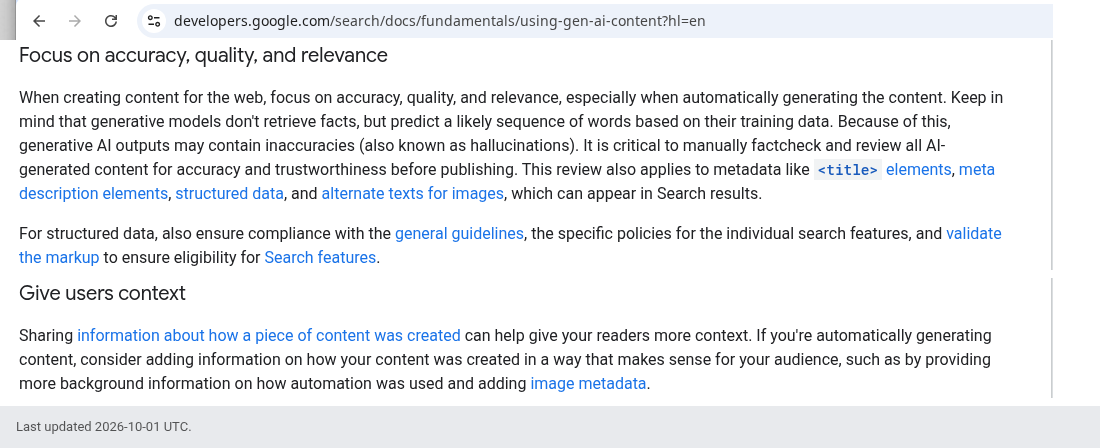
Gen AI page, updated Oct 1, 2026, captured Nov 3, 2026
Why it exists
For Google, "Why" is "perhaps the most important question." A page written to help a buyer decide or get a job done is aligned with what ranking systems reward. A page that exists mainly to catch search visits isn't, and producing pages with automation mainly to manipulate rankings breaks the spam policies.
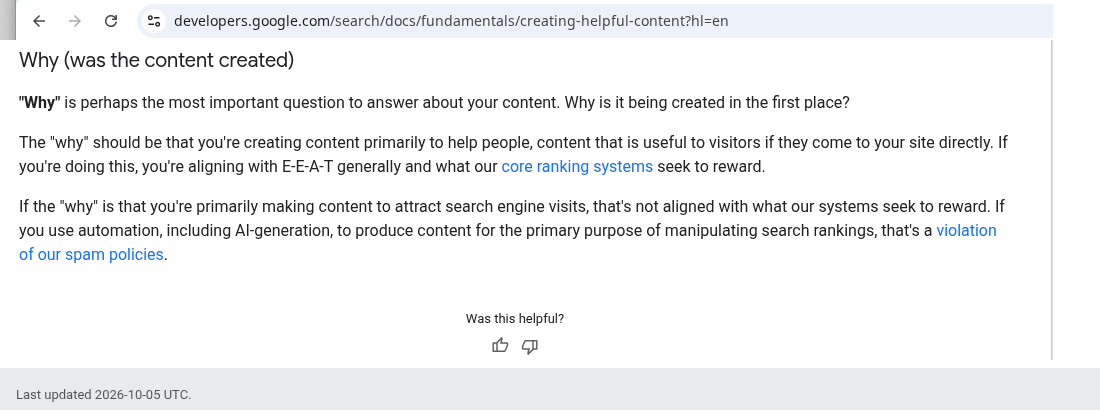
Why the content exists section, captured Nov 3, 2026
A quick test for a SaaS blog: would the team send this page to a prospect or a new customer? Pages nobody would send are usually written for the keyword.
Where a SaaS company has experience nobody else has
Support tickets show which steps confuse new users. Implementation and solutions engineers know which integrations break and why. Sales calls record objections in the buyer's own words. Product usage data, aggregated and handled within your privacy terms, can answer questions the whole category guesses at.
That material is also what AI answers draw on. In Google's guide to optimizing for generative AI features (last updated July 10, 2026), a first-hand review based on personal experience stands apart from a summary that "simply restates information already available elsewhere." Site owners are told not to "recycle what others on the internet have already said, or could easily be produced by a generative AI model." The original research guide covers how to turn internal data into something citable.
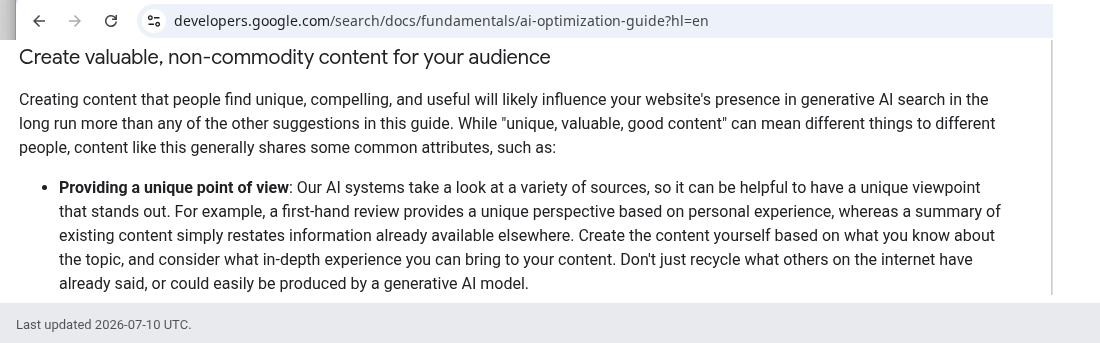
First-hand review passage, AI features guide, captured Nov 3, 2026
If you want help producing first-hand content that earns citations in AI answers as well as rankings, Miraa does that work as an answer engine optimization agency.
Trust signals outside the blog
A SaaS site earns trust with an about page that names real leaders, a contact route that reaches a person, a security or trust page, a public changelog, and pricing that matches what sales quotes.
Off-site evidence carries weight too. Review profiles on software marketplaces are often the first third-party page a buyer reads, and the G2 and Capterra profile guide covers keeping them complete. Unlinked mentions in trade press and analyst notes build authority without a backlink; the brand mentions vs backlinks post has the detail. Authors with an active professional profile give the byline somewhere real to lead, covered in LinkedIn for AI search visibility.
A worked E-E-A-T review for a hypothetical help desk SaaS
Take a hypothetical help desk software company selling to mid-market support teams. Its blog has grown through freelance writers, most posts carry a "Marketing Team" byline, and two author profiles use generated headshots for writers who don't exist. The content lead runs a review across its main page types and records one row per issue.
Page | Current state | Gap | Fix | Owner |
|---|---|---|---|---|
"How to reduce first response time" | Rewritten from ranking posts, team byline | Effort, Who | Support lead co-authors, adds real queue screenshots and the setup the team uses | Support lead, content lead |
"[Rival] vs us" | Feature grid, no date | Accuracy, Trust | Add criteria, a review date and links to the rival's own docs | Product marketing |
CRM integration page | One templated paragraph | Effort | Real setup steps, field mapping table, known sync limits | Solutions engineer |
"Customer service statistics" roundup | Figures collected from other sites | Originality | Replace with a study of aggregated product data, or retire | Content lead, data team |
Two persona author pages | Invented names, generated photos | Deception | Remove the personas, reassign posts to real contributors | Content lead |
About page | No names, no address | Trust | Add leadership names, company address, contact route | Marketing ops |
The order of work follows risk. The persona pages go first, because Google treats fabricated profiles as deception and the fix takes an afternoon. The comparison page comes next, since an inaccurate claim about a rival is a trust problem on a page buyers use to decide. The roundup and the how-to post take longer, because they need new material from the support and data teams.
Nothing in the table involves markup.
Who this is for
It fits B2B SaaS teams whose blog, docs or comparison pages need to hold up to a quality review by a rater, a buyer or an AI system choosing what to cite. It's most urgent where output is freelance or AI-assisted and author information is thin. Regulated categories also need the YMYL treatment linked above.
It can't promise a ranking change. Google's documentation doesn't tie E-E-A-T to any one factor, so the work shows up through the many signals the systems use, and timing varies.
What to watch out for
Treating author schema as the fix. Markup can describe a real writer once one exists. It can't supply the expertise.
Badges with no review behind them. "Expert reviewed" only helps when a named expert reviewed the page.
Personas. Invented writers with generated photos are the exact pattern Google's guidance flags as deception.
Citation as a substitute for work. A post can cite twenty sources and still add nothing of its own.
Date bumps without changes. Changing the published date on an unchanged post misleads readers about freshness.
Bios full of adjectives. Job titles, years in the field and the topics a person covers are easier to verify than "passionate thought leader."
FAQ
What is E-E-A-T?
E-E-A-T stands for experience, expertise, authoritativeness and trustworthiness. It's Google's name for the qualities its ranking systems try to identify in helpful content, with trust as the most important of the four.
Is E-E-A-T a ranking factor?
Not directly. In Google's documentation, E-E-A-T itself isn't a specific ranking factor. Its systems use a mix of signals that tend to line up with content showing good E-E-A-T.
Do SaaS blog posts need named authors?
Google encourages accurate bylines where readers expect them, and most B2B buyers expect them on advice and how-to content. A named author with a profile page is the simplest way to answer the Who question.
Can AI-assisted content show E-E-A-T?
Yes, when a person with real knowledge adds the experience, checks every fact and stays accountable for the result. Google treats a manual fact-check of AI-generated content as critical, and a note on how automation was used helps where readers would expect one.
How does E-E-A-T relate to AI search?
Google's generative AI features rely on its core ranking and quality systems, and its optimization guide favors first-hand, non-commodity content. The same work that shows E-E-A-T to a rater gives an AI answer something original to cite.
Starting an E-E-A-T review
List the twenty pages that bring the most signups or demo requests, then check each one for a real author, visible proof of how it was made, accurate and dated claims, and something only your team could have written. Fix deception first, accuracy second and effort third, and run the check again whenever a new writer or AI workflow joins the content team.