
Last updated: November 16, 2026
For 349 days, from May 13, 2025 to April 27, 2026, the biggest search engine's reporting tool for site owners logged impressions inaccurately. Once the bug was fixed, its public log of known data issues warned that owners might see impressions fall in their reports. Clicks were never affected. So for a good share of teams, a chart that sagged in spring 2026 was a counting correction, and nothing happened to their rankings at all.
That's why, for "why did my organic traffic drop", the boring checks come first. A rewrite, a new agency or a fresh content plan costs months. Ruling out a reporting fix, a seasonal dip or a broken template costs an afternoon in Search Console.
The ten checks below run from cheapest to rule out to most expensive to fix. Each one names the screen to open and what the result means, and where a cause has its own deep-dive guide, the check sends you there. GA4 appears only as a cross-check. Nearly everything else happens inside Search Console and two public Google pages.
Set up the Performance report before you start
Open Search Console, pick the property, then go to Performance > Search results. Three settings make every later check faster:
Click the date filter, open the Compare tab and choose "Compare last 3 months to previous period". The solid line is the recent period and the dotted line is the one before.
Run the same filter a second time with "Last 16 months" so a yearly dip can't pass for a new one.
Right-click the chart on the day you think the drop began and add an annotation. In a December 2025 walkthrough on Google's Search Central channel, annotations show for everyone with access to the property but vanish in comparison mode and in the 24-hour view, so add them before you switch views.
Two details from the same walkthrough trip people up. Dates are in Pacific time, apart from the 24-hour view. And the chart shows complete days only unless you set custom dates, so a "cliff" in the last day or two is often data that hasn't arrived yet.
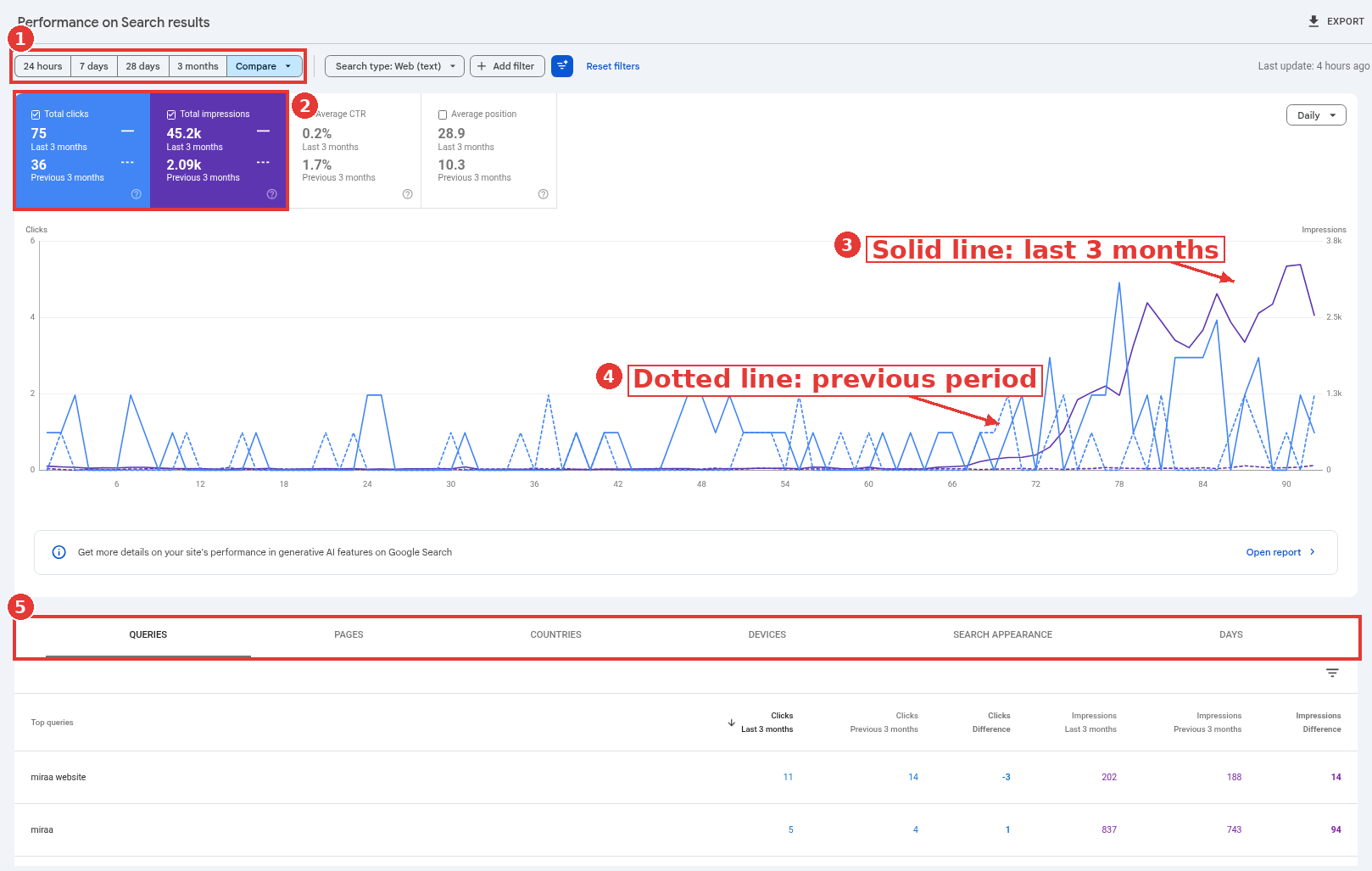
miraa.io (healthy baseline) Performance report in Compare mode, captured Nov 14, 2026.
1. Is the drop in the data or in the traffic?
Open Google's data anomalies page (Search Console Help > Data anomalies in Search Console) and expand "Performance reports". Every entry has a date. Hold your drop date against the list before you touch anything on the site.
The two entries that matter most for 2026 charts:
The impressions logging fix covered in the intro. Impressions, CTR and average position moved; clicks didn't.
From May 7, 2026, FAQ rich results stopped appearing in Google Search, so FAQ impressions in the Search appearance tab fell for every site that had them.
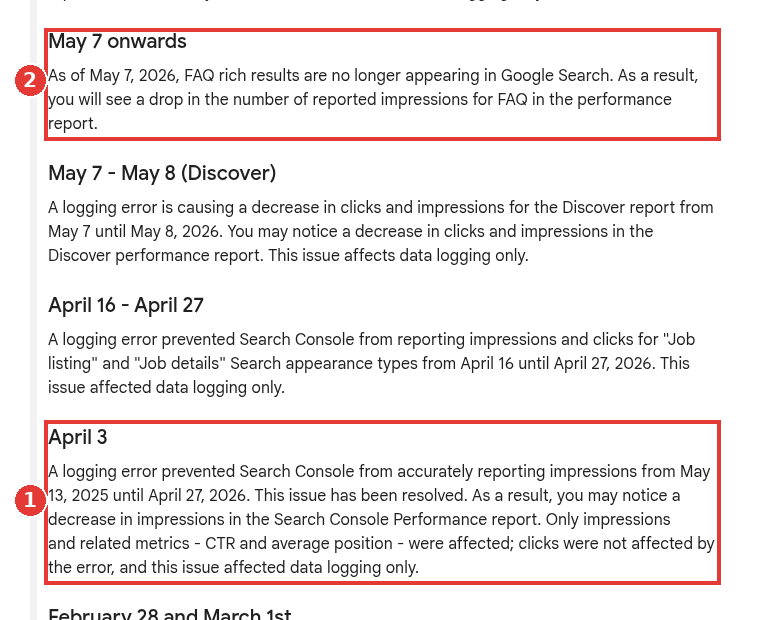
Search Console data anomalies page, Performance reports section, captured Nov 14, 2026.
Then compare the shape with your analytics tool. In GA4 that means Reports > Acquisition > Traffic acquisition, filtered to the Organic Search channel. The totals will never match Search Console, and they don't need to. If organic sessions held steady while Search Console clicks fell, look at the reporting side first. If both fell on the same days, the traffic really left.
2. Did clicks fall, or did impressions fall with them?
Click the Impressions and Clicks boxes above the chart so both lines show. Their shapes split the problem in two.
When both lines fall together, the site lost visibility, and checks 3 to 9 cover the likely reasons. When impressions hold and clicks slide, people still see you but pick something else: a weaker title or snippet, a competitor's rich result, or an AI Overview answering the question on the page. That pattern gets its own guide on why impressions grow while clicks decline.
The second pattern is the less urgent one. Your pages still rank, so the fix is usually a title, a snippet or a format, and none of it requires new content.
3. Does the drop line up with a Google update?
Open the Google Search Status Dashboard and go to Ranking > View history. Each row has a start date and a rollout length, and a row with no end date is still rolling out. As of November 14, 2026, the newest row is the November 2026 core update, released November 10.
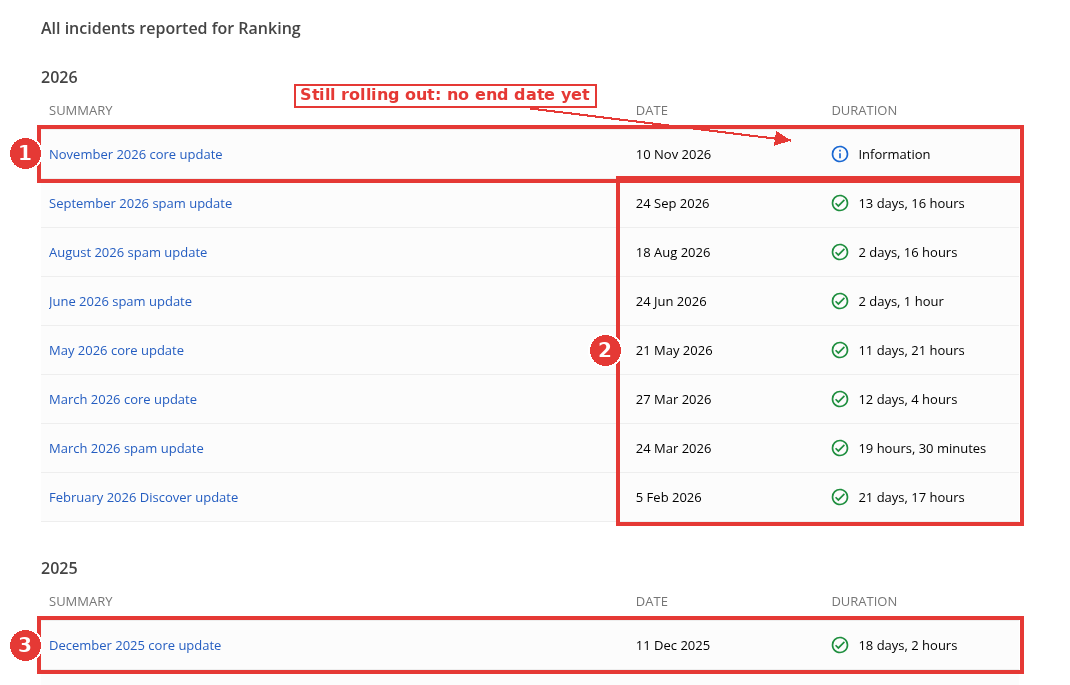
Search Status Dashboard, Ranking history, captured Nov 14, 2026.
A drop that starts inside a rollout window makes the update a suspect. It doesn't prove anything yet. Updates roll out often enough that a coincidence is likely, so the proof takes a few more steps: a step change that starts inside the window, holds afterward and doesn't repeat the same week last year. I walk through that test in the guide to the signs a Google algorithm update hit your site.
The chart below shows the overlay on miraa.io's own monthly data. miraa.io's volume is small and nothing on it is an update hit. The chart is here for the method, with each update window shaded from the dashboard dates.
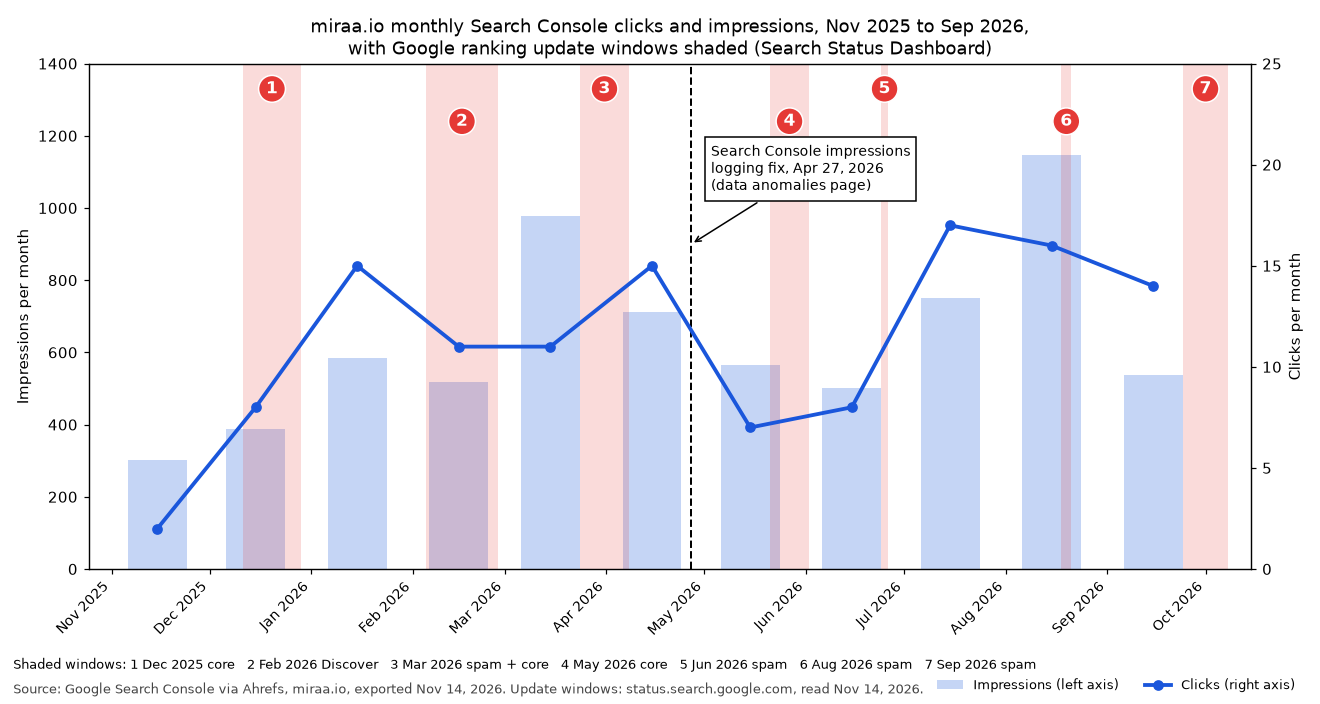
miraa.io GSC data via Ahrefs, update windows, captured Nov 14, 2026.
4. Is it the same dip you had last year?
Switch the date filter to Last 16 months, or use "Compare last 3 months year over year". If the line fell in the same weeks a year ago and climbed back, you're looking at the calendar.
B2B software sites have quieter seasons than consumer retail, but they have them: late December, August in Europe, and the weeks around budget freezes in the buyer's industry. To confirm one query at a time, filter the Performance report to a top query and check the same term in Google Trends. If searches dropped across the web in the same weeks, your share held and demand fell.
5. Is it one search type, country or device?
The chart defaults to Web. Open the Search type filter and check Image, Video and News separately; a site can lose most of its image traffic while web results stay flat, and the default view hides that.
Then click through the tabs under the chart:
Countries: one market falling while the rest hold usually means a local competitor, a hreflang mistake or a regional SERP change.
Devices: a mobile-only drop points to a mobile template, a speed regression or an interstitial.
Search appearance: a drop confined to one result type ties back to SERP changes like the FAQ removal in check 1.
Dates: sort by clicks, lowest first, to find the first bad day and put an annotation on it.
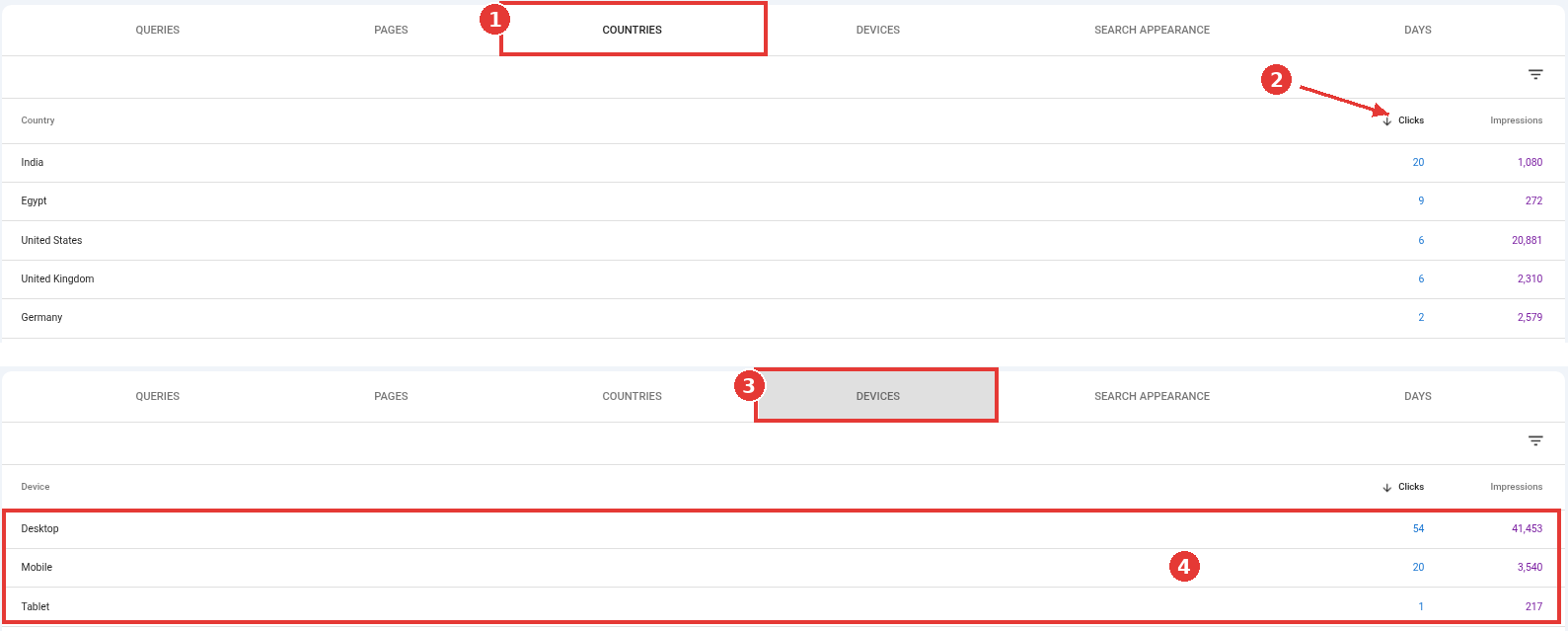
miraa.io Countries and Devices tabs, last 3 months, captured Nov 14, 2026.
6. Is it a few pages or the whole site?
Still in compare mode, open the Pages tab and sort on each page's change in clicks, so the biggest losers rise to the top.
A loss concentrated in three or four URLs is a page problem. Look at who outranks you now and what changed on your page in the last month. Also search the query yourself: if two of your own URLs trade places for it, they may be competing (the keyword cannibalization guide covers that check). A loss spread thinly across hundreds of URLs is a site problem, and the next three checks matter more.
Branded and non-branded queries deserve a split here too. Use the query filter's branded option where your property has it: a branded drop is a demand or reputation question, and SEO work won't fix it.
7. Did pages fall out of the index?
Go to Indexing > Pages. The chart shows indexed and not-indexed counts over time. A drop in indexed pages that starts near your traffic drop is the clearest technical signal in the whole report.
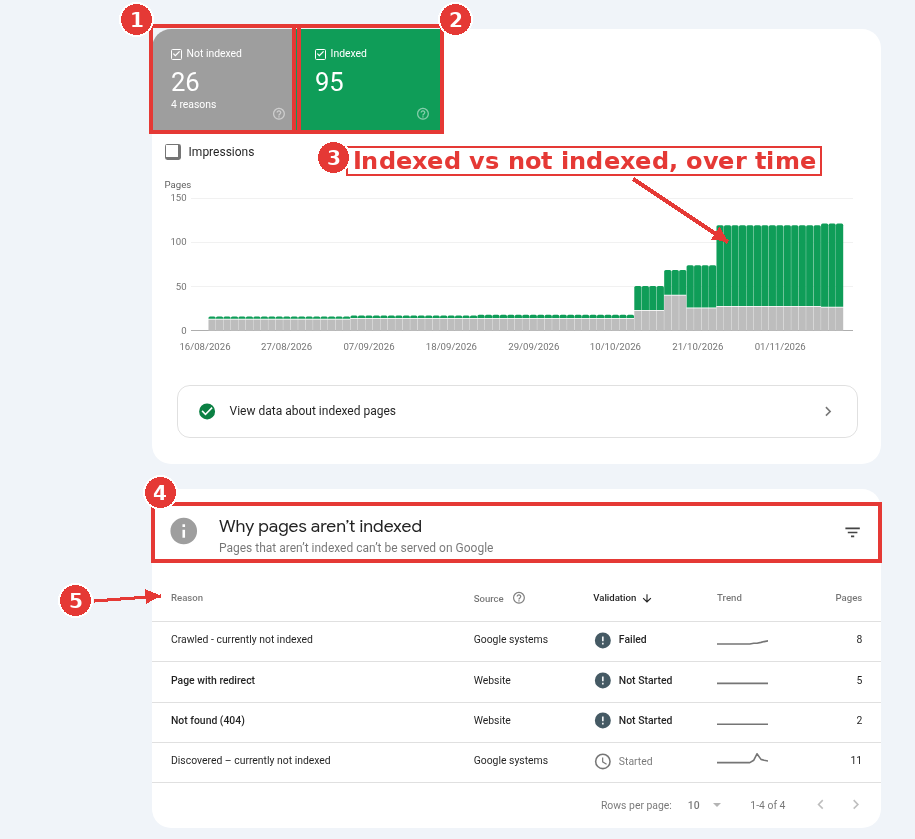
miraa.io Page indexing report, captured Nov 14, 2026.
Scroll to "Why pages aren't indexed" and open any reason whose count jumped. A noindex tag shipped by accident, a robots.txt rule or a canonical pointing at the wrong URL shows up here first. A misplaced noindex causes a slow decline, because each page drops only after Google recrawls it. A server outage causes a sudden cliff. For crawl problems, Settings > Crawl stats shows if server errors or response times spiked on the same days.
A fuller triage of every indexing status is coming as its own guide. Until it's live, the SaaS technical SEO checklist has the pass conditions for each fix.
8. Did you move, redesign or change URLs?
Ask engineering what shipped in the two weeks before the drop. Migrations, a move to a new hostname, CMS swaps, a new URL pattern for the blog, a JavaScript library upgrade. Rankings wobble while Google recrawls changed URLs, and for a medium site that takes a few weeks.
A drop that is still falling a month after a move has something broken. Spot-check old URLs for redirects that land on the right page with a single 301 hop, and compare the old sitemap against the new one. A step-by-step recovery checklist for post-migration drops is on the calendar; the planning side lives in the SaaS website migration guide.
9. Is there a manual action or security issue?
Open Security & Manual Actions in the left menu and check both reports. On most sites both say "No issues detected", and that's a two-minute check you can cross off. If either report lists something, everything else on this page waits. A manual action needs a fix and a reconsideration request, and a security warning in the results suppresses clicks until it's cleared.
10. Did the results page itself change?
Search your top five lost queries in a private window and look at what sits above your listing now. An AI Overview, a video carousel, a "People also ask" block or a new ad slot can take clicks while your position stays the same. The AI Overviews keyword audit shows how to sort a B2B keyword list by how exposed each term is to AI answers.
This is the one cause on the list you can't reverse. The response is a choice: target the queries where clicks still happen, or change the page so it earns the citation inside the answer.
A worked triage, start to finish
Take a hypothetical B2B SaaS site whose clicks fell by half over six weeks. The numbers are mine, built to show the order, not a real client.
Check 1 finds no matching anomaly entry, and GA4 organic sessions fell on the same days. The loss is real.
Check 2 shows impressions fell with clicks, so the site lost visibility and CTR is a side issue.
Check 3 finds the drop started nine days before the nearest update window opened. Update unlikely.
Check 4 shows last year's line flat in the same weeks. Not seasonal.
Check 6 shows the loss spread across 300 of 340 blog URLs. Site-wide.
Check 7 shows not-indexed pages rising from the same week, with "Excluded by noindex tag" as the reason that jumped.
Six checks in, the answer is a template bug, found without rewriting a single article. Had the team skipped to "our content strategy stopped working", they'd have spent a quarter on the wrong fix.
When to change strategy, and when to wait
Checks 1, 4 and 7 point to a data fix, a season or a technical fault, and none of those calls for a new strategy. Fix the fault, annotate the chart and give it a few weeks.
Strategy belongs on the table only when the drop is real, site-wide, not seasonal and not technical, and the update test in check 3 holds up. Even then, a small slide (position 2 to 4) and a large one (position 4 to 29) are different problems. Small slides often reverse with no action. Large ones call for an honest look at how the site compares with the pages now ranking above it.
If the checks point to a technical cause your team can't trace in-house, a technical SEO agency can audit the crawl and index side, and that work is narrower and cheaper than a strategy reset.
FAQ
How long should I wait before reacting to a traffic drop?
Wait at least three full days of data, because the newest days are incomplete. For a suspected update, wait until the dashboard shows the rollout as complete before you judge it.
Can a drop in impressions alone hurt my traffic?
Not by itself. Clicks are the traffic. An impressions drop with flat clicks often means you lost low-value appearances, or that a logging change or SERP feature removal moved the count.
Does a core update hit mean my content is bad?
No. A ranking change after a core update may not mean anything is fundamentally wrong with the content, a point Google makes in its own debugging guidance. Other pages may have become more useful for the query. Self-assess the whole site, and expect any recovery to show up over weeks or months.
Should I trust GA4 or Search Console when they disagree?
Use each for what it measures. Search Console counts Google Search clicks, GA4 counts sessions from browsers that run its tag, and they'll never match exactly. When the shapes disagree, investigate tracking before rankings.