
Last updated: November 14, 2026
On SaaS prompts, listicles earned 35.37% of the citations handed out by three AI answer engines, according to a March 2026 study of more than a million AI citations run by a website builder's AI search research lab. Across all five industries in the same data, comparison pages earned 2.20% of citations and alternatives pages 0.29%. Those two are the pages most software teams treat as their money pages. The page an AI engine quotes and the page a buyer reads before signing are often different pages, so the content calendar has to plan for both.
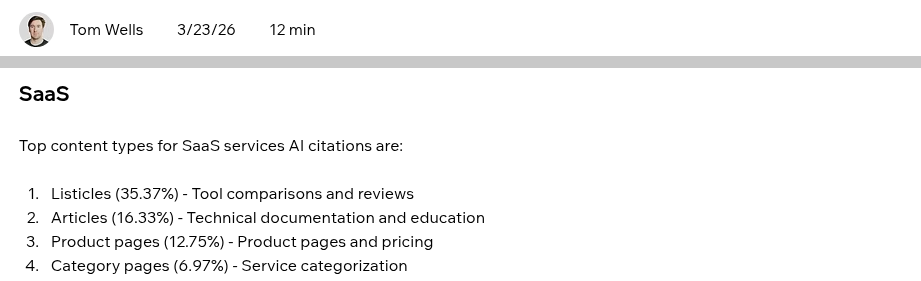
SaaS citations by content type, listicles 35.37%, captured Nov 3, 2026.
In 2026, a B2B SaaS blog format earns its place by helping a buyer decide or by giving an AI engine a clean answer to cite. The formats worth the most budget do both.
Who this is for
Content leads and founders at B2B software companies setting next quarter's calendar, or who inherited a blog nobody can tie to signups. A blog with only a handful of posts needs product, pricing and comparison pages before a format review, and the B2B SaaS SEO pillar guide covers that groundwork.
What each B2B SaaS blog format is for
Format | Buyer question it answers | Strongest published evidence | Drop it when |
|---|---|---|---|
Comparison and alternatives page | "Which of these fits us?" | Pages with three tables earned 25.7% more ChatGPT citations on commercial prompts | You can't name real differences or show prices |
Original research | "What is normal for teams like ours?" | Early-stage pages with five to seven stats had a 20.3% higher citation likelihood | The sample is too thin to publish |
How-to tied to the product | "How do I get this done?" | 9.21% of citations on informational prompts | The steps never touch your product |
Glossary entry | "What does this term mean?" | No study here measures glossaries on their own | The definition adds nothing to what already ranks |
Listicle | "What are my options?" | 35.37% of citations on SaaS prompts | Your own product sits first with no stated method |
Customer story | "Did this work for a company like mine?" | Not measured in these studies | The customer won't be named or share results |
Thought leadership | "How should we think about this problem?" | Not measured in these studies | No named author has a stake in the argument |
Template or calculator | "Can I start from something?" | Not measured in these studies | It doesn't lead into the job your product does |
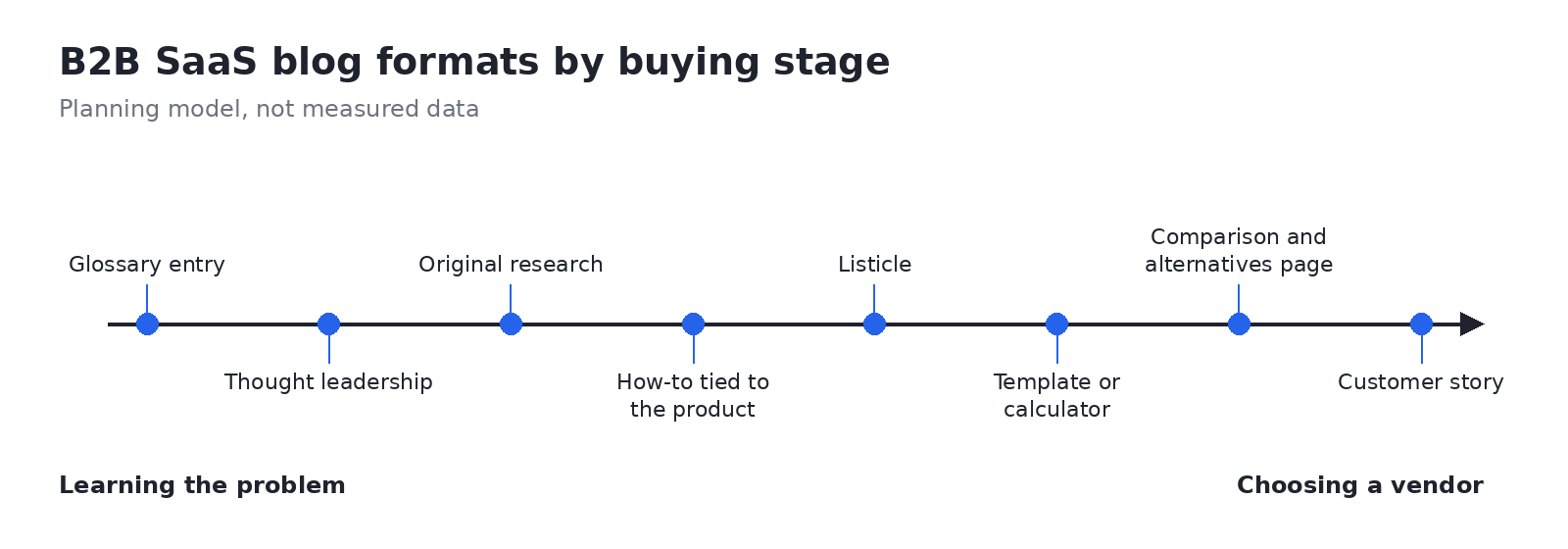
Formats by buying stage: a planning model, not measured data.
Half of these formats have no citation data behind them, so AI visibility alone can't settle whether customer stories, thought leadership, templates or glossaries stay.
What the citation studies measured, and what they left out
Three recent citation studies carry most of the numbers in circulation, and each comes from a company that sells something related to AI search. That makes their methods as important as their figures.
The Wix Studio AI Search Lab study measured ChatGPT, Google's AI Mode and Perplexity. Its author, Tom Wells, notes that all of the data was created and retrieved in Peec AI, an AI visibility tracker where he works as a GEO researcher. The study covers 75,000 AI answers and 1,056,727 citations on non-branded prompts across four intents and five industries. It doesn't give a collection window.
AirOps, which sells content workflow software, published an April 2026 report that compared 217,508 pages that ChatGPT retrieved for 7,500 commercial prompts, splitting the pages it cited from the ones it retrieved and passed over. It covers one engine only.
The third study, from the AI search analytics company Profound, sorts citations by who owns the site they point to and ignores page format. Across 11.8 billion citations from eight models, swept from April 16 to July 16, 2026, the median SaaS or software company got just 11.4% of its citations from earned media, and roughly 57% of citations across all industries went to brand sites. For software, pages the company publishes itself do much of the work.
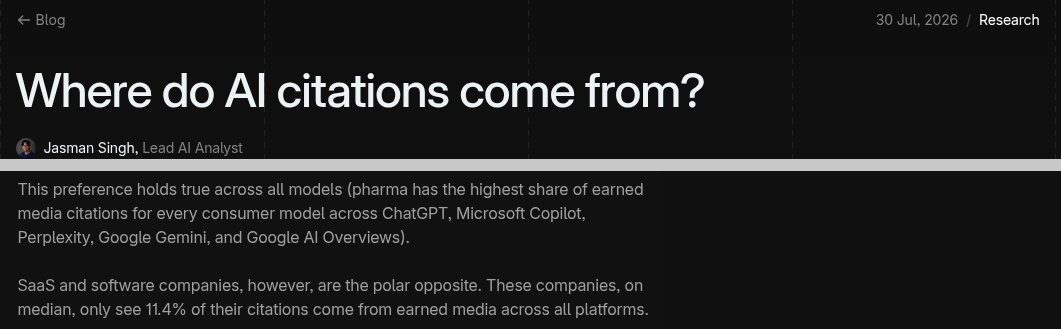
Profound: SaaS median earned media share 11.4%, captured Nov 3, 2026.
None of the three tracks signups, demos or revenue. Citation share is one input. Pipeline still has to be measured on your own site, and the guides on measuring AI search visibility and B2B SEO attribution cover how to connect the two.
Formats that sit closest to a purchase
Comparison and alternatives pages
A 2.20% citation share looks small until you remember who lands on these pages. People searching "HubSpot alternatives" or "Notion vs Confluence" have a shortlist and a budget. On commercial-intent prompts in the Wix data, comparison pages rose to 4.08% of citations, nearly double their overall share.
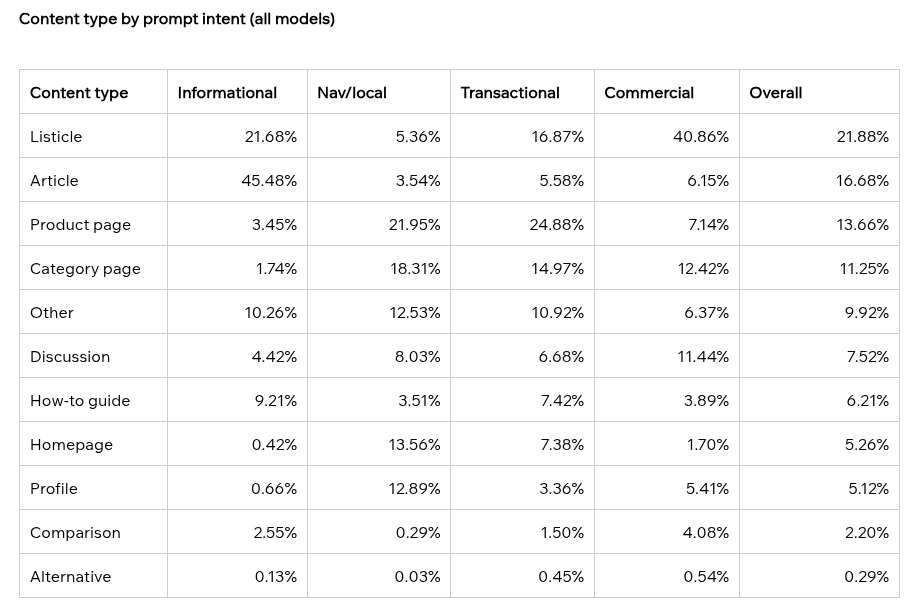
Overall table: comparison 2.20%, alternatives 0.29%, captured Nov 3, 2026.
The AirOps findings describe how to build one. Pages with three tables earned 25.7% more citations, and pages with seven distinct price points earned 15.7% more.
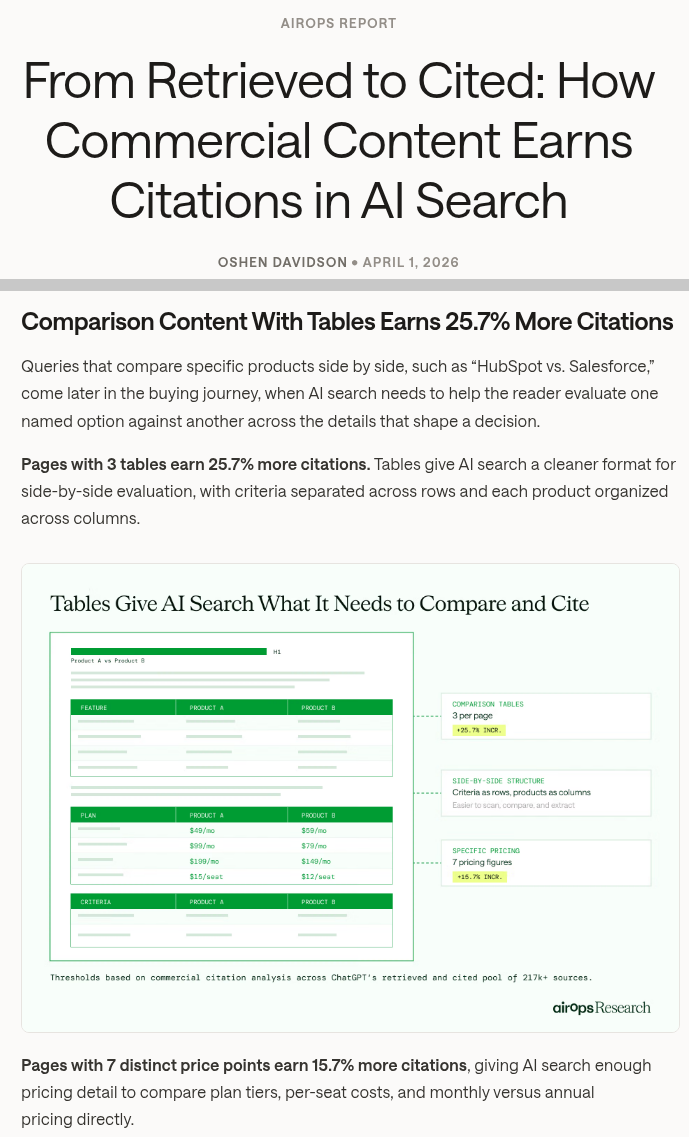
AirOps: three tables +25.7%, seven price points +15.7%, captured Nov 3, 2026.
Buyers want the same things: side-by-side criteria, real plan prices and the tradeoffs they would otherwise hear on a sales call. A page that hides its own price while listing everyone else's reads as an ad. The comparison pages guide covers structure, and the piece on whether SaaS companies should publish pricing covers the harder internal argument.
Customer stories
None of the studies measures customer stories, and they rarely pull much search traffic. Their job happens later, when a champion needs to show a manager that a similar company made the switch. The useful version names the customer, the problem in their words, the setup and results the customer approved for print.
Formats that teach
How-tos tied to the product
How-to guides earned 6.21% of citations overall and 9.21% on informational prompts in the Wix data. Google's AI Mode leaned slightly toward them, at 1.58% above the study's average. For transactional prompts, the study's recommendation was to "Publish how-to guides for complex products."
A guide to writing a sales follow-up email can come from anyone. A guide to setting up follow-up sequences in a specific tool, with the settings and the screens, is hard to copy and brings readers who already use or are evaluating that tool. The AI Mode citations guide covers what that engine tends to pick up.
Glossary entries
A short definition of a term buyers search, linked to the product page that puts the term to work, helps search engines and AI systems connect the brand to its category. A single entry rarely brings in buyers.
Glossaries get into trouble at scale. Google's guide to its generative AI features, last updated July 10, 2026, warns that creating separate content for every possible variation of how people search, mainly to manipulate rankings or AI responses, violates its scaled content abuse policy.
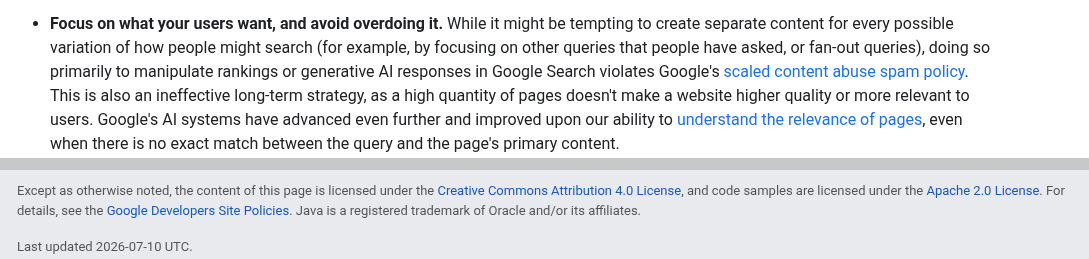
Google's AI features guide on scaled content, captured Nov 3, 2026.
Hundreds of thin definition pages built from a keyword export fit that description. A few dozen entries that each add an example, a common mistake or a number from your own product are a different thing. The programmatic SEO for SaaS guide covers where templated pages hold up.
Formats that get quoted
Listicles
The 35.37% SaaS figure is the reason listicles stay on most calendars, and on commercial prompts listicles took 40.86% of citations across industries. The same study looked at the 1,000 most cited URLs for professional services, the industry with the highest listicle rate. Self-promotional lists drew 19.1% of those listicle citations, and third-party lists drew 80.9%, so the engines lean on lists written by someone other than the vendors being ranked.

Professional services listicles: self-promo 19.1%, third-party 80.9%, captured Nov 3, 2026.
For a vendor's own listicle, ranking the publisher's product first with no stated method is the weakest version. A list with written criteria, a disclosed placement and fair entries for rivals has a better chance of being used. Getting onto third-party lists is a separate job, closer to PR than to blogging, and the guides on brand mentions versus backlinks and getting recommended by ChatGPT cover it.
Original research
AirOps found that early-discovery content with five to seven statistics had a 20.3% higher likelihood of being cited. Original research is the most direct way to own those statistics instead of borrowing them. Product usage data, a customer survey or a support ticket benchmark all count if the sample and dates are published.
Research also travels into discussions. Perplexity drew 17.35% of its citations from discussion pages in the Wix data, more than double the 7.52% average, and a number from a named study is the kind of thing people quote in those threads. The guides on original research for AI citations and Reddit for AEO cover both sides.
Formats that need a reason to exist
Thought leadership and templates have no citation data in these studies, so the case for each rests on its fit with the product.
Thought leadership earns a slot when a named person with real standing argues something specific, such as a founder explaining why a category's pricing model is broken or a security lead explaining why a common control fails. Trend roundups under a company byline don't qualify. On February 2, 2026, Kanishka, content lead at a newsletter platform, wrote that if he were rebuilding a SaaS content strategy he "wouldn't start with awareness," listing trend blogs and generic guides as where teams waste time.
Templates and calculators work when the file leads into the job the product does. A pricing model template from a billing tool fits. A generic content calendar template from the same tool brings downloads from people who will never buy.
Posts to retire or merge
Older SaaS blogs tend to carry three kinds of posts that no longer earn their upkeep: news recaps that went stale within weeks, broad top-of-funnel guides with no link to the product, and several thin posts chasing one query. Recaps can usually go, with a redirect. Broad guides can be cut down and merged into a product-tied how-to. Thin duplicates belong on one page. The content refresh guide covers how to decide between updating and removing a post.
A worked example: a hypothetical format review
Take a hypothetical HR software company with years of blog posts from three writers and no format tags. The content lead has one quarter before the next budget review.
Export every blog URL and tag each one with one of the eight formats. Posts that fit no row get tagged "other."
Pull Search Console clicks and queries for each URL, plus any signups or demo requests attributed to it.
Run the prompts buyers would ask about the category through ChatGPT, Perplexity and Google's AI Mode, and note which of the company's pages appear.
Decide each URL's fate with a short rule set, then set the next quarter's mix from what's missing.
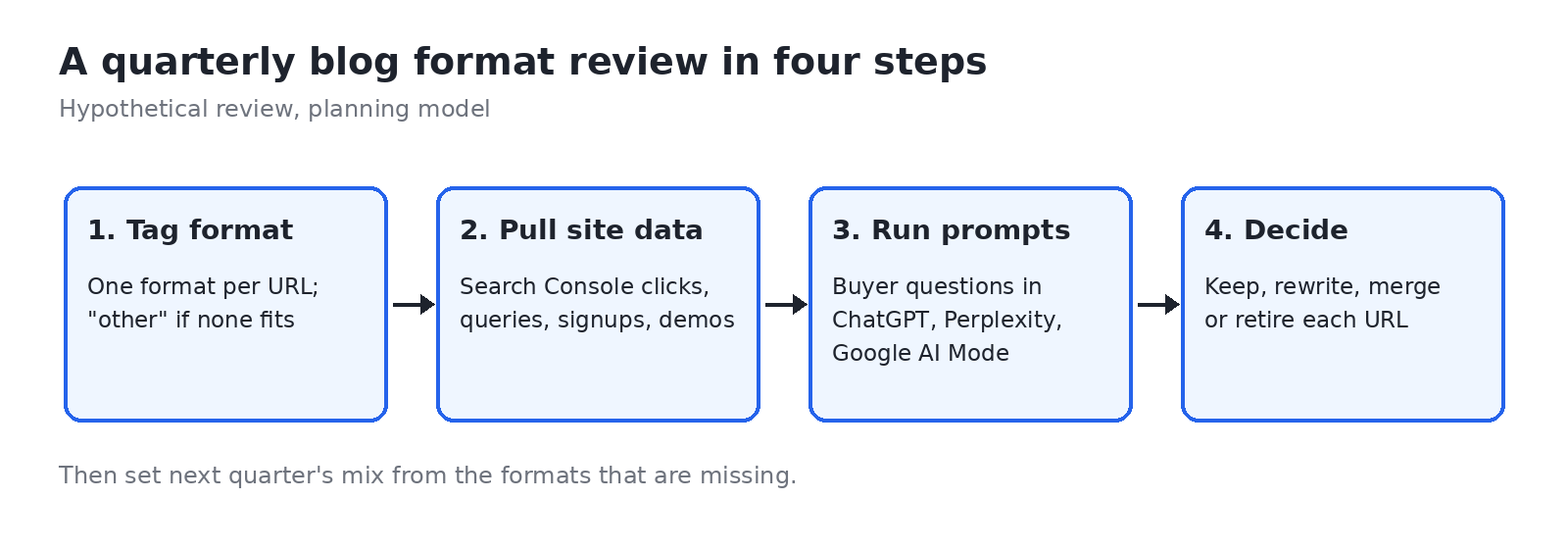
Hypothetical four-step format review, a planning model.
Possible findings, and what the team does with each:
What the team finds | Decision | Reason |
|---|---|---|
A long tail of trend posts from past years, each with little traffic | Retire with redirects to the nearest guide | They answer none of the eight buyer questions |
Two alternatives pages with no pricing for the company's own plans | Rewrite with tables and real prices | Buyers and the AirOps data both reward price detail |
A payroll glossary built from a keyword export | Cut to entries that link to a product page and add something new | Thin variants are the pattern Google's guide warns about |
How-tos that never mention the product | Rebuild a few around product setup, merge the rest | Product-tied steps are hard to copy |
No original research at all | Plan one study from anonymized product data | Owned stats are what early-stage pages get cited for |
A customer story with an unnamed client | Ask the client for approval to name them, or retire it | Sales can't send an anonymous story |
Setting next quarter's mix
The right mix depends on where the company stands. A team creating a new category has few comparison searches to target yet, so definitions, research and thought leadership carry more of the load, and the guide to SEO for a new software category goes deeper. A team in a crowded category already has buyers comparing tools, so comparison pages, pricing transparency and third-party lists come first. A product-led company with a free plan gets the most from how-tos and templates that end inside the product.
Comparison pages and original research take the most specialist time to do well. Teams without writers who can handle pricing tables or survey design sometimes bring in an SEO content agency for those two formats and keep how-tos and customer stories in-house, where product knowledge lives.
FAQ
What are the best blog post types for SaaS?
For most software companies: comparison and alternatives pages, product-tied how-tos, original research and customer stories, with listicles for category queries.
Do listicles still work for SaaS content?
On SaaS prompts they were the most cited format in the March 2026 study. Third-party lists drew most listicle citations in the professional services subset, though, so a vendor's own list needs a stated method to be taken seriously.
How many SaaS content formats should one team run?
As many as it can do well with the people it has. A small team running three formats with care tends to get more from each post than one spread thin across eight.