

Last updated: November 25, 2026
On May 15, 2026, Google clarified in its documentation log that its spam policies also apply to its generative AI responses in Search. Those spam policies list five examples of scaled content abuse. The first is using generative AI tools to make many pages without adding value for users.
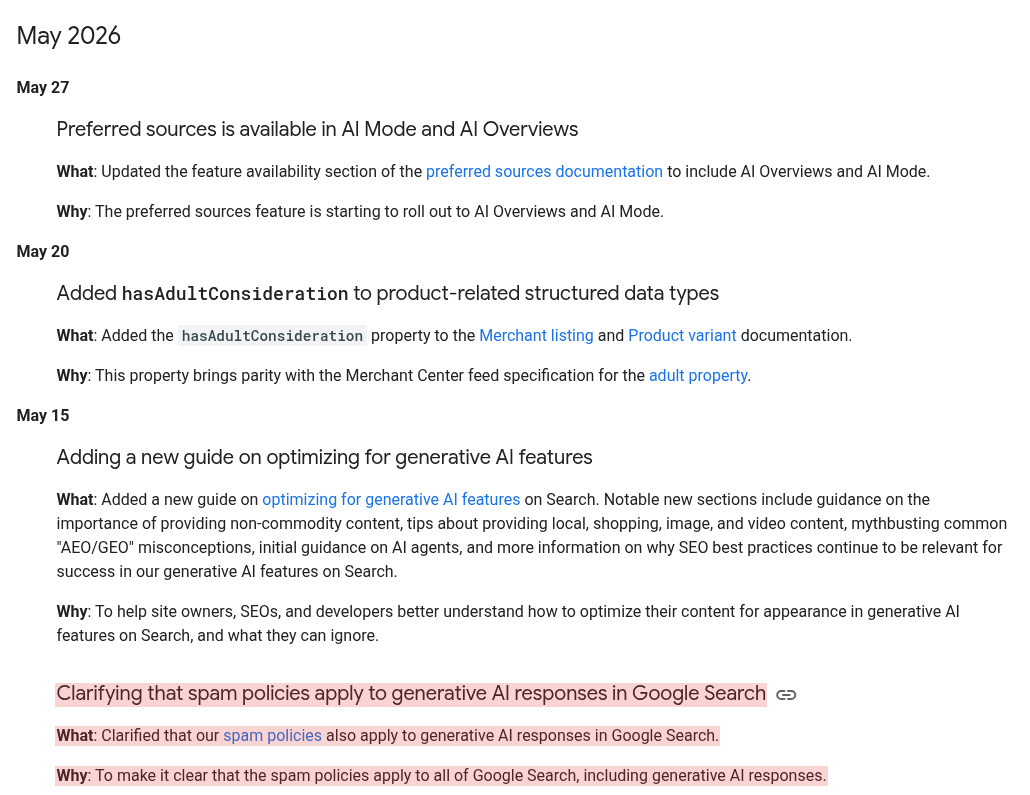
Google's May 2026 update log, captured Nov 22, 2026.
So a blog that published hundreds of AI drafts answers to one set of spam policies, in ranked results and in AI answers. Google's stated reason for the change was to make that clear. Weak pages are worth fixing for both. This guide is for the team that has to recover traffic after AI-generated content without reading every post by hand.
What the policy allows and forbids is covered in does Google penalize AI content. What to do with any one weak URL is in the guide on whether to delete, rewrite or noindex. This guide is the plan that sits above both: find the batch, score a sample, write rules and rebuild what is worth keeping.
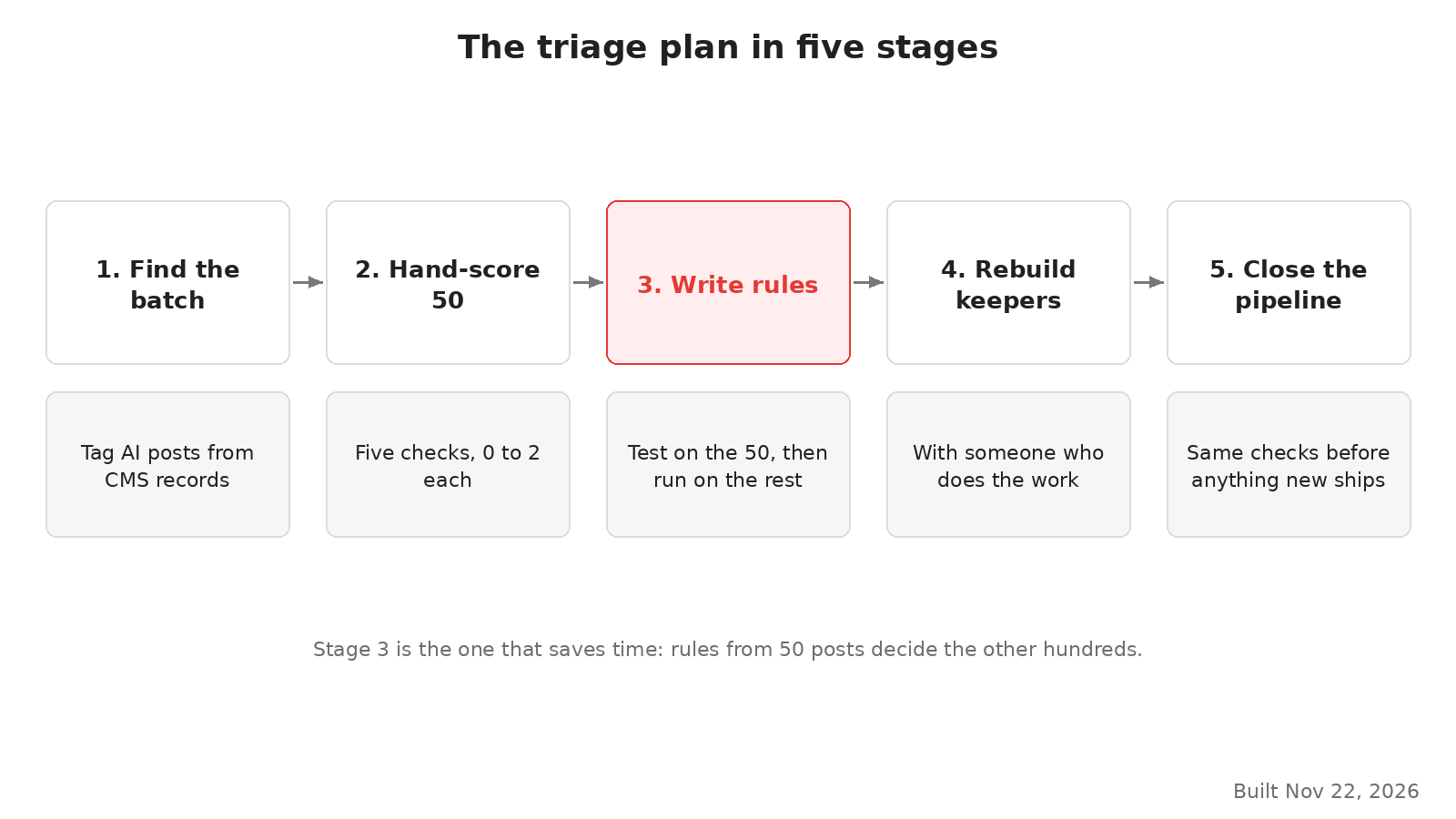
Five stages, one sheet. Built Nov 22, 2026.
Find the AI batch before you judge any page
Start with the publishing records before the traffic report. Export every post from your CMS with its publish date, author account, word count and the brief or template it came from. AI content projects often leave a trace in those fields. A shared author account, a burst of posts in a few months, or the same word count over and over all point to the batch.
Tag each post as part of the batch or not. Then compare monthly clicks for the batch with clicks for everything else. The guide to losing traffic while publishing more shows the same split by post age. If the batch lost clicks and the older posts held, the problem is probably in the batch. If both groups fell together, look at the whole site first.
Two checks come before any cleanup. Look for a manual action in Search Console, which is a penalty a Google reviewer applies by hand. Then compare the date of the drop with Google's update dates. The guide to recovering from a spam update covers both steps, and how a manual action changes the plan.
Hand-score a sample of 50 posts
Say a blog has 600 AI posts. That is too many to read first. A sample of 50 is not. I would pick them on purpose: 20 from the batch's best performers by clicks, 20 at random and 10 that never got a click.
Read each one with the top result for its main query open beside it. Score five checks from 0 to 2:
Facts. Pick three claims and check them against a source you trust.
Sources. Open every link and number. Make sure each one exists and says what the post claims.
Sameness. Compare the intro and headings with three other posts from the batch. A shared shape points to a template nobody edited.
Added value. Look for something the top result lacks: an example, your own data, a real screenshot or a view from someone who did the work.
Metadata. Read the title, meta description and image alt text against the body. AI drafts often promise more in the title than the post delivers.
The last check comes from Google's guidance on AI content. It asks for a manual fact-check that covers titles, meta descriptions, structured data and alt text. The E-E-A-T guide covers that guidance in more detail.
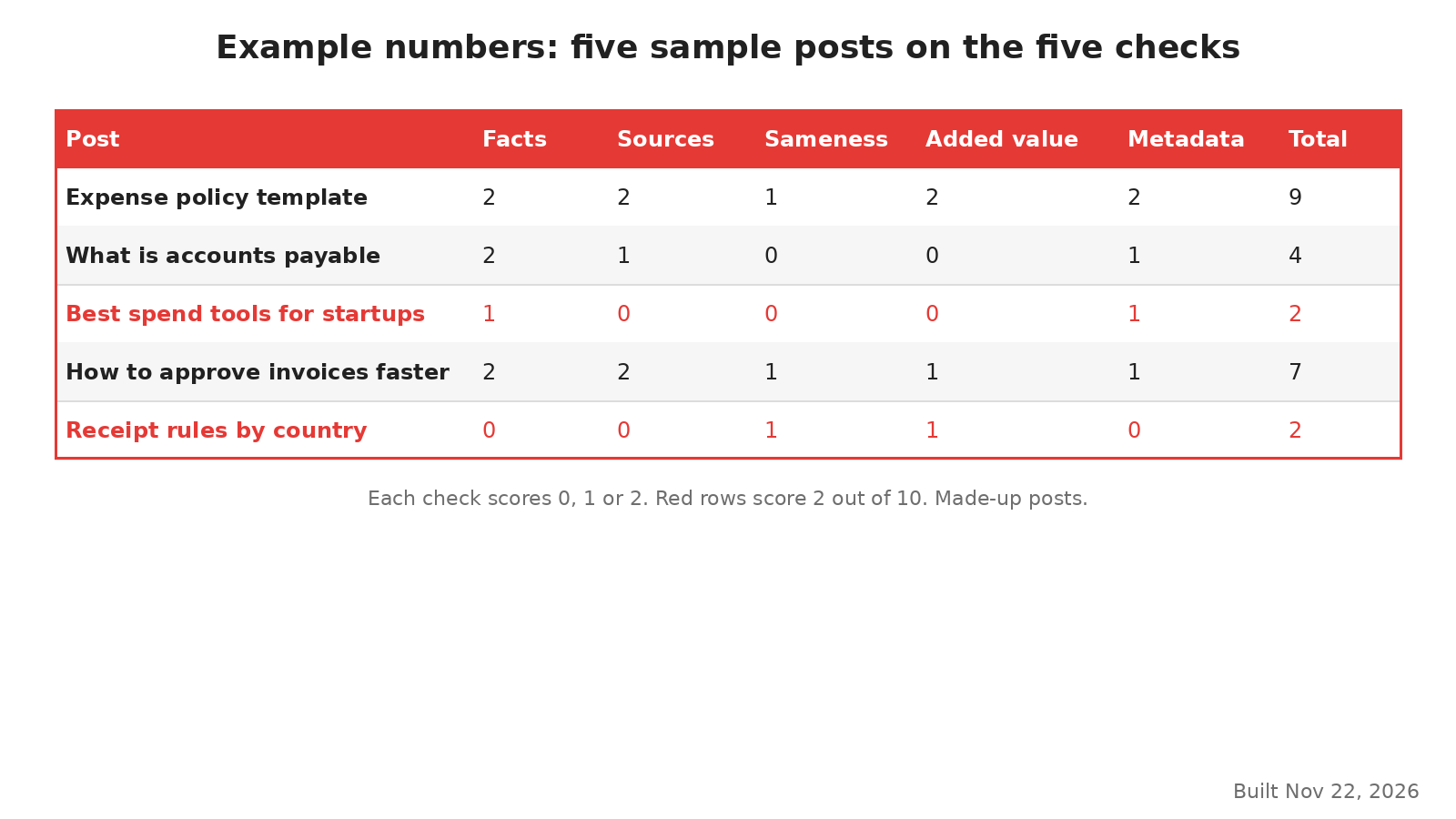
Example numbers, made-up posts. Built Nov 22, 2026.
Budget the time before you start. At about 20 minutes a post, 50 posts take two working days for one person. That is my estimate, and fact checks on technical topics take longer.
Turn the scores into rules for the rest
The sample is only useful if it tells you what to do with the other 550. Look for patterns between the scores and data you have for every post: clicks, impressions, internal links, leads and topic.
You might find that almost every post scoring 0 on added value also had fewer than 10 clicks in 12 months. That becomes a rule you can run on the whole batch. Keep the rules on one sheet, each as one sentence with a condition, an action and an owner. Write the sheet before anyone changes a URL, because deletions are hard to undo.
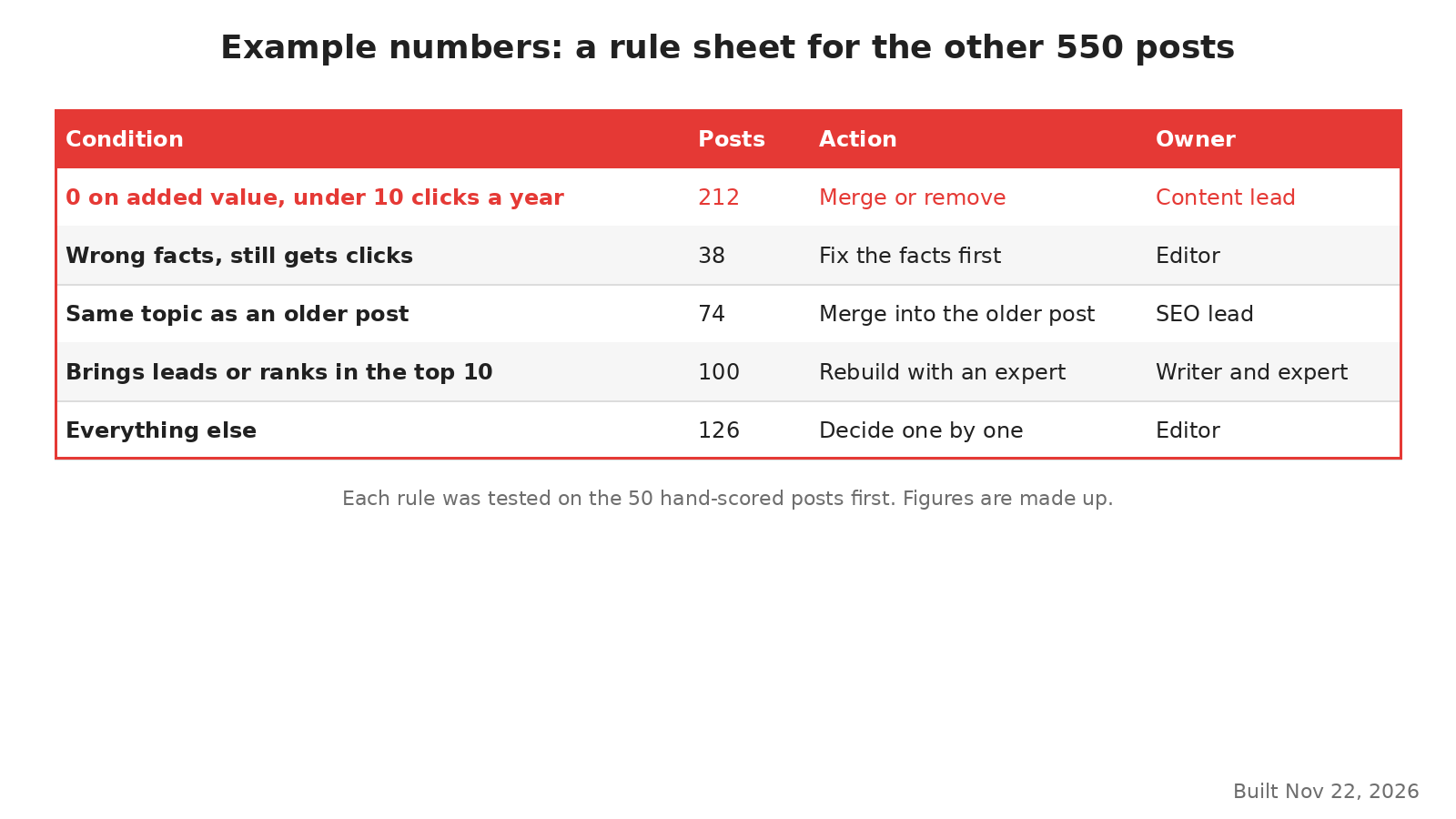
Example numbers for a made-up blog. Built Nov 22, 2026.
Posts that only restate common facts are often the first group to cut or merge. Danny Sullivan, who works on Google's search team, made a related point in a Search Off the Record episode from December 17, 2025. AI systems already present commodity, factual content well. A post that adds nothing to those facts has little left to offer a reader.
Before you run a rule, test it on the sample. Apply it to the 50 posts and compare its calls with yours. If it disagrees with you on more than a handful, rewrite the condition. Then run it on the rest and log the date of each batch of changes.
Rebuild the keepers with someone who knows the subject
Some posts are worth keeping. They rank, they bring leads, or they cover a topic your buyers ask about. Sort those by business value and rebuild from the top.
A rebuild is more than a rewrite. Book 30 minutes with someone who does the work, such as a product manager, a support lead or a customer. Ask for one example from a real account, one mistake people make and one opinion they would defend. Then rebuild the post around those answers and fact-check the rest.
In the same episode, Sullivan said people also want first-hand experience next to expert takes. That is the part an AI draft can't supply on its own.
Capacity sets the pace. Two writers rebuilding five posts a week each will finish 100 keepers in ten weeks. Those are example numbers. If your team can't spare that, our SEO content agency rebuilds B2B SaaS posts with subject experts.
Close the pipeline that made the batch
Cleanup does not last if the same process keeps publishing. Before any new AI draft goes live, it should pass the same five checks as the sample. Name one reviewer who can reject a draft, and cap how many drafts a week they review.
Keep the AI for the jobs it does well: research notes, outlines and first drafts that an expert then reshapes. Then add two fields to your CMS, reviewer and review date, and fill them in for every post. They are the fields the next audit will look for first.
Start with the batch posts that still bring clicks
Fix the batch posts that still bring clicks or leads first. They carry the traffic you can still lose, and a rebuild with someone who knows the subject lifts them most. Posts with no clicks have nothing to lose, so the rules from your sample can handle them later.