
Last updated: November 20, 2026
On average, 4.0% of the domains one AI chat model cited also appeared in a search engine's top 10 results. That figure comes from 1,000 "best of" queries run through both. For more than half of the queries, the overlap was zero. A university research team published those figures in a paper first released in January 2026 and revised on May 16, 2026.
That is the gap behind the question. You can hold the first spot on Google and still be missing from the answer. The answer is built from a different set of pages. The model in that study was GPT-4o with web search, called through its API, on consumer topics such as laptops and airlines. ChatGPT today may behave a little differently. The direction is still clear: a Google ranking does not carry over by itself.
This post is for brands that already rank. If you are starting from zero in both places, the ChatGPT recommendation playbook is the better first read. Here I go through seven reasons the gap exists, how to test each one, and which to fix first.
Match the symptom to the likely reason
What you see | Most likely reason |
|---|---|
ChatGPT cites other pages for your exact query | 1. It searched a different query |
Your page never appears in any ChatGPT source list | 2. It used a different search index, or 3. a bot block |
ChatGPT cites newer pages that rank below you on Google | 4. Your page looks old |
ChatGPT names competitors from review sites and lists | 5. Few third-party pages mention you |
ChatGPT describes your product wrongly or not at all | 6. The model does not know your brand well |
ChatGPT cites you for some prompts but not for "best" lists | 7. Your page does not fit the answer's shape |
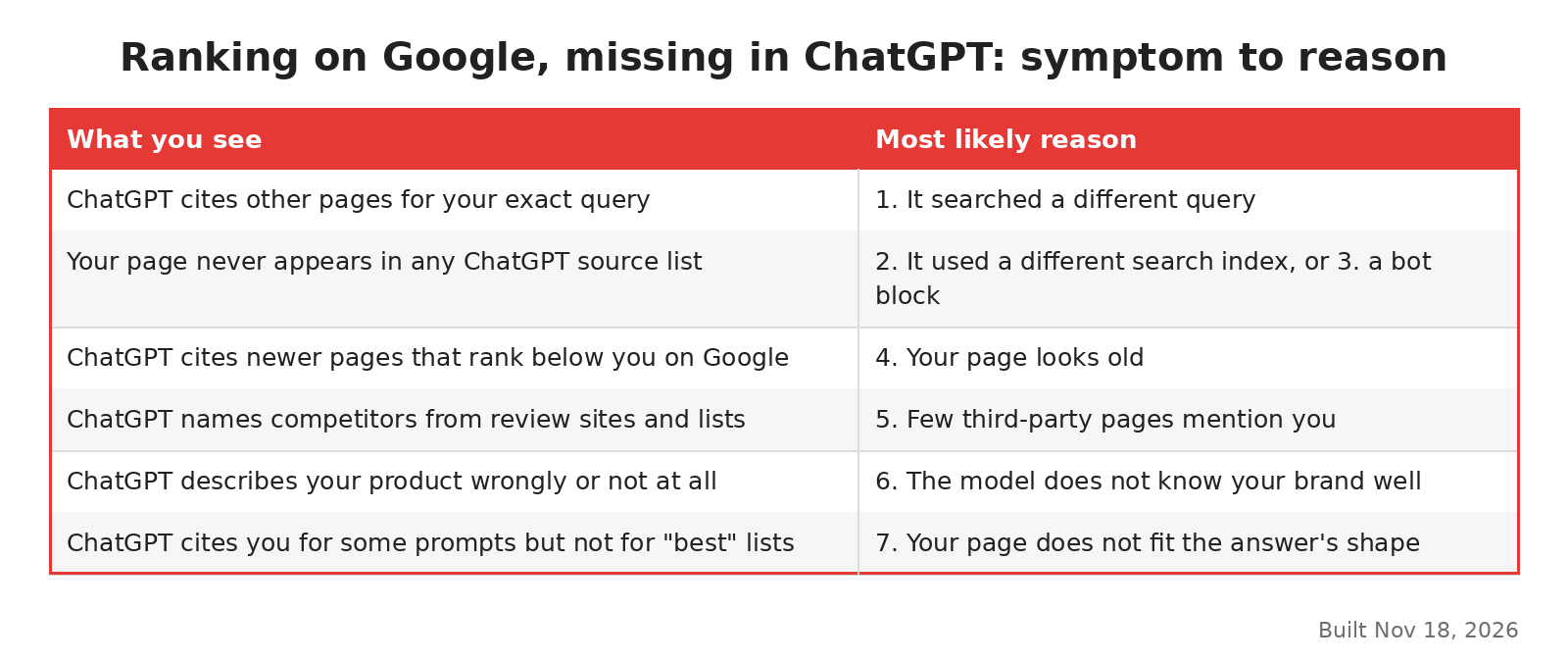
Symptoms matched to the seven reasons, built Nov 18, 2026.
Reasons on the retrieval side
These four are about how ChatGPT finds pages. They decide whether your page is even in the set of pages the model reads.
1. ChatGPT searched for a different query
You rank for the words a person types into Google. ChatGPT does not search with those words. OpenAI's help article on searching the web with ChatGPT explains that ChatGPT usually rewrites the question into one or more targeted queries. It may then send more specific follow-up queries after reading the first results.
So a prompt like "what is the best help desk tool for a 10 person team" may turn into several narrower searches. Your page may rank for none of them. Read the source list under the answer, then guess which queries produced those pages. That tells you which topics your site does not cover yet.
2. It searched a different index than Google's
The same article lists other search partners, including Microsoft. A strong Google position tells you little about how your page ranks in those other systems.
The 4.0% overlap from the intro fits this. The authors found the other AI tools they tested were also far from Google's results. Gemini 2.5 Flash shared 11.1% of domains on average, Claude 4.5 Sonnet 12.6% and Perplexity Sonar Pro 15.2%. Even the tool built on Google search grounding picked mostly different sites.
Bing is the easiest place to test this. Search your main query there. If your page sits on page two or is missing, check that it is indexed in Bing Webmaster Tools.
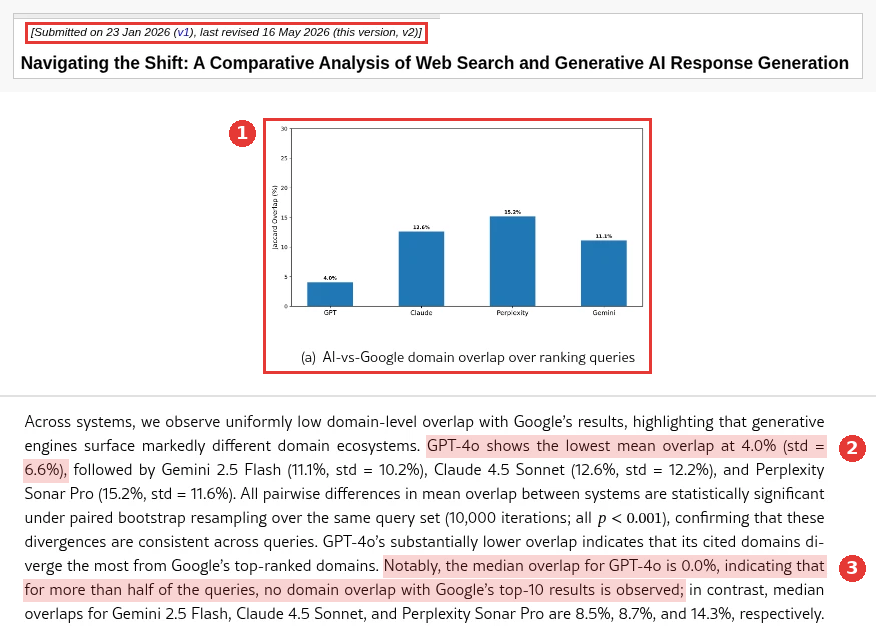
Overlap between AI answer sources and search results, captured Nov 18, 2026.
3. A bot rule or firewall blocks the AI crawlers
OpenAI's ChatGPT search article names the bot that matters. To make a site eligible for search results, allow OAI-Searchbot to crawl the site, and confirm that your host or content delivery network allows traffic from OpenAI's published searchbot IP addresses. The AI crawlers and robots.txt guide lists each user agent and the rule to use.
Check your CDN too. Bot protection that blocks unknown crawlers can stop AI bots even when robots.txt allows them. Your server logs will show whether the search bots get a 200 response or a block.
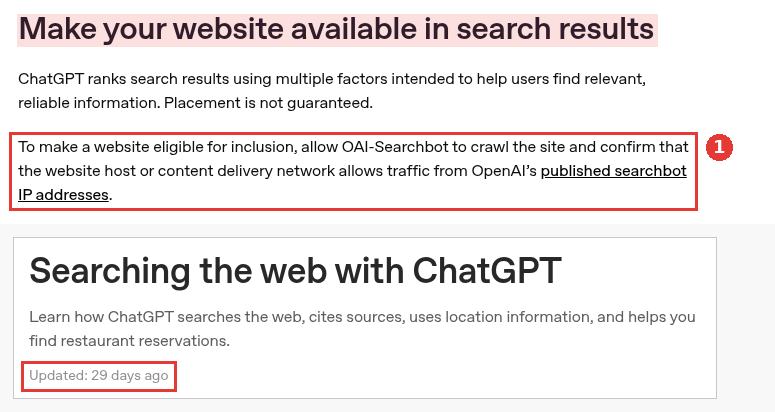
What ChatGPT search asks of your site, captured Nov 18, 2026.
4. Your page looks older than the pages it cites
In the same paper, the AI tools cited newer pages than Google ranked. For car queries, the median age of cited pages was 148 to 217 days. Google's top results had a median age of 493 days.
A page that wins on Google because of years of links can still lose here. If your page has no visible date, or shows a date from 2024, a newer page from a weaker site may be picked first. Update the facts, show the date of the last real change, and keep the published date honest. The content refresh guide covers what counts as a real update.
Reasons on the brand side
These three are about what the model and the web say about you. They decide whether your name gets picked from that set.
5. Few third-party pages mention you
Google gave a fairly even mix of source types in that study: 41% earned media, 34% social and 26% brand sites. Earned media here means independent outlets and review sites. GPT-4o leaned toward earned sources, at 57%, with only 8% social. For queries where people compare options, earned sources made up 59% to 86% of AI citations.
So the pages that rank you on Google may be your own. The pages that get you into an AI answer are often someone else's: a review site, a roundup or a trade publication. If none of them mention you, the model has nothing outside your site to quote. The brand mentions guide explains why a mention without a link still counts here.
6. The model does not know your brand well
A model brings its own memory from training to every answer. The same paper tested this with GPT-4o. For popular products, the model's rankings stayed fairly stable even when the authors shuffled the search snippets. For niche entities, the rankings moved a lot with the snippets. The model leaned on what it found because it knew little. In the popular group, 16% of the names in its rankings did not appear in any page it retrieved. Those names came from memory.
For a smaller SaaS brand, this has a bad side and a good side. The model will not name you from memory. Still, a few clear and consistent pages about you can shape the answer, because the model has no strong prior to override them. Use one product name, one category and one short description everywhere: your site, your profiles and your partner pages. If ChatGPT already gets your facts wrong, the guide to fixing wrong AI answers about your company covers that case.
7. Your page does not fit the shape of the answer
A Google result only needs a good title and snippet. An AI answer needs a passage it can lift. For a "best tools" prompt, that passage is usually a list entry with a name, a fit and a reason.
The paper found that for transactional queries, AI tools cited brand sites far more often, 52% to 68% of the time. For comparison queries, they leaned on earned lists. So your product page may be cited when someone asks about pricing, and skipped when someone asks for the best options. Clear comparison pages that state who each product fits give the model a passage it can use for that second type of prompt.
How to test which reason applies
You can run this in an afternoon with no paid tools.
Write down five prompts your buyers would type, in full sentences, with a team size or a use case.
Run each prompt in ChatGPT with search on. Save the answer and every source link.
Note whether your site appears in the sources, in the text, or nowhere.
Search the same topics on Bing and check whether your page shows in the top 10.
The last three steps check access and brand facts.
Open your server logs or CDN dashboard and look for the AI search bots, with the status code each one received.
Search your brand name with your category on two or three review sites and roundups.
Ask ChatGPT, with search off, what your product does. Compare its reply with your own description.
Repeat the prompts on a different day. AI answers change between runs, so one test can mislead. The AI visibility measurement guide explains how to track this over weeks.
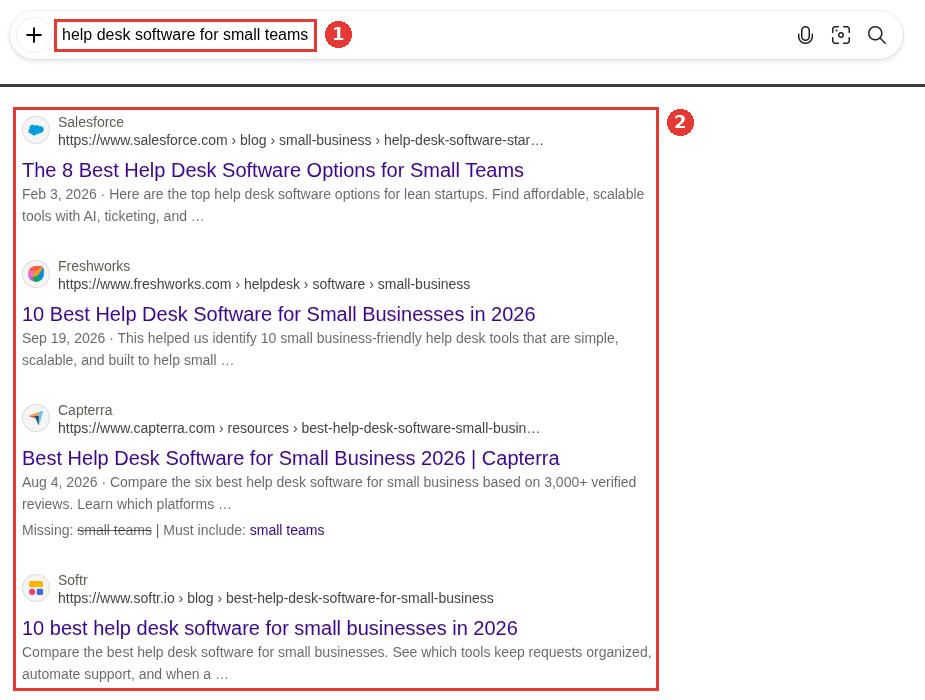
Two parts of the same Bing results page, captured Nov 18, 2026.
Then confirm the Google side in Search Console. Filter the Performance report to one query and read its average position. A December 2025 Search Central walkthrough shows how to add that query filter and turn on the average position metric. The example below uses a branded query, so it only shows where to look. For the test, use the category queries behind your five prompts.
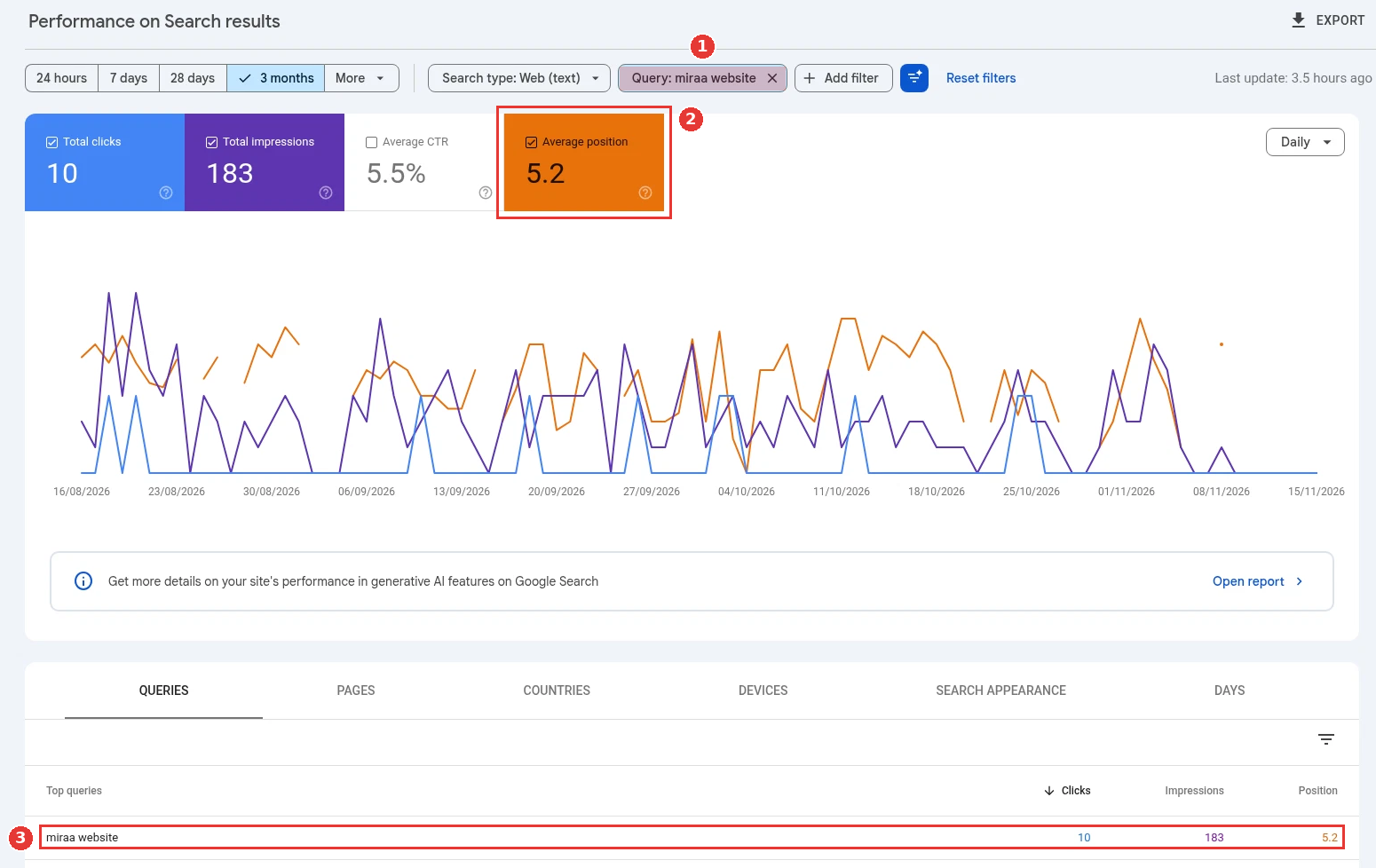
Checking your Google position for one query, captured Nov 18, 2026.
What to fix first
I would start with whatever blocks retrieval. A bot block or a missing Bing listing stops every other fix from working. After that, the brand-side work takes longer but lasts.
Order | Fix | Effort | Time to see a change |
|---|---|---|---|
1 | Remove bot or firewall blocks on AI search bots | Low | Days |
2 | Get key pages indexed and ranking on Bing | Low to medium | Weeks |
3 | Refresh dates and facts on pages that win on Google | Medium | Weeks |
4 | Add comparison and fit pages that answer "best" prompts | Medium | Weeks |
5 | Make your product name and description consistent everywhere | Low | Months |
6 | Earn mentions on review sites, roundups and trade press | High | Months |
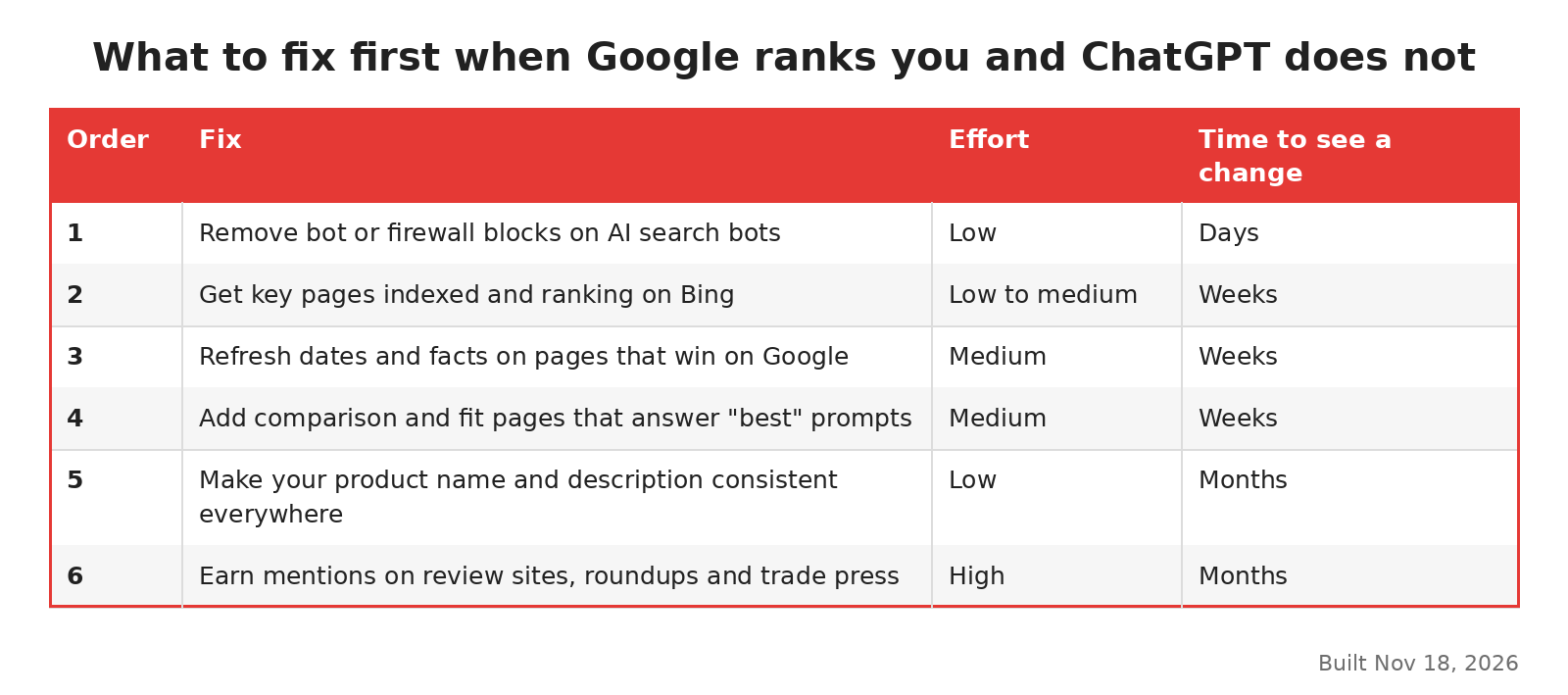
Which fixes to do first, built Nov 18, 2026.
The last row is the slowest and, for most brands that already rank, the most important. A Google ranking proves your page is good. It does not prove that other sites talk about you. If you want help with the AI side, an LLM SEO agency works on these same steps. The detailed fixes for each one are in the ChatGPT recommendation playbook. The explainer on how LLMs search the web covers the retrieval side in more depth.