
Last updated: November 12, 2026
Seven in ten of the 288 US business decision-makers in a survey a global market research firm published on August 18, 2026 said AI plays a part in how they select vendors. And 42% said AI hands them a starting list that includes vendors they wouldn't otherwise have considered. Read those numbers with care. The respondents make or help make indirect procurement decisions across many industries (technology accounts for about 11% of the sample), they answered online between May 20 and June 1, 2026, and the results weren't weighted. It's a signal about how business shortlists get built, and it doesn't isolate software deals.

Ipsos 2026 B2B buyer report page, dated 08.18.26, captured Nov 1, 2026
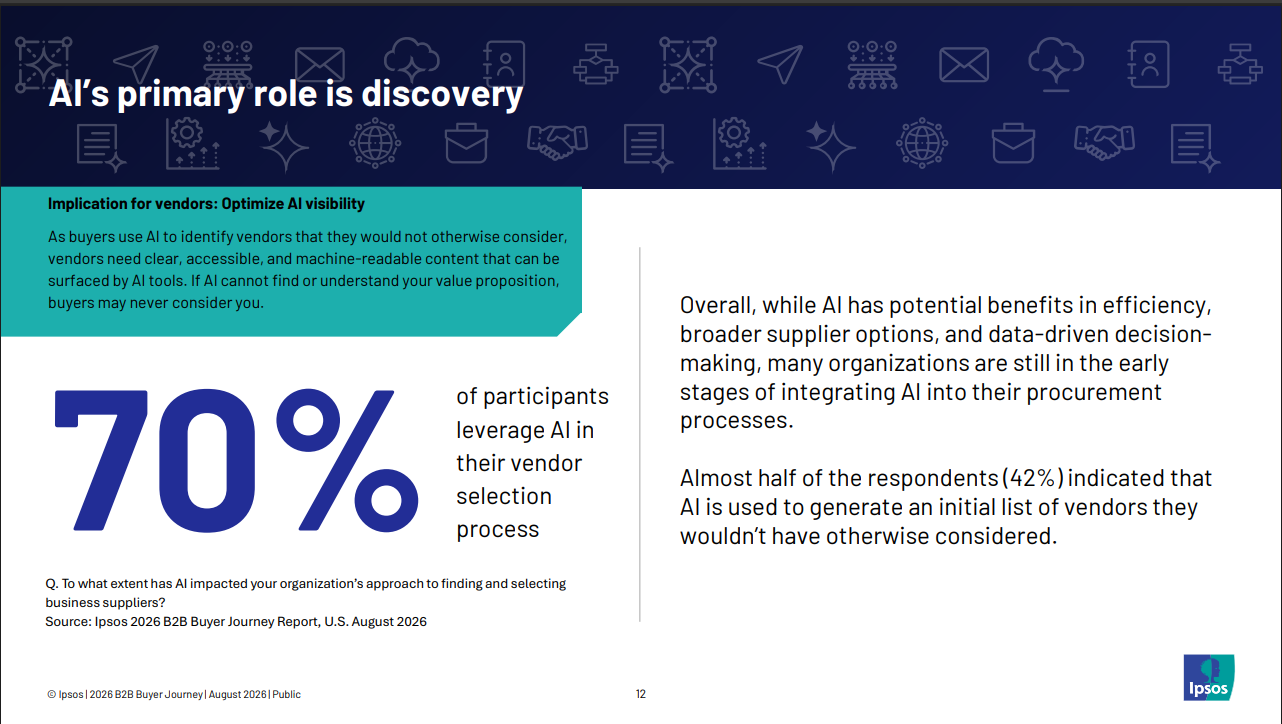
Ipsos: 70% use AI for vendor selection, captured Nov 1, 2026
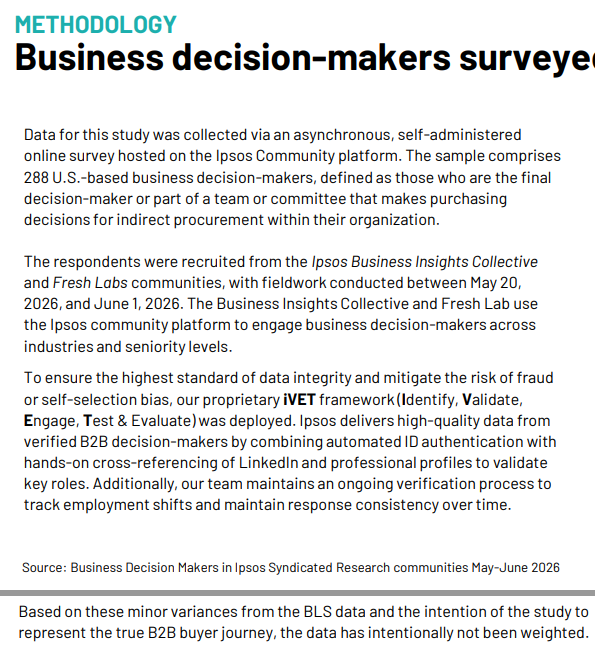
Ipsos survey notes: 288 respondents, unweighted sample, captured Nov 1, 2026
Still, a list drafted by a model is a list you're either on or missing from, and a missing vendor rarely finds out why.
Spend the first month measuring and publish nothing new. Most generative engine optimization (GEO) advice hands a small SaaS marketing team forty tactics at once, so everything feels urgent and very little gets finished. The order below puts facts and measurement first, corrections second, new pages third, and a second reading at the end. Each phase has an owner and a deliverable, and the deeper guides on this blog cover the detail behind each step.
Who this plan is for, and what "done" means on day 90
The plan assumes a B2B SaaS company with a working website, pages Google already indexes, and a marketing lead who can borrow a developer and a content writer for part of the quarter. It also assumes buyers already search for your category by name. A company inventing a category, or one whose pages aren't indexed at all, has an earlier problem to fix, since no model can describe a product its crawlers have never read.
For definitions first, read what GEO is and the pillar on answer engine optimization. In short, GEO concerns the paragraph an AI system writes about your company: whether you appear in it, and whether it describes you correctly.
Nobody controls a single generated answer, so day 90 can't be judged on a citation count. A finished quarter leaves you holding six things:
A frozen set of buyer prompts with two complete readings, one from week two and one from week twelve.
A short, approved list of company facts that every page you own now matches.
Confirmed crawler access for the search bots of the engines your buyers use.
A handful of new or rebuilt pages aimed at the prompts where you were missing or misdescribed.
Corrected profiles on the third-party sites the engines cited in your baseline.
A one-page monthly report and a ranked backlog for the next quarter.
Those six outputs are dull on purpose. Dull deliverables still exist in week twelve, while a quarter organized around a citation target tends to turn into screenshot collecting by week six.
The plan at a glance
Weeks | Focus | Main tasks | Owner | Output |
|---|---|---|---|---|
1 to 2 | Facts and prompts | Agree on company facts, collect buyer questions, freeze the prompt set | Marketing lead with product marketing | Facts sheet, prompt panel |
2 to 3 | Baseline | Run every prompt in each chosen engine, log mentions, citations, accuracy and cited URLs | Marketing lead or analyst | Baseline sheet |
3 to 4 | Access | Review robots.txt, firewall rules, JavaScript rendering, Search Console and Bing settings | Web developer | Access checklist, fixes shipped |
4 | Triage | Sort every gap by cause and pick month two's work | Marketing lead | Ranked backlog |
5 to 6 | Own pages | Fix contradictory pages, publish a facts page, rewrite the main pages to answer first | Content lead | Corrected pages |
6 to 8 | New pages | Comparison, alternatives, pricing, integration and use-case pages for lost prompts | Content lead with product marketing | New pages live |
7 to 8 | Markup | Organization and SoftwareApplication schema that matches visible facts | Web developer | Validated markup |
5 to 9 | Third parties | Review profiles, marketplace listings, partner pages, honest community answers | Product marketing or customer marketing | Updated profiles, outreach log |
9 to 10 | Freshness | Refresh cited but stale pages, request re-crawls | Content lead | Refreshed pages |
11 to 12 | Second reading | Rerun the frozen panel under the same conditions, compare with baseline | Marketing lead or analyst | Comparison sheet |
13 | Decide | Report to leadership, choose next quarter's bets | Marketing lead | One-page report, quarter-two backlog |
Some weeks overlap deliberately. Third-party outreach is the slowest work to land, so it starts at the beginning of month two and runs next to the page work.
Days 1 to 30: build a baseline you can trust
Month one ships no new content. That feels slow. Without a baseline, though, every change in month two is a guess and every result in month three is an anecdote.
Week 1: agree on the facts you want repeated
The first deliverable is a one-page document listing what a model should get right about your company:
What the product is, in one plain sentence, using the category name buyers use.
Who it's for, and who should look elsewhere.
The pricing model (per seat, usage-based, tiered) and whether a free plan or trial exists.
The integrations that come up in sales conversations.
Security and compliance claims you can document.
Basic company facts: founding year, headquarters, product names, and any former names.
Get product marketing and sales to sign off. Then open the homepage, pricing page, docs, about page, top blog posts, LinkedIn page and main review-site profiles side by side, and mark every place they disagree. Old blog posts are the usual offenders, with review profiles nobody has edited since launch close behind.
Later, when an AI answer gets something wrong, this sheet is what you check it against. Memory of last year's pricing won't settle the argument.
Weeks 1 to 2: build and freeze the prompt panel
Next, gather the questions buyers actually ask. Sales call recordings, the free-text field on the demo form and support tickets work better than keyword tools for this, because people type whole sentences into assistants. Group the prompts by intent: category shortlists, alternatives to a named competitor, head-to-head comparisons, integration and fit questions, pricing questions, and problem-led questions that never name a vendor.
A few dozen prompts is plenty. Freeze the set once it's built, because a panel that changes every month can't show change. Wording, sampling frequency and the columns to record are covered in the guide to measuring AI search visibility, so they aren't repeated here.
Let your buyers' habits pick the engines. The sales calls and demo-form answers gathered above will show which assistants they use.
Weeks 2 to 3: record the baseline
Run each prompt in every engine on your list, in a clean session, from the country you sell in. Run each one more than once, since answers vary from run to run. For every answer, log four things: whether you're named, whether one of your URLs is cited, whether the description matches the facts sheet, and which other URLs the engine cited.
Teams tend to skip that fourth column, and it's the most useful one. The cited URLs become the map for month two. When the same review site, comparison article or forum thread keeps appearing for your shortlist prompts, that's where outreach goes. When a competitor's comparison page keeps getting cited for "Notion vs Confluence", you've found a page to build.
Pull the first-party data the same week:
The generative AI performance report in Google Search Console. Google rolled the report out to all websites worldwide as of August 31, 2026, and it counts impressions in AI Overviews and AI Mode. What counts as an impression there is less obvious than it looks; reading that report goes through it.
The AI Performance report in Bing Webmaster Tools, which Microsoft introduced on February 10, 2026 to show citations across Copilot, Bing's AI summaries and some partner integrations. The guide on getting cited in Microsoft Copilot walks through it.
AI referral sessions in your analytics, split by engine and landing page.
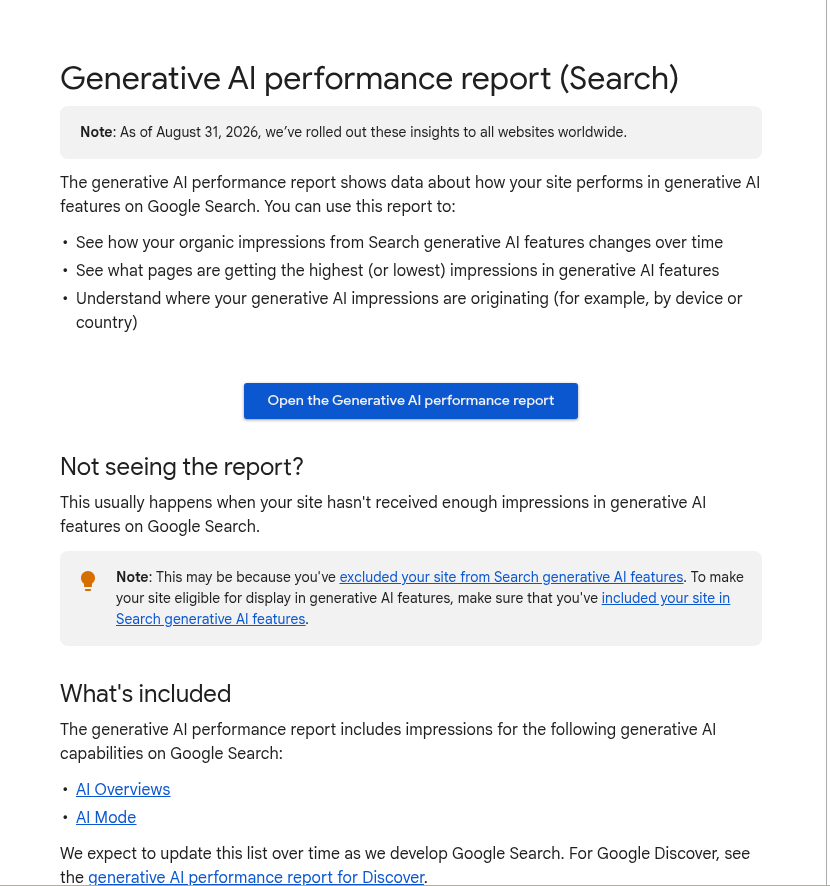
Search Console AI report help, Aug 31 rollout, captured Nov 1, 2026
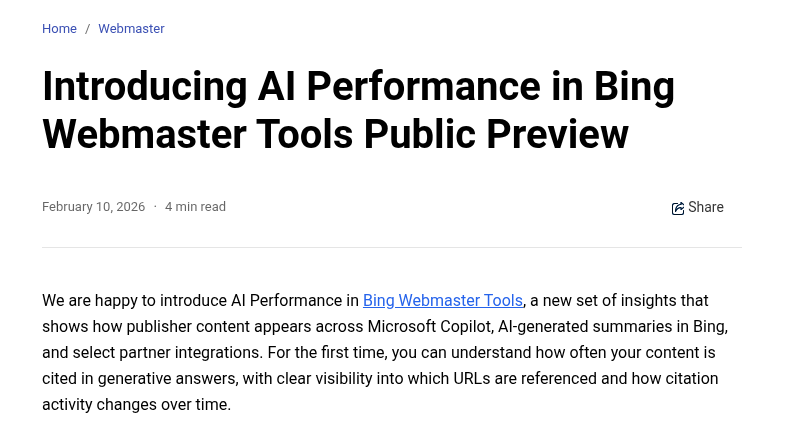
Bing AI Performance announcement, February 10, 2026, captured Nov 1, 2026
If the demo form doesn't already ask where the buyer first heard of the company, add that field now. On day 90, self-reported answers naming ChatGPT or "an AI tool" will be the only pipeline evidence available.
Weeks 3 to 4: confirm crawlers can reach you
Of all the fixes in this plan, this one costs least and looks worst to miss. A developer should check four things.
Robots.txt comes first. If you want to show up in Claude's search answers, make sure your rules don't block Claude's search crawler. Perplexity's help center, last modified September 14, 2026, states that PerplexityBot won't index the text of any site that disallows it in robots.txt. For ChatGPT, read OpenAI's current crawler documentation on OAI-SearchBot before changing any rule. Blocking AI training crawlers is a separate policy decision, so don't treat it as a visibility fix in either direction.
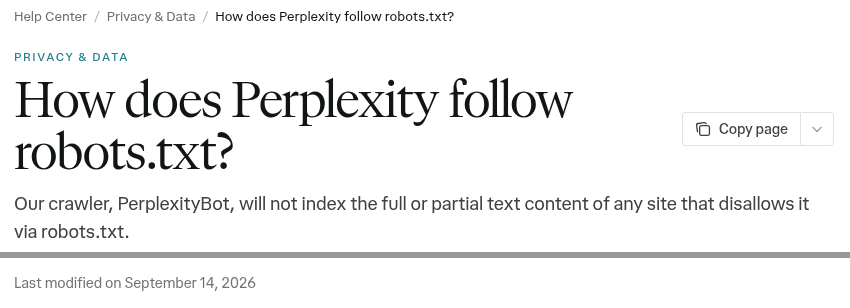
Perplexity help: PerplexityBot follows robots.txt, captured Nov 1, 2026
Then the firewall and CDN, where an old anti-scraping rule can block the very search crawlers you want without anyone noticing.
Then rendering. If the pricing table or feature list appears only after JavaScript runs, assume some crawlers never see it. Open the raw HTML of the pricing page and look for the actual numbers.
Last, Google's own setting. Google's guide to generative AI features in Search, last updated July 10, 2026, requires a site to be included in the Search generative AI features setting in Search Console before it's eligible for them. Confirm nobody switched it to exclude.
The AI crawlers and robots.txt guide has a starting pattern and the log checks. An llms.txt file can wait, since Google Search ignores such files according to the same guide, and the llms.txt explainer covers who might still want one.
Week 4: triage every gap by cause
Close the month by putting every problem from the baseline into one of four buckets. The bucket decides the fix, and teams that mix them up lose month two.
Wrong facts. The engine names you but gets the pricing, features or category wrong. Correct your own pages first, then the third-party sources. The guide to fixing wrong information in ChatGPT shows how to trace an error back to where it started.
Missing from shortlists. Competitors are named for category prompts and you aren't. This is usually a third-party gap, because the lists, reviews and comparisons the engines cite leave you out.
Cited for the wrong things. Blog posts get cited for definitions while product pages never appear for buying prompts. That's a page problem.
Blocked or unreadable. A crawler can't reach the page, or reaches it and can't see the content. This is technical, and it goes to the top.
Rank the buckets by how many high-intent prompts each one touches. That ranking is month two's plan.
Days 31 to 60: fix what's wrong, then publish what's missing
Month two carries most of the effort, and the order matters: correct before you create. A new comparison page helps little while the pricing page still contradicts it.
Weeks 5 to 6: correct your own pages
Work through the contradictions logged in week one. Update or redirect old posts that describe retired features or old prices. Make the homepage say what the product is in the first screen, using the wording from the facts sheet.
A plain facts page, listing the week-one details with dates, gives engines and journalists one place to check. Keep it accurate and dull, because marketing claims on a facts page defeat its purpose.
Then rewrite the most important product and category pages so the answer comes first. When a buyer asks whether the product integrates with Salesforce, the integration page should say yes or no in its opening lines and explain how afterward. Content doesn't need to be split into tiny chunks for Google's AI features, per the same guide, so leave page length alone and move the answer above the hero banner and the three paragraphs of positioning.
Weeks 6 to 8: publish pages for the prompts you lost
Now build what the baseline showed was missing. For most SaaS companies that's some mix of:
Comparison and alternatives pages for the competitors that appear beside you in answers. Treat the competitor fairly, or buyers and models will both discount the page. Structure for both is in comparison and alternatives pages.
A pricing page that states the model and the plans in plain HTML text. If publishing prices is still under debate, read whether SaaS companies should publish pricing.
Integration pages for the tools buyers ask about by name.
Use-case pages for the segments in the facts sheet's "who it's for" line.
The effort belongs here for a reason. In the Ipsos survey cited at the top of this post, product-specific documents led the list of materials buyers found most helpful when choosing a vendor, picked by 53% of respondents. A March to April 2026 survey by Semrush, which sells SEO and AI visibility software, found that 41% of the B2B professionals who use AI at work begin with AI and then verify through search. So the same page gets read twice, first by the model and then by a buyer checking the model's work.
One warning. Resist publishing a page for every prompt in the panel. Google's guide treats separate content for every query variation, made mainly to manipulate rankings or AI responses, as a breach of its scaled content abuse policy. One strong page per real buyer question will do more than a dozen thin ones.
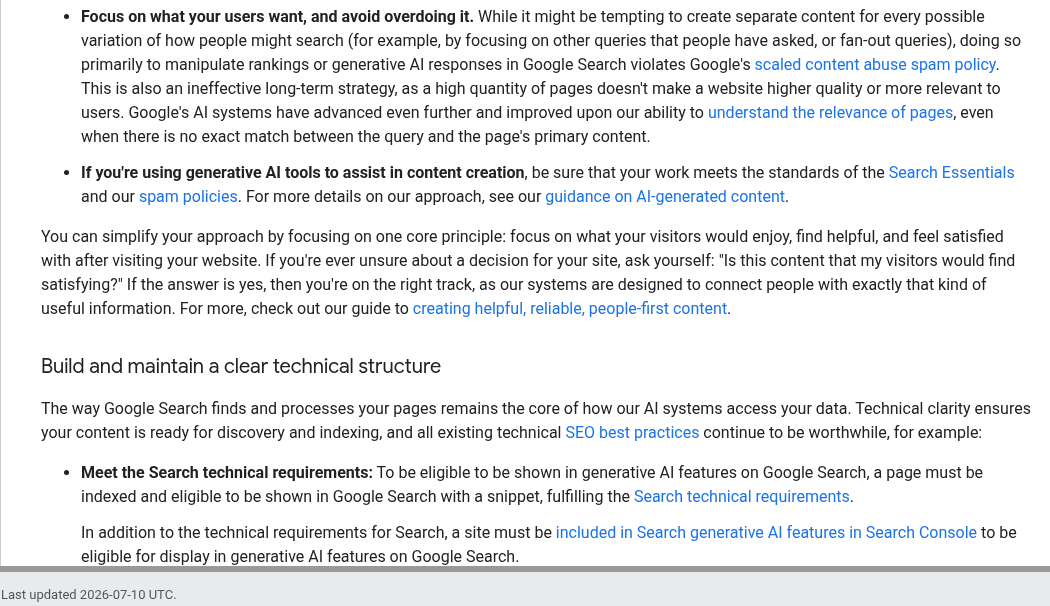
Google AI features guide on scaled content abuse, captured Nov 1, 2026
Weeks 7 to 8: add schema that matches what's on the page
Schema supports the other work and won't carry a strategy by itself. Google doesn't require structured data for its generative AI features, and no special markup exists for them. Organization markup on the homepage and SoftwareApplication markup on product pages are still worth adding, provided every value in the markup also appears on the visible page.
Have the developer generate the markup from templates, validate it, and confirm it sits in the server-rendered HTML. The guide to schema for AI answers covers which types are worth the effort for SaaS. A few days is enough for this task.
Weeks 5 to 9: fix the third-party sources the engines cited
This track starts early because other people own these pages and update them on their own schedule. Go back to the cited-URL column in the baseline, sort the sites by how often they appeared for high-intent prompts, and work down the list:
Review profiles. Bring the description, categories, screenshots and pricing fields in line with the facts sheet, and ask happy customers for reviews in whatever way each platform permits. Which fields get quoted is mapped in G2 and Capterra profiles for AI search.
Integration marketplaces and partner directories. These are often years out of date and quick to fix.
Lists and roundups that left you out. Write to the author with a factual reason to include you, and don't offer payment. In Google's words, chasing inauthentic "mentions" "isn't as helpful as it might seem", and buyers spot paid placements too.
Community threads. When a Reddit or forum thread keeps getting cited, take part as a named employee who states where they work. The guide to Reddit for AEO explains how to do that without getting banned.
The Ipsos data supports this track as well. Product review sites came second among the channels buyers prefer for vendor information, chosen by 63%, behind word-of-mouth recommendations at 70%. For how much weight to give unlinked mentions against links, see brand mentions vs backlinks.
Engine-specific tuning, only where the baseline says so
A separate project for each engine spreads a small team too thin. Pick the one or two engines with the biggest baseline gap:
Getting recommended by ChatGPT for shortlist and alternatives prompts.
Getting cited by Perplexity, where the cited sources change often.
Getting cited by Claude if the baseline shows your buyers use Claude.
Getting cited in Microsoft Copilot for buyers who work inside Microsoft 365.
Microsoft's announcement of the AI Performance report also recommends IndexNow, which notifies participating search engines when a page is added, updated or removed. Switch it on in month two so month three's refreshes get picked up sooner.
Days 61 to 90: measure, refresh, and choose next quarter's bets
Month three has two jobs: report honestly on what changed, and line up the next quarter so the work continues after the review meeting.
Weeks 9 to 10: refresh the pages that are cited but stale
Older pages that engines already cite, but that carry outdated numbers, screenshots or feature names, are worth more than new pages, because they already have the engines' attention. Update the facts, date the update honestly, and request a re-crawl in Search Console and through IndexNow.
For the full pass, see refreshing content for AI search, which also covers when merging or redirecting beats an update.
Weeks 11 to 12: take the second reading
Rerun the frozen panel exactly as the baseline ran: same prompts, same engines, same clean sessions, same country, same number of runs. Change any one of those and the comparison is worthless.
Read the results in this order:
Accuracy first. Corrected facts usually move first, since they depend mostly on pages you control.
Citations of your own URLs next, especially the new comparison and pricing pages.
Mentions on shortlist prompts last. These depend on third parties, and many outreach requests will still be pending.
Expect noise. Look for changes that hold across runs and across several related prompts, and ignore a single lucky answer. If nothing moved at all, recheck the week-four access fixes before concluding the content failed.
Compare the first-party data as well: the Search Console generative AI report, Bing's AI Performance report, AI referral sessions by landing page, and the self-reported answers from the demo form. Three months is a short window, so describe what changed and stop short of claiming the work caused it.
Week 13: report and decide
Leadership gets one page, with the full sheet kept as an appendix:
What the engines said about you on day one and what they say now, with two or three quoted examples.
Which errors got fixed and which still wait on third parties.
Citation and mention changes on high-intent prompts, with run-to-run noise stated plainly.
AI referral sessions and self-reported mentions, labeled as early signals that fall short of pipeline proof.
What to do next quarter, and why.
If leadership asks for pipeline numbers, the guide to B2B SEO attribution explains how to set up tracking that holds up, and why AI-assisted deals often surface as direct or branded search traffic.
Choose next quarter's bets from the second reading. If engines keep citing data-heavy pages from competitors or publishers, plan a piece of original research; it takes longer than a quarter to pay off, so start early. If third-party gaps are still the biggest problem, put more people on outreach. If accuracy is fixed and citations are climbing, extend the panel to a second product line or segment as a new group, leaving the original set untouched so it stays comparable.
Adjusting the plan to your starting point
The sequence holds for most teams, but the weight shifts with where you start.
A marketing team of one, with no developer on call, should still do month one in full, since it needs only a spreadsheet and a few hours a week. Push the schema work to the next quarter and spend the saved developer hours on the week-four access checks, which matter far more.
When the baseline shows engines naming you but getting you wrong, accuracy becomes the whole of month two. Correct your own pages and the review profiles before building anything new, and leave the comparison pages until the facts are consistent everywhere you control.
When engines describe you correctly but leave you off shortlists, the third-party track is the real project. Start outreach in week five as planned, but give it more hours than the new pages get.
A company in a young category, where buyers don't yet search for the category name, will see thin baseline results almost everywhere. Treat that as a category-awareness problem first. The prompt panel is still worth freezing now, so the next quarter has something to compare against.
A company that already pays an SEO agency or a visibility tool should still run the first baseline by hand. That's the only way to judge whether the tool's numbers match what buyers actually see.
What to skip in the first 90 days
These are the usual time sinks:
Buying a tracking tool before anyone has read answers by hand. A hand-run baseline teaches the team what matters, and after that a tool can save time; the roundup of AI visibility tracking tools compares the options. Andy Carlson, who describes himself as a B2B industrial CMO, wrote on X in late June 2026 that buyers are moving from whether to measure AI visibility to which tool to use, and he suggested mocking up the monthly report you want before buying anything. The mock-up advice is sound. The purchase itself is a month-four question for most teams.
Treating llms.txt as a priority. It won't fix a wrong description.
Rewriting the whole site "for AI". By Google's own account, there's no special way to write for its generative AI features. Fix the pages the baseline flagged and leave the rest alone.
Mass-producing prompt pages, for the spam-policy reason above.
Paying for mentions or for "placement" in AI answers. Nobody can sell inclusion in a specific generated answer, and bought mentions can backfire.
Promising a citation number to the CEO. Posts on X promising AI citations within 90 days come mostly from people selling that service, and the ones that turned up in an October 2026 search offered no method anyone could check. Promise the six outputs from the top of this post instead.
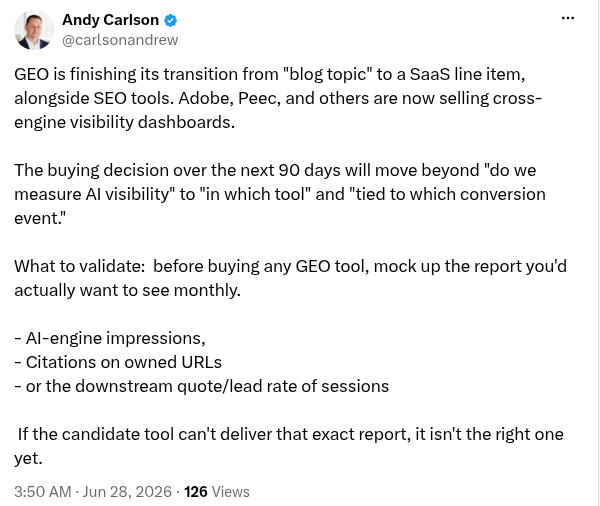
Andy Carlson on X: mock up reports first, captured Nov 1, 2026
Where outside help fits
One person with a spreadsheet can handle most of month one in-house. Month two is where teams run short, because page work, developer time and outreach all land in the same few weeks. If you bring in help, keep the baseline and the facts sheet in-house. They're the reference point for judging anyone else's work.
Miraa, which publishes this guide, sets out how it scopes this work on its generative engine optimization services page. For outside help with the wider search program, the comparison of B2B SaaS SEO agencies covers how to judge them on pipeline evidence.
FAQ
How long does a GEO plan take to show results?
Fixes to wrong facts on your own pages can show up within weeks once crawlers revisit them. Changes that depend on third parties, such as being added to roundups or review categories, often take longer than a quarter. That's why this plan judges day 90 by its six outputs and sets no citation target.
Which AI engine should a B2B SaaS company start with?
Start with the engines your buyers use, which sales calls and the demo form will tell you. For most teams that means ChatGPT and Google's AI features, plus Gemini, Perplexity, Claude or Copilot depending on the audience.
How many prompts should the panel include?
A few dozen, grouped by intent, is enough for most companies. With too few, one odd answer skews the whole reading. With too many, nobody runs the full set each month. A smaller weekly set of the prompts closest to a purchase decision helps between full readings.
Is GEO different from SEO?
Google's position is that optimizing for its generative AI features is still SEO. In practice, GEO adds the habit of reading how models describe a company and tracing errors back to their sources. If your pages aren't indexed, start with SEO. If they are, and AI answers still get you wrong or leave you out, this plan is the next step. The explainer on what GEO is covers the terms in more detail.